

D.G. BARBER, A. THOMAS, AND T.N. PAPAKYRIAKOU
30 ppt at the ice-ocean interface]. Ice density is relatively uniform at 0.92-0.96 g·cm-3•
Liquid brine is interspersed through the ice as intercrystalline brine inclusions and brine
drainage channels. The brine inclusions are generally formed in the orientation of
growth (vertical) or directed according to the predominant ocean current (Vant et al.
1978). The brine drainage channels are distributed heterogeneously across the ice surface and provide a primary mechanism for brine drainage in the spring (Wakatsuchi
and Kawamura 1987).
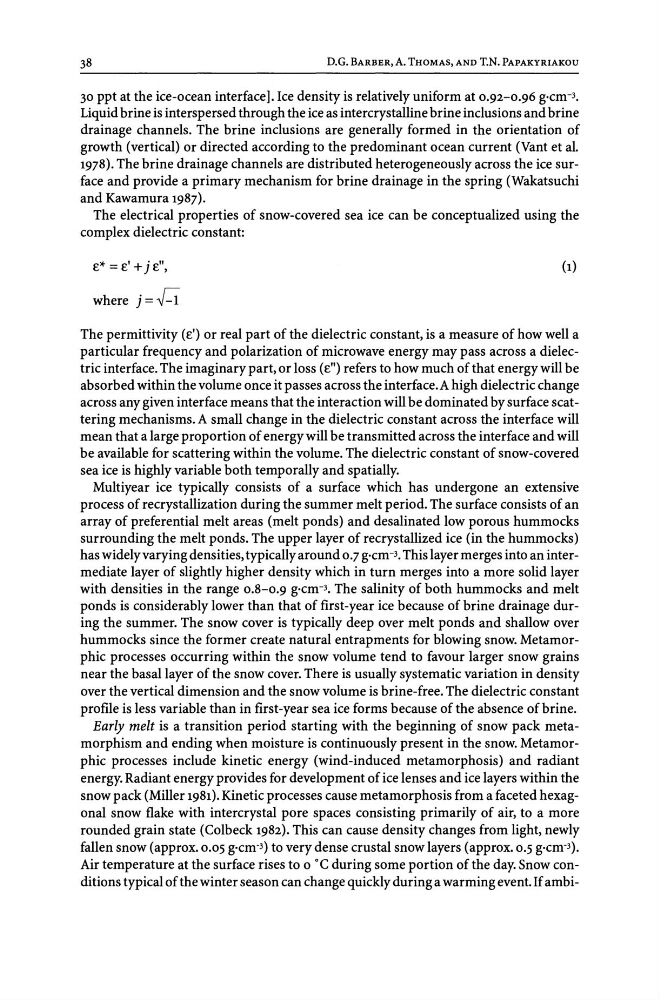
The electrical properties of snow-covered sea ice can be conceptualized using the
complex dielectric constant:
10* = 10' + jE",
where j = -vCl
The permittivity (10') or real part of the dielectric constant, is a measure of how well a
particular frequency and polarization of microwave energy may pass across a dielectric interface. The imaginary part, or loss (E") refers to how much of that energy will be
absorbed within the volume once it passes across the interface. A high dielectric change
across any given interface means that the interaction will be dominated by surface scattering mechanisms. A small change in the dielectric constant across the interface will
mean that a large proportion of energy will be transmitted across the interface and will
be available for scattering within the volume. The dielectric constant of snow-covered
sea ice is highly variable both temporally and spatially.
Multiyear ice typically consists of a surface which has undergone an extensive
process of recrystallization during the summer melt period. The surface consists of an
array of preferential melt areas (melt ponds) and desalinated low porous hummocks
surrounding the melt ponds. The upper layer of recrystallized ice (in the hummocks)
has widely varying densities, typically around 0.7 g·cm-3• This layer merges into an intermediate layer of slightly higher density which in turn merges into a more solid layer
with densities in the range 0.8-0.9 g·cm-3• The salinity of both hummocks and melt
ponds is considerably lower than that of first-year ice because of brine drainage during the summer. The snow cover is typically deep over melt ponds and shallow over
hummocks since the former create natural entrapments for blowing snow. Metamorphic processes occurring within the snow volume tend to favour larger snow grains
near the basal layer of the snow cover. There is usually systematic variation in density
over the vertical dimension and the snow volume is brine-free. The dielectric constant
profile is less variable than in first -year sea ice forms because of the absence of brine.
Early melt is a transition period starting with the beginning of snow pack metamorphism and ending when moisture is continuously present in the snow. Metamorphic processes include kinetic energy (wind-induced metamorphosis) and radiant
energy. Radiant energy provides for development of ice lenses and ice layers within the
snow pack (Miller 1981). Kinetic processes cause metamorphosis from a faceted hexagonal snow flake with intercrystal pore spaces consisting primarily of air, to a more
rounded grain state (Colbeck 1982). This can cause density changes from light, newly
fallen snow (approx. 0.05 g·cm-3) to very dense crustal snow layers (approx. 0.5 g·cm-3).
Air temperature at the surface rises to 0 "C during some portion of the day. Snow conditions typical of the winter season can change quickly during a warming event. If ambi-
30 ppt at the ice-ocean interface]. Ice density is relatively uniform at 0.92-0.96 g·cm-3•
Liquid brine is interspersed through the ice as intercrystalline brine inclusions and brine
drainage channels. The brine inclusions are generally formed in the orientation of
growth (vertical) or directed according to the predominant ocean current (Vant et al.
1978). The brine drainage channels are distributed heterogeneously across the ice surface and provide a primary mechanism for brine drainage in the spring (Wakatsuchi
and Kawamura 1987).
The electrical properties of snow-covered sea ice can be conceptualized using the
complex dielectric constant:
10* = 10' + jE",
where j = -vCl
The permittivity (10') or real part of the dielectric constant, is a measure of how well a
particular frequency and polarization of microwave energy may pass across a dielectric interface. The imaginary part, or loss (E") refers to how much of that energy will be
absorbed within the volume once it passes across the interface. A high dielectric change
across any given interface means that the interaction will be dominated by surface scattering mechanisms. A small change in the dielectric constant across the interface will
mean that a large proportion of energy will be transmitted across the interface and will
be available for scattering within the volume. The dielectric constant of snow-covered
sea ice is highly variable both temporally and spatially.
Multiyear ice typically consists of a surface which has undergone an extensive
process of recrystallization during the summer melt period. The surface consists of an
array of preferential melt areas (melt ponds) and desalinated low porous hummocks
surrounding the melt ponds. The upper layer of recrystallized ice (in the hummocks)
has widely varying densities, typically around 0.7 g·cm-3• This layer merges into an intermediate layer of slightly higher density which in turn merges into a more solid layer
with densities in the range 0.8-0.9 g·cm-3• The salinity of both hummocks and melt
ponds is considerably lower than that of first-year ice because of brine drainage during the summer. The snow cover is typically deep over melt ponds and shallow over
hummocks since the former create natural entrapments for blowing snow. Metamorphic processes occurring within the snow volume tend to favour larger snow grains
near the basal layer of the snow cover. There is usually systematic variation in density
over the vertical dimension and the snow volume is brine-free. The dielectric constant
profile is less variable than in first -year sea ice forms because of the absence of brine.
Early melt is a transition period starting with the beginning of snow pack metamorphism and ending when moisture is continuously present in the snow. Metamorphic processes include kinetic energy (wind-induced metamorphosis) and radiant
energy. Radiant energy provides for development of ice lenses and ice layers within the
snow pack (Miller 1981). Kinetic processes cause metamorphosis from a faceted hexagonal snow flake with intercrystal pore spaces consisting primarily of air, to a more
rounded grain state (Colbeck 1982). This can cause density changes from light, newly
fallen snow (approx. 0.05 g·cm-3) to very dense crustal snow layers (approx. 0.5 g·cm-3).
Air temperature at the surface rises to 0 "C during some portion of the day. Snow conditions typical of the winter season can change quickly during a warming event. If ambi-