

30
L.-K. SOH, C. TSATSOULIS, AND B. HOLT
tat ion component has difficulty determining the proper categories of each primary
grouping. This includes ridges (which are brighter than multiyear ice) often being
improperly segmented as open water, and multiyear ice falling into the water/ice mixture grouping.
Within the outermost marginal zones, extreme variations in backscatter from both
the ice and open ocean, often within the same image and across short distances, can
wreak havoc on accurate segmentation. The ocean variations arise not only from varying wind speeds but from mesoscale eddies, atmospheric boundary layer effects such
as windrows, and strong variations in sea surface temperatures. These variations result
in a comparatively limited percentage of useful output, especially compared to the optimal conditions of wet-dark floes and windy open water within the central pack.
The floe algorithm is also sensitive to the backscatter fall-off at increasing incidence
angles seen in both ice and ocean returns. The ERS-l imaging beam extends over a range
of incidence angles from 20 0 to 26 0 • Ocean signatures are strongly dependent on incidence angle, as are ice signatures, although less so. Therefore both the absolute level
and the contrast between ice and ocean decrease at higher incidence angles, reducing
the ability to isolate floes, and this results in increased apparent branching. The net
result is that there are high number of discarded floes at far range, i.e., floes that were
originally determined to be floes but were then found to be too branchy. This effect
could probably be reduced by increasing the overall backscatter level at higher angles,
however, such a boost only at higher angles adds a processing step and would be applied
in a nonuniform (or nonlinear) fashion to the calibrated data.
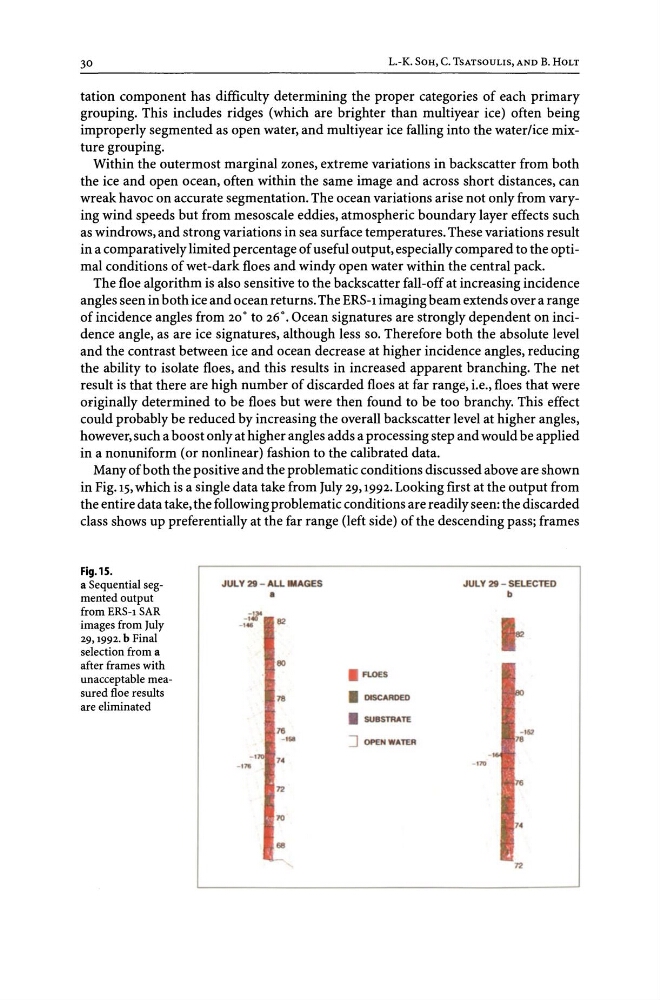
Many of both the positive and the problematic conditions discussed above are shown
in Fig. 15, which is a single data take from July 29, 1992. Looking first at the output from
the entire data take, the following problematic conditions are readily seen: the discarded
class shows up preferentially at the far range (left side) of the descending pass; frames
Fig. 15.
a Sequential segmented output
from ERS-1 SAR
images from July
29,1992. b Final
selection from a
after frames with
unacceptable measured floe results
are eliminated
JULY 211 - All .. AGES
•
-iJr 82
-, ..
eo
78
78
-' ..
-, 7_
-,,.
n
JO
68
. ~S
•
DISCARDeD
•
SUBSTRATE
]
OI'ENWATER
JULY 211 - SELECTED
b
1'2
L.-K. SOH, C. TSATSOULIS, AND B. HOLT
tat ion component has difficulty determining the proper categories of each primary
grouping. This includes ridges (which are brighter than multiyear ice) often being
improperly segmented as open water, and multiyear ice falling into the water/ice mixture grouping.
Within the outermost marginal zones, extreme variations in backscatter from both
the ice and open ocean, often within the same image and across short distances, can
wreak havoc on accurate segmentation. The ocean variations arise not only from varying wind speeds but from mesoscale eddies, atmospheric boundary layer effects such
as windrows, and strong variations in sea surface temperatures. These variations result
in a comparatively limited percentage of useful output, especially compared to the optimal conditions of wet-dark floes and windy open water within the central pack.
The floe algorithm is also sensitive to the backscatter fall-off at increasing incidence
angles seen in both ice and ocean returns. The ERS-l imaging beam extends over a range
of incidence angles from 20 0 to 26 0 • Ocean signatures are strongly dependent on incidence angle, as are ice signatures, although less so. Therefore both the absolute level
and the contrast between ice and ocean decrease at higher incidence angles, reducing
the ability to isolate floes, and this results in increased apparent branching. The net
result is that there are high number of discarded floes at far range, i.e., floes that were
originally determined to be floes but were then found to be too branchy. This effect
could probably be reduced by increasing the overall backscatter level at higher angles,
however, such a boost only at higher angles adds a processing step and would be applied
in a nonuniform (or nonlinear) fashion to the calibrated data.
Many of both the positive and the problematic conditions discussed above are shown
in Fig. 15, which is a single data take from July 29, 1992. Looking first at the output from
the entire data take, the following problematic conditions are readily seen: the discarded
class shows up preferentially at the far range (left side) of the descending pass; frames
Fig. 15.
a Sequential segmented output
from ERS-1 SAR
images from July
29,1992. b Final
selection from a
after frames with
unacceptable measured floe results
are eliminated
JULY 211 - All .. AGES
•
-iJr 82
-, ..
eo
78
78
-' ..
-, 7_
-,,.
n
JO
68
. ~S
•
DISCARDeD
•
SUBSTRATE
]
OI'ENWATER
JULY 211 - SELECTED
b
1'2