

12
L.-K. SOH, C. TSATSOULIS, AND B. HOLT
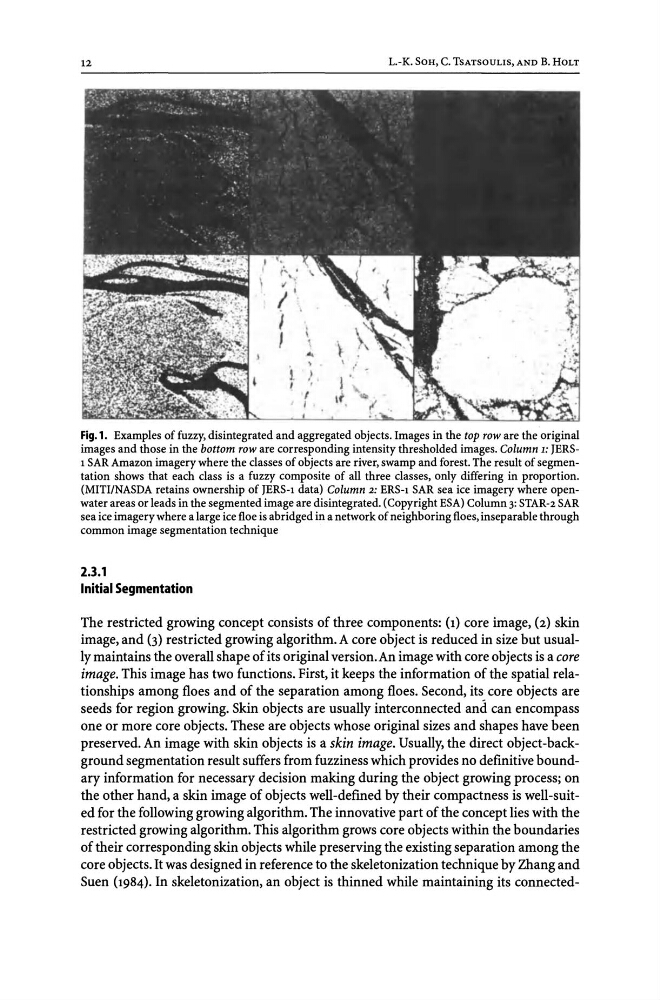
Fig.1. Examples of fuzzy, disintegrated and aggregated objects. Images in the top row are the original
images and those in the bottom row are corresponding intensity thresholded images. Column 1: JERS1 SAR Amazon imagery where the classes of objects are river, swamp and forest. The result of segmentation shows that each class is a fuzzy composite of all three classes, only differing in proportion.
(MITI/NASDA retains ownership of JERS-l data) Column 2: ERS-l SAR sea ice imagery where openwater areas or leads in the segmented image are disintegrated. (Copyright ESA) Column 3: STAR-2 SAR
sea ice imagery where a large ice floe is abridged in a network of neighboring floes, inseparable through
common image segmentation technique
2.3.1
Initial Segmentation
The restricted growing concept consists of three components: (1) core image, (2) skin
image, and (3) restricted growing algorithm. A core object is reduced in size but usually maintains the overall shape of its original version. An image with core objects is a core
image. This image has two functions. First, it keeps the information of the spatial relationships among floes and of the separation among floes. Second, its core objects are
seeds for region growing. Skin objects are usually interconnected and can encompass
one or more core objects. These are objects whose original sizes and shapes have been
preserved. An image with skin objects is a skin image. Usually, the direct object-background segmentation result suffers from fuzziness which provides no definitive boundary information for necessary decision making during the object growing process; on
the other hand, a skin image of objects well-defined by their compactness is well-suited for the following growing algorithm. The innovative part of the concept lies with the
restricted growing algorithm. This algorithm grows core objects within the boundaries
of their corresponding skin objects while preserving the existing separation among the
core objects. It was designed in reference to the skeletonization technique by Zhang and
Suen (1984). In skeletonization, an object is thinned while maintaining its connected-
L.-K. SOH, C. TSATSOULIS, AND B. HOLT
Fig.1. Examples of fuzzy, disintegrated and aggregated objects. Images in the top row are the original
images and those in the bottom row are corresponding intensity thresholded images. Column 1: JERS1 SAR Amazon imagery where the classes of objects are river, swamp and forest. The result of segmentation shows that each class is a fuzzy composite of all three classes, only differing in proportion.
(MITI/NASDA retains ownership of JERS-l data) Column 2: ERS-l SAR sea ice imagery where openwater areas or leads in the segmented image are disintegrated. (Copyright ESA) Column 3: STAR-2 SAR
sea ice imagery where a large ice floe is abridged in a network of neighboring floes, inseparable through
common image segmentation technique
2.3.1
Initial Segmentation
The restricted growing concept consists of three components: (1) core image, (2) skin
image, and (3) restricted growing algorithm. A core object is reduced in size but usually maintains the overall shape of its original version. An image with core objects is a core
image. This image has two functions. First, it keeps the information of the spatial relationships among floes and of the separation among floes. Second, its core objects are
seeds for region growing. Skin objects are usually interconnected and can encompass
one or more core objects. These are objects whose original sizes and shapes have been
preserved. An image with skin objects is a skin image. Usually, the direct object-background segmentation result suffers from fuzziness which provides no definitive boundary information for necessary decision making during the object growing process; on
the other hand, a skin image of objects well-defined by their compactness is well-suited for the following growing algorithm. The innovative part of the concept lies with the
restricted growing algorithm. This algorithm grows core objects within the boundaries
of their corresponding skin objects while preserving the existing separation among the
core objects. It was designed in reference to the skeletonization technique by Zhang and
Suen (1984). In skeletonization, an object is thinned while maintaining its connected-