

SOME OCEAN MODEL FUNDAMENTALS
P o t e n t i a l Density-1 000
Latitude
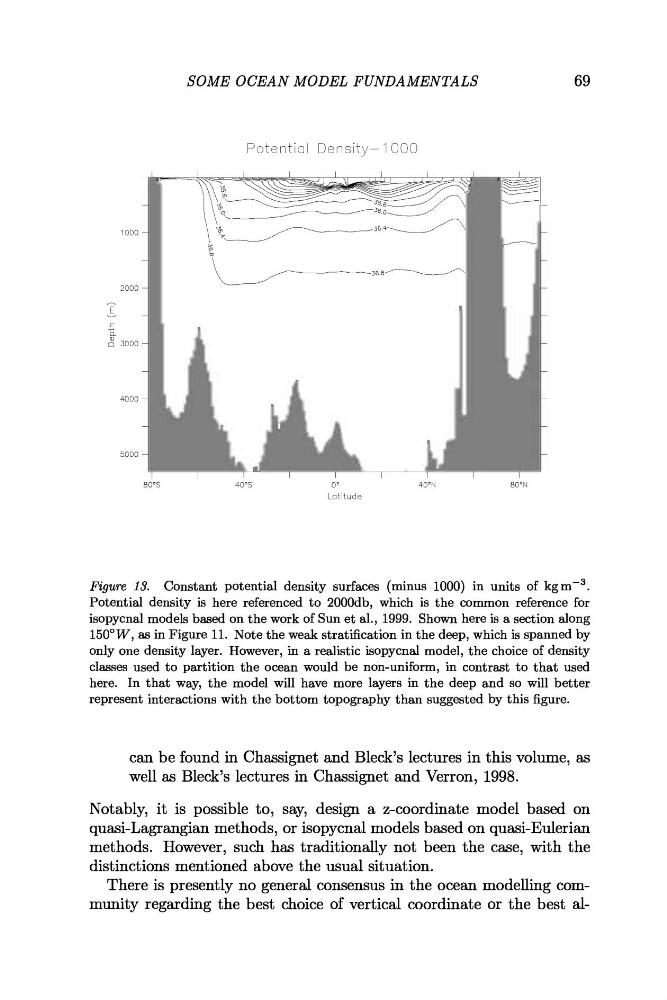
Figure 13. Constant potential density surfaces (minus 1000) in units of kgrnp3.
Potential density is here referenced to 2000db, which is the common reference for
isopycnal models based on the work of Sun et al., 1999. Shown here is a section along
150°W, as in Figure 11. Note the weak stratification in the deep, which is spanned by
only one density layer. However, in a realistic isopycnal model, the choice of density
classes used to partition the ocean would be non-uniform, in contrast to that used
here. In that way, the model will have more layers in the deep and so will better
represent interactions with the bottom topography than suggested by this figure.
can be found in Chassignet and Bleck's lectures in this volume, as
well as Bleck's lectures in Chassignet and Verron, 1998.
Notably, it is possible to, say, design a z-coordinate model based on
quasi-Lagrangian methods, or isopycnal models based on quasi-Eulerian
methods. However, such has traditionally not been the case, with the
distinctions mentioned above the usual situation.
There is presently no general consensus in the ocean modelling community regarding the best choice of vertical coordinate or the best al-
P o t e n t i a l Density-1 000
Latitude
Figure 13. Constant potential density surfaces (minus 1000) in units of kgrnp3.
Potential density is here referenced to 2000db, which is the common reference for
isopycnal models based on the work of Sun et al., 1999. Shown here is a section along
150°W, as in Figure 11. Note the weak stratification in the deep, which is spanned by
only one density layer. However, in a realistic isopycnal model, the choice of density
classes used to partition the ocean would be non-uniform, in contrast to that used
here. In that way, the model will have more layers in the deep and so will better
represent interactions with the bottom topography than suggested by this figure.
can be found in Chassignet and Bleck's lectures in this volume, as
well as Bleck's lectures in Chassignet and Verron, 1998.
Notably, it is possible to, say, design a z-coordinate model based on
quasi-Lagrangian methods, or isopycnal models based on quasi-Eulerian
methods. However, such has traditionally not been the case, with the
distinctions mentioned above the usual situation.
There is presently no general consensus in the ocean modelling community regarding the best choice of vertical coordinate or the best al-