

SOME OCEAN MODEL FUNDAMENTALS
51
integrations (e.g., less than a year). However, the feedbacks related to
climate and climate change may be nontrivial. Furthermore, the changes
in model formulation are minor once a free surface algorithm has been
implemented. Thus, it is prudent and straightforward to jettison the virtual tracer flux in favor of the physically motivated boundary condition
(90) (Huang, 1993 and Griffies et al., 2001).
4.
Linear momentum budget
The purpose of this section is to formulate the budget for linear momentum over a finite region of the ocean, with specific application to
ocean model grid cells. The material here requires many of the same
elements as in Section 3, but with added complexity arising from the
vector nature of momentum, and the additional considerations of forces
from pressure, friction, gravity, and planetary rotation.
4.1
General formulation
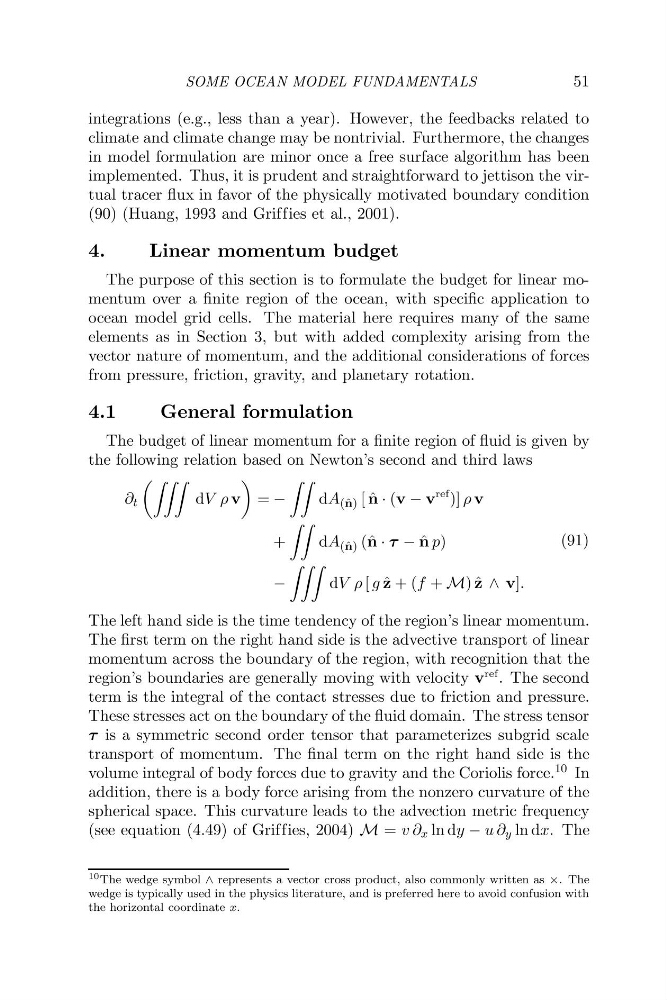
The budget of linear momentum for a finite region of fluid is given by
the following relation based on Newton's second and third laws
at (11 d v p v) = - 1 1 dA(.) [ b (v - vref)] p v
+ //dA(q ( b . r - b p )
- / I d v p [ g i + ( f + M ) P A v].
The left hand side is the time tendency of the region's linear momentum.
The first term on the right hand side is the advective transport of linear
momentum across the boundary of the region, with recognition that the
region's boundaries are generally moving with velocity vref. The second
term is the integral of the contact stresses due to friction and pressure.
These stresses act on the boundary of the fluid domain. The stress tensor
r is a symmetric second order tensor that parameterizes subgrid scale
transport of momentum. The final term on the right hand side is the
volume integral of body forces due to gravity and the Coriolis force.'' In
addition, there is a body force arising from the nonzero curvature of the
spherical space. This curvature leads to the advection metric frequency
(see equation (4.49) of Griffies, 2004) M = v ax In dy - u a, In dx. The
'O~he wedge symbol A represents a vector cross product, also commonly written as X . The
wedge is typically used in the physics literature, and is preferred here to avoid confusion with
the horizontal coordinate x.
51
integrations (e.g., less than a year). However, the feedbacks related to
climate and climate change may be nontrivial. Furthermore, the changes
in model formulation are minor once a free surface algorithm has been
implemented. Thus, it is prudent and straightforward to jettison the virtual tracer flux in favor of the physically motivated boundary condition
(90) (Huang, 1993 and Griffies et al., 2001).
4.
Linear momentum budget
The purpose of this section is to formulate the budget for linear momentum over a finite region of the ocean, with specific application to
ocean model grid cells. The material here requires many of the same
elements as in Section 3, but with added complexity arising from the
vector nature of momentum, and the additional considerations of forces
from pressure, friction, gravity, and planetary rotation.
4.1
General formulation
The budget of linear momentum for a finite region of fluid is given by
the following relation based on Newton's second and third laws
at (11 d v p v) = - 1 1 dA(.) [ b (v - vref)] p v
+ //dA(q ( b . r - b p )
- / I d v p [ g i + ( f + M ) P A v].
The left hand side is the time tendency of the region's linear momentum.
The first term on the right hand side is the advective transport of linear
momentum across the boundary of the region, with recognition that the
region's boundaries are generally moving with velocity vref. The second
term is the integral of the contact stresses due to friction and pressure.
These stresses act on the boundary of the fluid domain. The stress tensor
r is a symmetric second order tensor that parameterizes subgrid scale
transport of momentum. The final term on the right hand side is the
volume integral of body forces due to gravity and the Coriolis force.'' In
addition, there is a body force arising from the nonzero curvature of the
spherical space. This curvature leads to the advection metric frequency
(see equation (4.49) of Griffies, 2004) M = v ax In dy - u a, In dx. The
'O~he wedge symbol A represents a vector cross product, also commonly written as X . The
wedge is typically used in the physics literature, and is preferred here to avoid confusion with
the horizontal coordinate x.