

SOME OCEAN MODEL FUNDAMENTALS
49
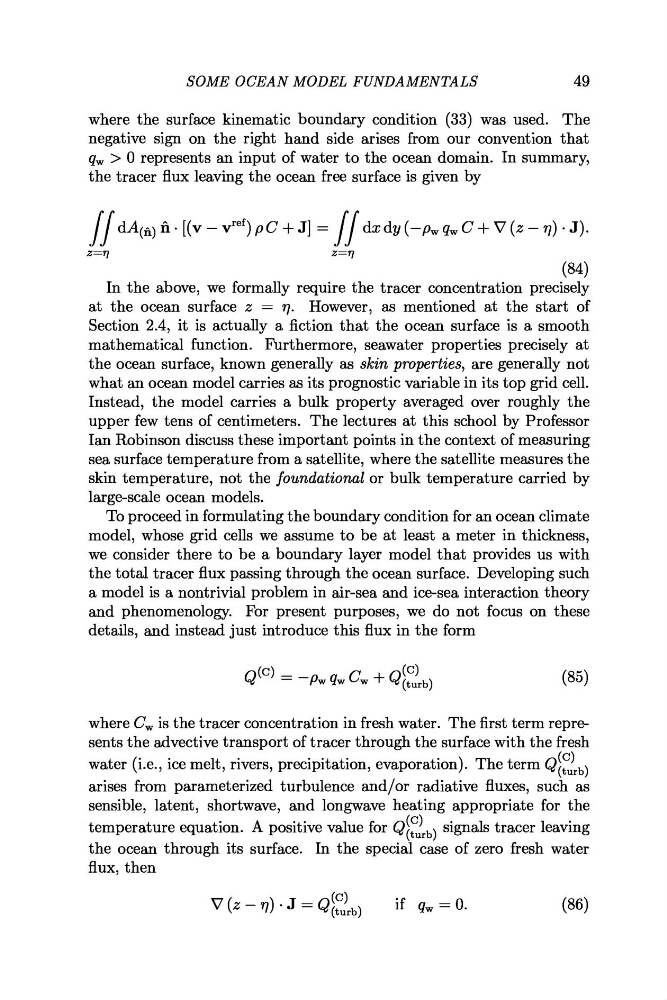
where the surface kinematic boundary condition (33) was used. The
negative sign on the right hand side arises from our convention that
qw > 0 represents an input of water to the ocean domain. In summary,
the tracer flux leaving the ocean free surface is given by
(84)
In the above, we formally require the tracer concentration precisely
at the ocean surface x = q. However, as mentioned at the start of
Section 2.4, it is actually a fiction that the ocean surface is a smooth
mathematical function. Furthermore, seawater properties precisely at
the ocean surface, known generally as skin properties, are generally not
what an ocean model carries as its prognostic variable in its top grid cell.
Instead, the model carries a bulk property averaged over roughly the
upper few tens of centimeters. The lectures at this school by Professor
Ian Robinson discuss these important points in the context of measuring
sea surface temperature from a satellite, where the satellite measures the
skin temperature, not the foundational or bulk temperature carried by
large-scale ocean models.
To proceed in formulating the boundary condition for an ocean climate
model, whose grid cells we assume to be at least a meter in thickness,
we consider there to be a boundary layer model that provides us with
the total tracer flux passing through the ocean surface. ~ e v e l o ~ i n ~
such
a model is a nontrivial problem in air-sea and ice-sea interaction theory
and phenomenology. For present purposes, we do not focus on these
details, and instead just introduce this flux in the form
where Cw is the tracer concentration in fresh water. The first term repre
sents the advective transport of tracer through the surface with the fresh
(c)
water (i.e., ice melt, rivers, precipitation, evaporation). The term Q(turb)
arises from parameterized turbulence and/or radiative fluxes, such as
sensible, latent, shortwave, and longwave heating appropriate for the
(c)
temperature equation. A positive value for Q(tUrb) signals tracer leaving
the ocean through its surface. In the special case of zero fresh water
flux, then
49
where the surface kinematic boundary condition (33) was used. The
negative sign on the right hand side arises from our convention that
qw > 0 represents an input of water to the ocean domain. In summary,
the tracer flux leaving the ocean free surface is given by
(84)
In the above, we formally require the tracer concentration precisely
at the ocean surface x = q. However, as mentioned at the start of
Section 2.4, it is actually a fiction that the ocean surface is a smooth
mathematical function. Furthermore, seawater properties precisely at
the ocean surface, known generally as skin properties, are generally not
what an ocean model carries as its prognostic variable in its top grid cell.
Instead, the model carries a bulk property averaged over roughly the
upper few tens of centimeters. The lectures at this school by Professor
Ian Robinson discuss these important points in the context of measuring
sea surface temperature from a satellite, where the satellite measures the
skin temperature, not the foundational or bulk temperature carried by
large-scale ocean models.
To proceed in formulating the boundary condition for an ocean climate
model, whose grid cells we assume to be at least a meter in thickness,
we consider there to be a boundary layer model that provides us with
the total tracer flux passing through the ocean surface. ~ e v e l o ~ i n ~
such
a model is a nontrivial problem in air-sea and ice-sea interaction theory
and phenomenology. For present purposes, we do not focus on these
details, and instead just introduce this flux in the form
where Cw is the tracer concentration in fresh water. The first term repre
sents the advective transport of tracer through the surface with the fresh
(c)
water (i.e., ice melt, rivers, precipitation, evaporation). The term Q(turb)
arises from parameterized turbulence and/or radiative fluxes, such as
sensible, latent, shortwave, and longwave heating appropriate for the
(c)
temperature equation. A positive value for Q(tUrb) signals tracer leaving
the ocean through its surface. In the special case of zero fresh water
flux, then