

567
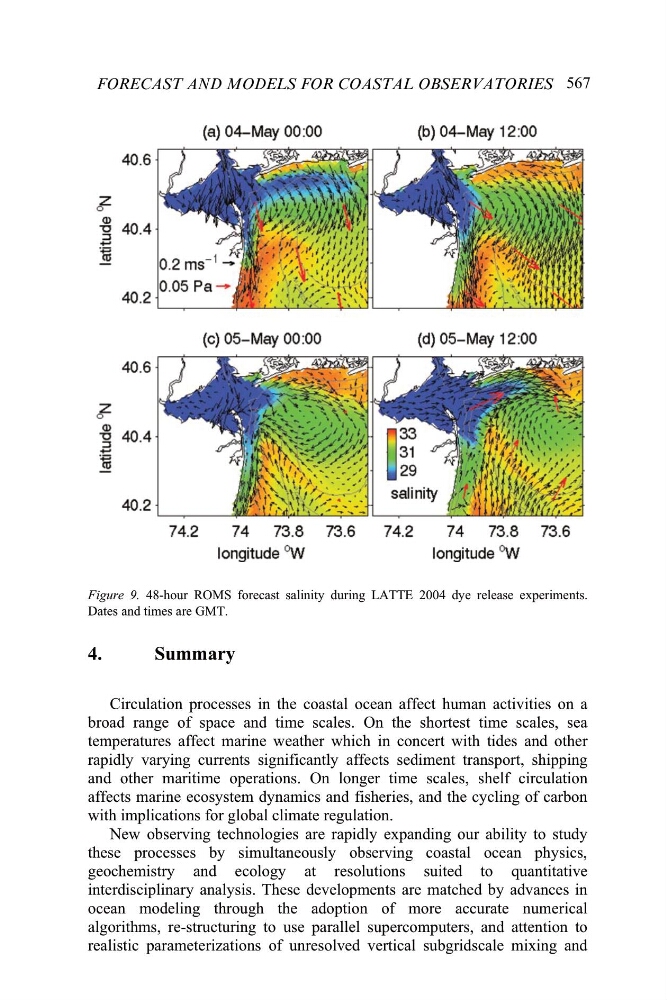
Figure 9. 48-hour ROMS forecast salinity during LATTE 2004 dye release experiments.
Dates and times are GMT.
4.
Summary
Circulation processes in the coastal ocean affect human activities on a
broad range of space and time scales. On the shortest time scales, sea
temperatures affect marine weather which in concert with tides and other
rapidly varying currents significantly affects sediment transport, shipping
and other maritime operations. On longer time scales, shelf circulation
affects marine ecosystem dynamics and fisheries, and the cycling of carbon
with implications for global climate regulation.
New observing technologies are rapidly expanding our ability to study
these processes by simultaneously observing coastal ocean physics,
geochemistry and ecology at resolutions suited to quantitative
interdisciplinary analysis. These developments are matched by advances in
ocean modeling through the adoption of more accurate numerical
algorithms, re-structuring to use parallel supercomputers, and attention to
realistic parameterizations of unresolved vertical subgridscale mixing and
FORECAST AND MODELS FOR COASTAL OBSERVATORIES