

DATA ASSIMILATION IN BIOGEOCHEMICAL MODELLING
541
of choice was a (micro-)genetic algorithm. Although this method also
requires several tenthousand evaluations of the cost function, a genetic
algorithm was found to be slightly more efficient than simulated annealing in an idealised model study by Athias et al. [2000]. The genetic
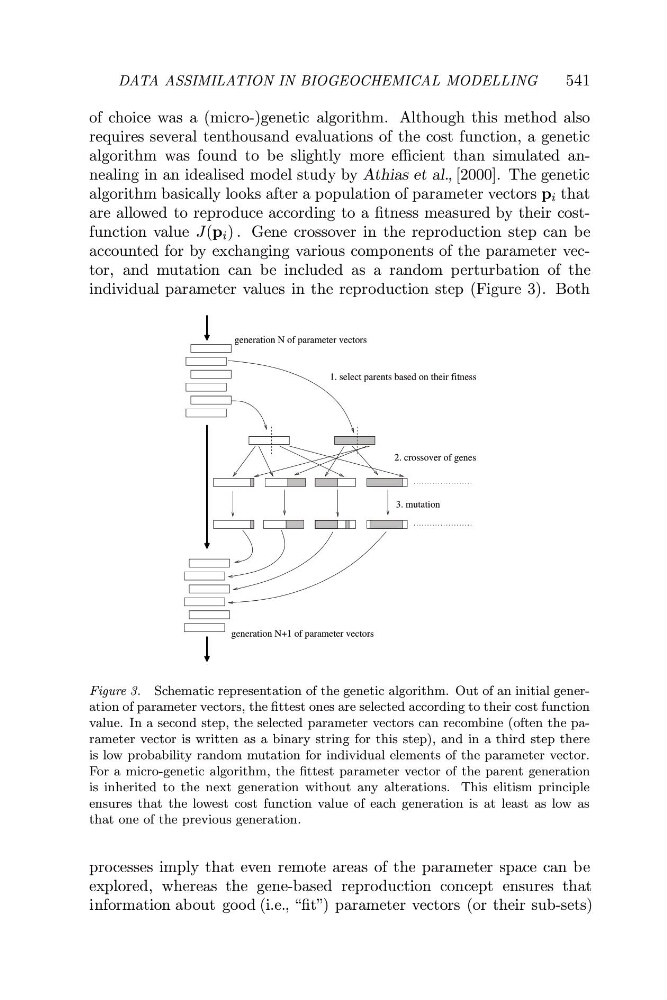
algorithm basically looks after a population of parameter vectors p i that
are allowed to reproduce according to a fitness measured by their costfunction value J(p i ) . Gene crossover in the reproduction step can be
accounted for by exchanging various components of the parameter vector, and mutation can be included as a random perturbation of the
individual parameter values in the reproduction step (Figure 3). Both
2. crossover of genes
3. mutation
1. select parents based on their fitness
generation N of parameter vectors
generation N+1 of parameter vectors
Figure 3. Schematic representation of the genetic algorithm. Out of an initial generation of parameter vectors, the fittest ones are selected according to their cost function
value. In a second step, the selected parameter vectors can recombine (often the parameter vector is written as a binary string for this step), and in a third step there
is low probability random mutation for individual elements of the parameter vector.
For a micro-genetic algorithm, the fittest parameter vector of the parent generation
is inherited to the next generation without any alterations. This elitism principle
ensures that the lowest cost function value of each generation is at least as low as
that one of the previous generation.
processes imply that even remote areas of the parameter space can be
explored, whereas the gene-based reproduction concept ensures that
formation about good (i.e., “fit”) parameter vectors (or their sub-sets)
,
in
541
of choice was a (micro-)genetic algorithm. Although this method also
requires several tenthousand evaluations of the cost function, a genetic
algorithm was found to be slightly more efficient than simulated annealing in an idealised model study by Athias et al. [2000]. The genetic
algorithm basically looks after a population of parameter vectors p i that
are allowed to reproduce according to a fitness measured by their costfunction value J(p i ) . Gene crossover in the reproduction step can be
accounted for by exchanging various components of the parameter vector, and mutation can be included as a random perturbation of the
individual parameter values in the reproduction step (Figure 3). Both
2. crossover of genes
3. mutation
1. select parents based on their fitness
generation N of parameter vectors
generation N+1 of parameter vectors
Figure 3. Schematic representation of the genetic algorithm. Out of an initial generation of parameter vectors, the fittest ones are selected according to their cost function
value. In a second step, the selected parameter vectors can recombine (often the parameter vector is written as a binary string for this step), and in a third step there
is low probability random mutation for individual elements of the parameter vector.
For a micro-genetic algorithm, the fittest parameter vector of the parent generation
is inherited to the next generation without any alterations. This elitism principle
ensures that the lowest cost function value of each generation is at least as low as
that one of the previous generation.
processes imply that even remote areas of the parameter space can be
explored, whereas the gene-based reproduction concept ensures that
formation about good (i.e., “fit”) parameter vectors (or their sub-sets)
,
in