

530
ANDREAS OSCHLIES
2.1
Ecosystem model types
Today, a large variety of marine ecosystem models exist, probably
similar in number to the number of researchers in the field. Although
strict categories do not exist, present models roughly fall into three main
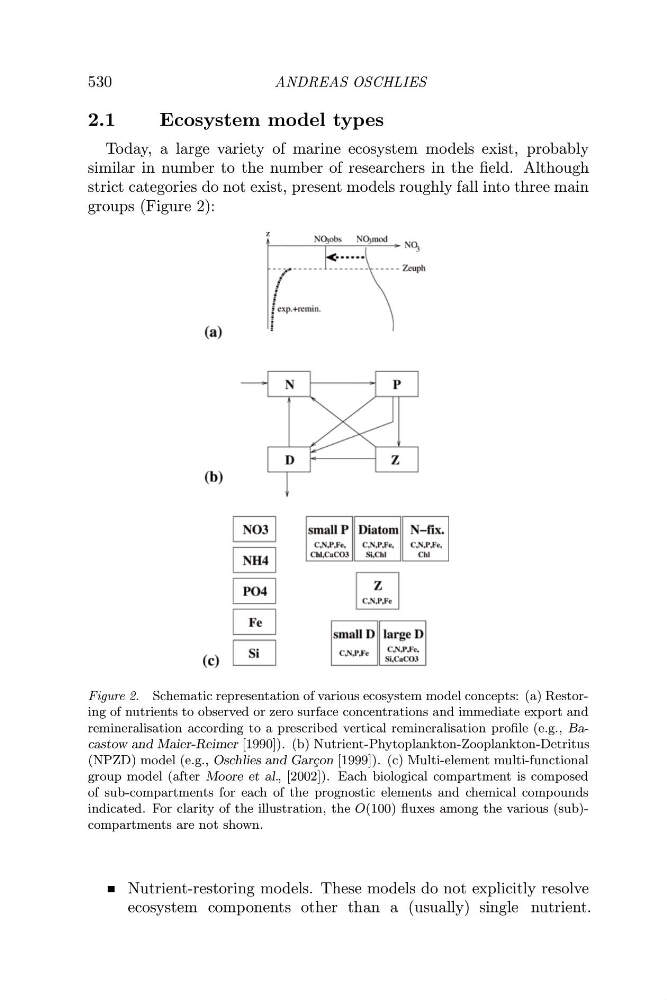
groups (Figure 2):
Figure 2. Schematic representation of various ecosystem model concepts: (a) Restoring of nutrients to observed or zero surface concentrations and immediate export and
remineralisation according to a prescribed vertical remineralisation profile (e.g., Bacastow and Maier-Reimer [1990]). (b) Nutrient-Phytoplankton-Zooplankton-Detritus
(NPZD) model (e.g., Oschlies and Gar¸ con [1999]). (c) Multi-element multi-functional
group model (after Moore et al. [2002]). Each biological compartment is composed
of sub-compartments for each of the prognostic elements and chemical compounds
indicated. For clarity of the illustration, the O(100) fluxes among the various (sub)compartments are not shown.
Nutrient-restoring models. These models do not explicitly resolve
ecosystem components other than a (usually) single nutrient.
,
ANDREAS OSCHLIES
2.1
Ecosystem model types
Today, a large variety of marine ecosystem models exist, probably
similar in number to the number of researchers in the field. Although
strict categories do not exist, present models roughly fall into three main
groups (Figure 2):
Figure 2. Schematic representation of various ecosystem model concepts: (a) Restoring of nutrients to observed or zero surface concentrations and immediate export and
remineralisation according to a prescribed vertical remineralisation profile (e.g., Bacastow and Maier-Reimer [1990]). (b) Nutrient-Phytoplankton-Zooplankton-Detritus
(NPZD) model (e.g., Oschlies and Gar¸ con [1999]). (c) Multi-element multi-functional
group model (after Moore et al. [2002]). Each biological compartment is composed
of sub-compartments for each of the prognostic elements and chemical compounds
indicated. For clarity of the illustration, the O(100) fluxes among the various (sub)compartments are not shown.
Nutrient-restoring models. These models do not explicitly resolve
ecosystem components other than a (usually) single nutrient.
,