

526
ANDREAS OSCHLIES
Carbon fluxes in the ocean are often described in terms of solubility
pump and biological pump. The abiotic solubility pump is caused by
increasing solubility of CO 2 (as of other gases) with decreasing temperature. For present climate conditions, deep water forms at high latitudes
and average ocean temperatures are colder than average sea surface temperatures. The solubility pump then ensures that the volume averaged
carbon concentration is larger than the surface averaged one, yielding a
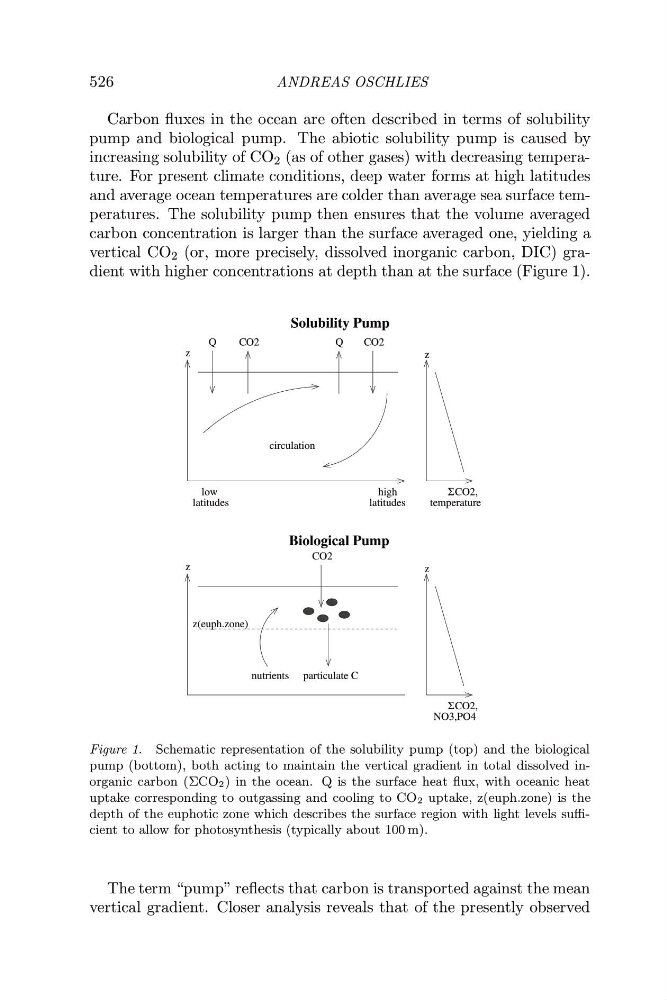
vertical CO 2 (or, more precisely, dissolved inorganic carbon, DIC) gradient with higher concentrations at depth than at the surface (Figure 1).
z
CO2,
Σ
temperature
z
low
latitudes
Q
CO2
circulation
Q
CO2
high
latitudes
z
z
CO2,
Σ
NO3,PO4
CO2
nutrients particulate C
z(euph.zone)
Solubility Pump
Biological Pump
Figure 1. Schematic representation of the solubility pump (top) and the biological
pump (bottom), both acting to maintain the vertical gradient in total dissolved inorganic carbon (ΣCO2) in the ocean. Q is the surface heat flux, with oceanic heat
uptake corresponding to outgassing and cooling to CO2 uptake, z(euph.zone) is the
depth of the euphotic zone which describes the surface region with light levels sufficient to allow for photosynthesis (typically about 100 m).
The term “pump” reflects that carbon is transported against the mean
vertical gradient. Closer analysis reveals that of the presently observed
ANDREAS OSCHLIES
Carbon fluxes in the ocean are often described in terms of solubility
pump and biological pump. The abiotic solubility pump is caused by
increasing solubility of CO 2 (as of other gases) with decreasing temperature. For present climate conditions, deep water forms at high latitudes
and average ocean temperatures are colder than average sea surface temperatures. The solubility pump then ensures that the volume averaged
carbon concentration is larger than the surface averaged one, yielding a
vertical CO 2 (or, more precisely, dissolved inorganic carbon, DIC) gradient with higher concentrations at depth than at the surface (Figure 1).
z
CO2,
Σ
temperature
z
low
latitudes
Q
CO2
circulation
Q
CO2
high
latitudes
z
z
CO2,
Σ
NO3,PO4
CO2
nutrients particulate C
z(euph.zone)
Solubility Pump
Biological Pump
Figure 1. Schematic representation of the solubility pump (top) and the biological
pump (bottom), both acting to maintain the vertical gradient in total dissolved inorganic carbon (ΣCO2) in the ocean. Q is the surface heat flux, with oceanic heat
uptake corresponding to outgassing and cooling to CO2 uptake, z(euph.zone) is the
depth of the euphotic zone which describes the surface region with light levels sufficient to allow for photosynthesis (typically about 100 m).
The term “pump” reflects that carbon is transported against the mean
vertical gradient. Closer analysis reveals that of the presently observed