

516
BRUCE HACKETT ET AL.
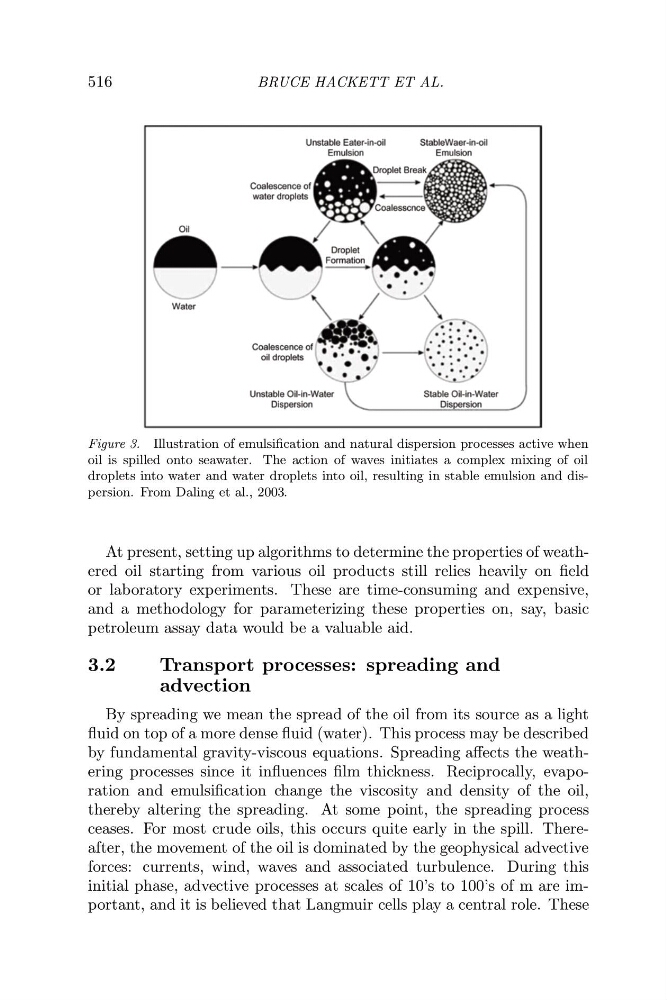
Figure 3. Illustration of emulsification and natural dispersion processes active when
oil is spilled onto seawater. The action of waves initiates a complex mixing of oil
droplets into water and water droplets into oil, resulting in stable emulsion and dispersion. From Daling et al., 2003
At present, setting up algorithms to determine the properties of weathered oil starting from various oil products still relies heavily on field
or laboratory experiments. These are time-consuming and expensive,
and a methodology for parameterizing these properties on, say, basic
petroleum assay data would be a valuable aid.
3.2
Transport processes: spreading and
advection
By spreading we mean the spread of the oil from its source as a light
fluid on top of a more dense fluid (water). This process may be described
by fundamental gravity-viscous equations. Spreading affects the weathering processes since it influences film thickness. Reciprocally, evaporation and emulsification change the viscosity and density of the oil,
thereby altering the spreading. At some point, the spreading process
ceases. For most crude oils, this occurs quite early in the spill. Thereafter, the movement of the oil is dominated by the geophysical advective
forces: currents, wind, waves and associated turbulence. During this
initial phase, advective processes at scales of 10’s to 100’s of m are important, and it is believed that Langmuir cells play a central role. These
.
BRUCE HACKETT ET AL.
Figure 3. Illustration of emulsification and natural dispersion processes active when
oil is spilled onto seawater. The action of waves initiates a complex mixing of oil
droplets into water and water droplets into oil, resulting in stable emulsion and dispersion. From Daling et al., 2003
At present, setting up algorithms to determine the properties of weathered oil starting from various oil products still relies heavily on field
or laboratory experiments. These are time-consuming and expensive,
and a methodology for parameterizing these properties on, say, basic
petroleum assay data would be a valuable aid.
3.2
Transport processes: spreading and
advection
By spreading we mean the spread of the oil from its source as a light
fluid on top of a more dense fluid (water). This process may be described
by fundamental gravity-viscous equations. Spreading affects the weathering processes since it influences film thickness. Reciprocally, evaporation and emulsification change the viscosity and density of the oil,
thereby altering the spreading. At some point, the spreading process
ceases. For most crude oils, this occurs quite early in the spill. Thereafter, the movement of the oil is dominated by the geophysical advective
forces: currents, wind, waves and associated turbulence. During this
initial phase, advective processes at scales of 10’s to 100’s of m are important, and it is believed that Langmuir cells play a central role. These
.