

492
MARY ALTALO
aspects of operations, planning, markets and policy making involved in the
respective industry were defined. Selected results from several of those
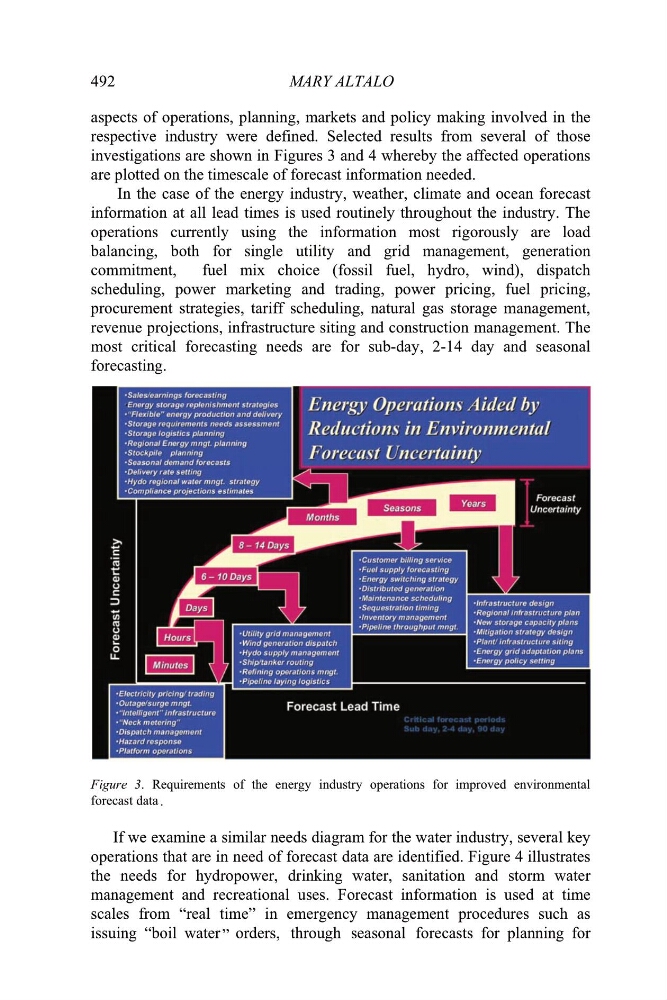
investigations are shown in Figures 3 and 4 whereby the affected operations
are plotted on the timescale of forecast information needed.
In the case of the energy industry, weather, climate and ocean forecast
information at all lead times is used routinely throughout the industry. The
operations currently using the information most rigorously are load
balancing, both for single utility and grid management, generation
commitment,
fuel mix choice (fossil fuel, hydro, wind), dispatch
scheduling, power marketing and trading, power pricing, fuel pricing,
procurement strategies, tariff scheduling, natural gas storage management,
revenue projections, infrastructure siting and construction management. The
most critical forecasting needs are for sub-day, 2-14 day and seasonal
forecasting.
Figure 3. Requirements of the energy industry operations for improved environmental
forecast data
If we examine a similar needs diagram for the water industry, several key
operations that are in need of forecast data are identified. Figure 4 illustrates
the needs for hydropower, drinking water, sanitation and storm water
management and recreational uses. Forecast information is used at time
scales from “real time” in emergency management procedures such as
issuing “boil water
“
orders, through seasonal forecasts for planning for
.
MARY ALTALO
aspects of operations, planning, markets and policy making involved in the
respective industry were defined. Selected results from several of those
investigations are shown in Figures 3 and 4 whereby the affected operations
are plotted on the timescale of forecast information needed.
In the case of the energy industry, weather, climate and ocean forecast
information at all lead times is used routinely throughout the industry. The
operations currently using the information most rigorously are load
balancing, both for single utility and grid management, generation
commitment,
fuel mix choice (fossil fuel, hydro, wind), dispatch
scheduling, power marketing and trading, power pricing, fuel pricing,
procurement strategies, tariff scheduling, natural gas storage management,
revenue projections, infrastructure siting and construction management. The
most critical forecasting needs are for sub-day, 2-14 day and seasonal
forecasting.
Figure 3. Requirements of the energy industry operations for improved environmental
forecast data
If we examine a similar needs diagram for the water industry, several key
operations that are in need of forecast data are identified. Figure 4 illustrates
the needs for hydropower, drinking water, sanitation and storm water
management and recreational uses. Forecast information is used at time
scales from “real time” in emergency management procedures such as
issuing “boil water
“
orders, through seasonal forecasts for planning for
.