

462
LAURENCE CROSNIER
x The Meridional Heat Transport (MHT) (PW=10
15
Watt). The
MHT is a variable of high climatological interest. The MHT is
strongly linked to the OSF and mostly reflects the North Atlantic
Deep Water (NADW) overturning cell behaviour: the stronger the
NADW cell, the stronger the northward MHT. The canonical value
is 1.2 +/- 0.3 PW at 24°N (Hall and Bryden, 1982). The OSF and
MHT Class 3 diagnostics provide a significant index of the
thermodynamic behaviour of the model.
3.5. Class 4 metrics
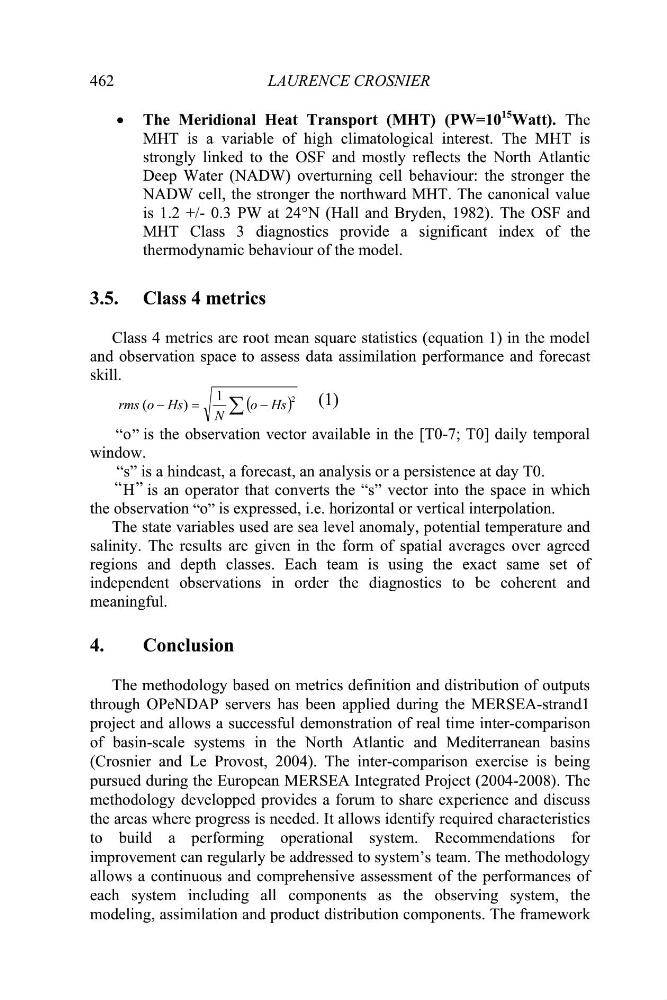
Class 4 metrics are root mean square statistics (equation 1) in the model
and observation space to assess data assimilation performance and forecast
skill.
¦
2
1
)
(
Hs
o
N
Hs
o
rms
(1)
o is the observation vector available in the [T0-7; T0] daily temporal
window.
“s” is a hindcast, a forecast, an analysis or a persistence at day T0.
H is an operator that converts the “s” vector into the space in which
the observation o is expressed, i.e. horizontal or vertical interpolation.
The state variables used are sea level anomaly, potential temperature and
salinity. The results are given in the form of spatial averages over agreed
regions and depth classes. Each team is using the exact same set of
independent observations in order the diagnostics to be coherent and
meaningful.
4.
Conclusion
The methodology based on metrics definition and distribution of outputs
through OPeNDAP servers has been applied during the MERSEA-strand1
project and allows a successful demonstration of real time inter-comparison
of basin-scale systems in the North Atlantic and Mediterranean basins
(Crosnier and Le Provost, 2004). The inter-comparison exercise is being
pursued during the European MERSEA Integrated Project (2004-2008). The
methodology developped provides a forum to share experience and discuss
the areas where progress is needed. It allows identify required characteristics
to build a performing operational system. Recommendations for
improvement can regularly be addressed to system’s team. The methodology
allows a continuous and comprehensive assessment of the performances of
each system including all components as the observing system, the
modeling, assimilation and product distribution components. The framework
“
“
“
”
”
”
LAURENCE CROSNIER
x The Meridional Heat Transport (MHT) (PW=10
15
Watt). The
MHT is a variable of high climatological interest. The MHT is
strongly linked to the OSF and mostly reflects the North Atlantic
Deep Water (NADW) overturning cell behaviour: the stronger the
NADW cell, the stronger the northward MHT. The canonical value
is 1.2 +/- 0.3 PW at 24°N (Hall and Bryden, 1982). The OSF and
MHT Class 3 diagnostics provide a significant index of the
thermodynamic behaviour of the model.
3.5. Class 4 metrics
Class 4 metrics are root mean square statistics (equation 1) in the model
and observation space to assess data assimilation performance and forecast
skill.
¦
2
1
)
(
Hs
o
N
Hs
o
rms
(1)
o is the observation vector available in the [T0-7; T0] daily temporal
window.
“s” is a hindcast, a forecast, an analysis or a persistence at day T0.
H is an operator that converts the “s” vector into the space in which
the observation o is expressed, i.e. horizontal or vertical interpolation.
The state variables used are sea level anomaly, potential temperature and
salinity. The results are given in the form of spatial averages over agreed
regions and depth classes. Each team is using the exact same set of
independent observations in order the diagnostics to be coherent and
meaningful.
4.
Conclusion
The methodology based on metrics definition and distribution of outputs
through OPeNDAP servers has been applied during the MERSEA-strand1
project and allows a successful demonstration of real time inter-comparison
of basin-scale systems in the North Atlantic and Mediterranean basins
(Crosnier and Le Provost, 2004). The inter-comparison exercise is being
pursued during the European MERSEA Integrated Project (2004-2008). The
methodology developped provides a forum to share experience and discuss
the areas where progress is needed. It allows identify required characteristics
to build a performing operational system. Recommendations for
improvement can regularly be addressed to system’s team. The methodology
allows a continuous and comprehensive assessment of the performances of
each system including all components as the observing system, the
modeling, assimilation and product distribution components. The framework
“
“
“
”
”
”