

SOME OCEAN MODEL FUNDAMENTALS
35
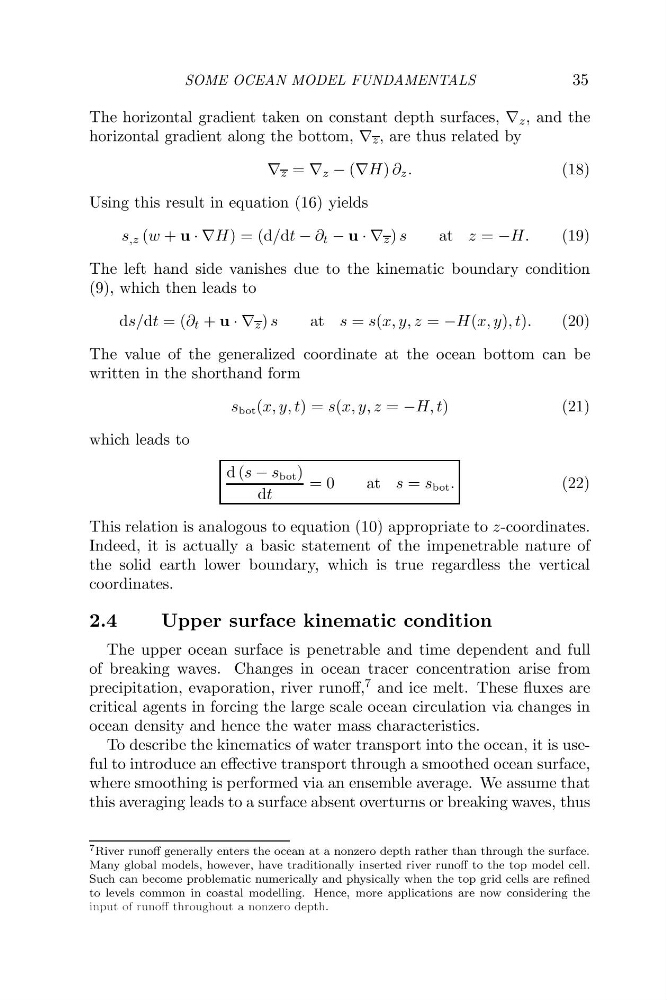
The horizontal gradient taken on constant depth surfaces, V,, and the
horizontal gradient along the bottom, Vz, are thus related by
Using this result in equation (16) yields
s,, (w + u . VH) = (dldt - 8, - u . V,) s at z = -H. (19)
The left hand side vanishes due to the kinematic boundary condition
(9), which then leads to
The value of the generalized coordinate at the ocean bottom can be
written in the shorthand form
which leads to
This relation is analogous to equation (10) appropriate to z-coordinates.
Indeed, it is actually a basic statement of the impenetrable nature of
the solid earth lower boundary, which is true regardless the vertical
coordinates.
2.4
Upper surface kinematic condition
The upper ocean surface is penetrable and time dependent and full
of breaking waves. Changes in ocean tracer concentration arise from
precipitation, evaporation, river r ~ n o f f , ~
and ice melt. These fluxes are
critical agents in forcing the large scale ocean circulation via changes in
ocean density and hence the water mass characteristics.
To describe the kinematics of water transport into the ocean, it is useful to introduce an effective transport through a smoothed ocean surface,
where smoothing is performed via an ensemble average. We assume that
this averaging leads to a surface absent overturns or breaking waves, thus
?River runoff generally enters the ocean at a nonzero depth rather than through the surface.
Many global models, however, have traditionally inserted river runoff to the top model cell.
Such can become problematic numerically and physically when the top grid cells are refined
to levels common in coastal modelling. Hence, more applications are now considering the
input of runoff throughout a nonzero depth.
35
The horizontal gradient taken on constant depth surfaces, V,, and the
horizontal gradient along the bottom, Vz, are thus related by
Using this result in equation (16) yields
s,, (w + u . VH) = (dldt - 8, - u . V,) s at z = -H. (19)
The left hand side vanishes due to the kinematic boundary condition
(9), which then leads to
The value of the generalized coordinate at the ocean bottom can be
written in the shorthand form
which leads to
This relation is analogous to equation (10) appropriate to z-coordinates.
Indeed, it is actually a basic statement of the impenetrable nature of
the solid earth lower boundary, which is true regardless the vertical
coordinates.
2.4
Upper surface kinematic condition
The upper ocean surface is penetrable and time dependent and full
of breaking waves. Changes in ocean tracer concentration arise from
precipitation, evaporation, river r ~ n o f f , ~
and ice melt. These fluxes are
critical agents in forcing the large scale ocean circulation via changes in
ocean density and hence the water mass characteristics.
To describe the kinematics of water transport into the ocean, it is useful to introduce an effective transport through a smoothed ocean surface,
where smoothing is performed via an ensemble average. We assume that
this averaging leads to a surface absent overturns or breaking waves, thus
?River runoff generally enters the ocean at a nonzero depth rather than through the surface.
Many global models, however, have traditionally inserted river runoff to the top model cell.
Such can become problematic numerically and physically when the top grid cells are refined
to levels common in coastal modelling. Hence, more applications are now considering the
input of runoff throughout a nonzero depth.