

406
MICHAEL J. BELL ET AL.
4 gives a simple indication of the importance of the background error
covariance for assimilation of SST data into the global FOAM configuration.
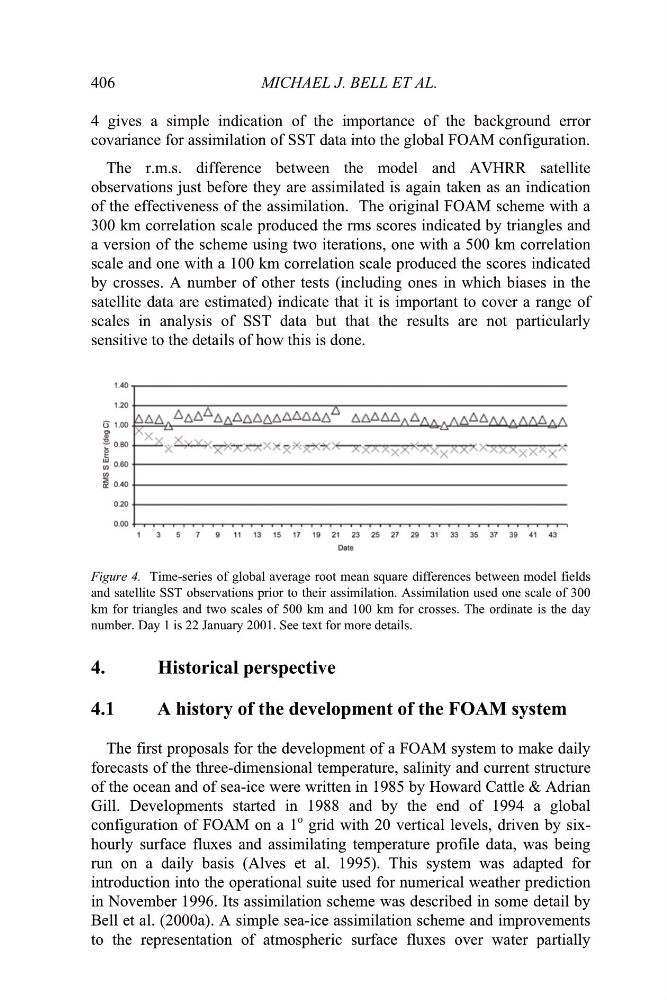
The r.m.s. difference between the model and AVHRR satellite
observations just before they are assimilated is again taken as an indication
of the effectiveness of the assimilation. The original FOAM scheme with a
300 km correlation scale produced the rms scores indicated by triangles and
a version of the scheme using two iterations, one with a 500 km correlation
scale and one with a 100 km correlation scale produced the scores indicated
by crosses. A number of other tests (including ones in which biases in the
satellite data are estimated) indicate that it is important to cover a range of
scales in analysis of SST data but that the results are not particularly
sensitive to the details of how this is done.
Figure 4. Time-series of global average root mean square differences between model fields
and satellite SST observations prior to their assimilation. Assimilation used one scale of 300
km for triangles and two scales of 500 km and 100 km for crosses. The ordinate is the day
number. Day 1 is 22 January 2001. See text for more details.
4.
Historical perspective
4.1
A history of the development of the FOAM system
The first proposals for the development of a FOAM system to make daily
forecasts of the three-dimensional temperature, salinity and current structure
of the ocean and of sea-ice were written in 1985 by Howard Cattle & Adrian
Gill. Developments started in 1988 and by the end of 1994 a global
configuration of FOAM on a 1
o grid with 20 vertical levels, driven by sixhourly surface fluxes and assimilating temperature profile data, was being
run on a daily basis (Alves et al. 1995). This system was adapted for
introduction into the operational suite used for numerical weather prediction
in November 1996. Its assimilation scheme was described in some detail by
Bell et al. (2000a). A simple sea-ice assimilation scheme and improvements
to the representation of atmospheric surface fluxes over water partially
MICHAEL J. BELL ET AL.
4 gives a simple indication of the importance of the background error
covariance for assimilation of SST data into the global FOAM configuration.
The r.m.s. difference between the model and AVHRR satellite
observations just before they are assimilated is again taken as an indication
of the effectiveness of the assimilation. The original FOAM scheme with a
300 km correlation scale produced the rms scores indicated by triangles and
a version of the scheme using two iterations, one with a 500 km correlation
scale and one with a 100 km correlation scale produced the scores indicated
by crosses. A number of other tests (including ones in which biases in the
satellite data are estimated) indicate that it is important to cover a range of
scales in analysis of SST data but that the results are not particularly
sensitive to the details of how this is done.
Figure 4. Time-series of global average root mean square differences between model fields
and satellite SST observations prior to their assimilation. Assimilation used one scale of 300
km for triangles and two scales of 500 km and 100 km for crosses. The ordinate is the day
number. Day 1 is 22 January 2001. See text for more details.
4.
Historical perspective
4.1
A history of the development of the FOAM system
The first proposals for the development of a FOAM system to make daily
forecasts of the three-dimensional temperature, salinity and current structure
of the ocean and of sea-ice were written in 1985 by Howard Cattle & Adrian
Gill. Developments started in 1988 and by the end of 1994 a global
configuration of FOAM on a 1
o grid with 20 vertical levels, driven by sixhourly surface fluxes and assimilating temperature profile data, was being
run on a daily basis (Alves et al. 1995). This system was adapted for
introduction into the operational suite used for numerical weather prediction
in November 1996. Its assimilation scheme was described in some detail by
Bell et al. (2000a). A simple sea-ice assimilation scheme and improvements
to the representation of atmospheric surface fluxes over water partially