

THE ECMWF PERSPECTIVE
373
the ocean reanalyses using ERA-40 match the independent data set of sealevel from satellite altimeters such as TOPEX and Poseidon more closely
and lead to better forecasts.
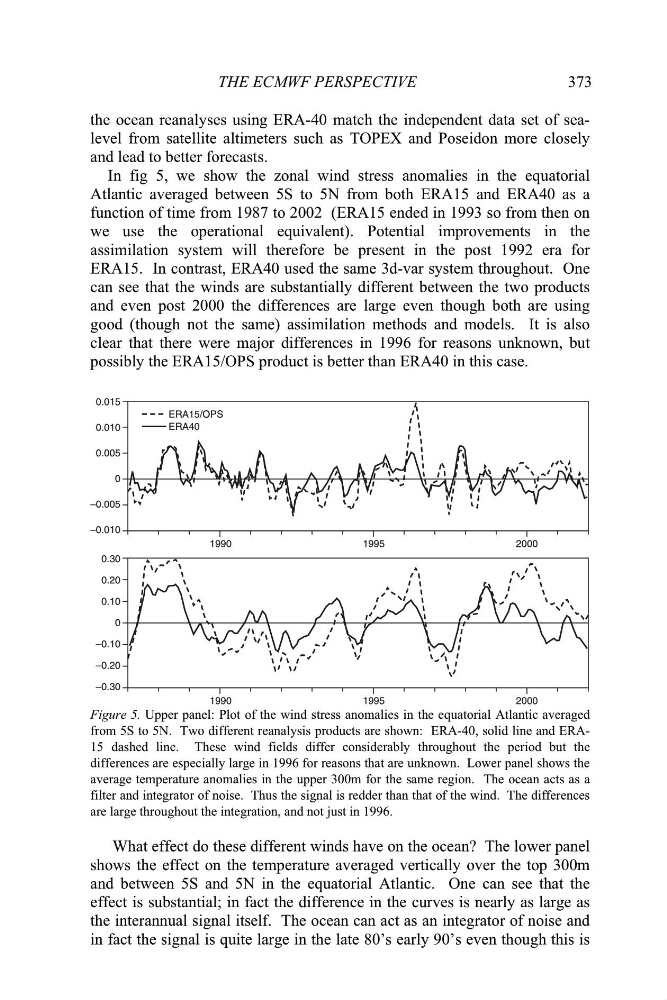
In fig 5, we show the zonal wind stress anomalies in the equatorial
Atlantic averaged between 5S to 5N from both ERA15 and ERA40 as a
function of time from 1987 to 2002 (ERA15 ended in 1993 so from then on
we use the operational equivalent). Potential improvements in the
assimilation system will therefore be present in the post 1992 era for
ERA15. In contrast, ERA40 used the same 3d-var system throughout. One
can see that the winds are substantially different between the two products
and even post 2000 the differences are large even though both are using
good (though not the same) assimilation methods and models. It is also
clear that there were major differences in 1996 for reasons unknown, but
possibly the ERA15/OPS product is better than ERA40 in this case.
0.015
ERA15/OPS
ERA40
0.010
Figure 5. Upper panel: Plot of the wind stress anomalies in the equatorial Atlantic averaged
from 5S to 5N. Two different reanalysis products are shown: ERA-40, solid line and ERA15 dashed line. These wind fields differ considerably throughout the period but the
differences are especially large in 1996 for reasons that are unknown. Lower panel shows the
average temperature anomalies in the upper 300m for the same region. The ocean acts as a
filter and integrator of noise. Thus the signal is redder than that of the wind. The differences
are large throughout the integration, and not just in 1996.
0.005
0
–0.005
–0.010
1990
1995
2000
0.30
0.20
0.10
0
–0.30
1990
1995
2000
–0.20
–0.10
What effect do these different winds have on the ocean? The lower panel
shows the effect on the temperature averaged vertically over the top 300m
and between 5S and 5N in the equatorial Atlantic. One can see that the
effect is substantial; in fact the difference in the curves is nearly as large as
the interannual signal itself. The ocean can act as an integrator of noise and
in fact the signal is quite large in the late 80’s early 90’s even though this is
373
the ocean reanalyses using ERA-40 match the independent data set of sealevel from satellite altimeters such as TOPEX and Poseidon more closely
and lead to better forecasts.
In fig 5, we show the zonal wind stress anomalies in the equatorial
Atlantic averaged between 5S to 5N from both ERA15 and ERA40 as a
function of time from 1987 to 2002 (ERA15 ended in 1993 so from then on
we use the operational equivalent). Potential improvements in the
assimilation system will therefore be present in the post 1992 era for
ERA15. In contrast, ERA40 used the same 3d-var system throughout. One
can see that the winds are substantially different between the two products
and even post 2000 the differences are large even though both are using
good (though not the same) assimilation methods and models. It is also
clear that there were major differences in 1996 for reasons unknown, but
possibly the ERA15/OPS product is better than ERA40 in this case.
0.015
ERA15/OPS
ERA40
0.010
Figure 5. Upper panel: Plot of the wind stress anomalies in the equatorial Atlantic averaged
from 5S to 5N. Two different reanalysis products are shown: ERA-40, solid line and ERA15 dashed line. These wind fields differ considerably throughout the period but the
differences are especially large in 1996 for reasons that are unknown. Lower panel shows the
average temperature anomalies in the upper 300m for the same region. The ocean acts as a
filter and integrator of noise. Thus the signal is redder than that of the wind. The differences
are large throughout the integration, and not just in 1996.
0.005
0
–0.005
–0.010
1990
1995
2000
0.30
0.20
0.10
0
–0.30
1990
1995
2000
–0.20
–0.10
What effect do these different winds have on the ocean? The lower panel
shows the effect on the temperature averaged vertically over the top 300m
and between 5S and 5N in the equatorial Atlantic. One can see that the
effect is substantial; in fact the difference in the curves is nearly as large as
the interannual signal itself. The ocean can act as an integrator of noise and
in fact the signal is quite large in the late 80’s early 90’s even though this is