

310
PIERRE BRASSEUR
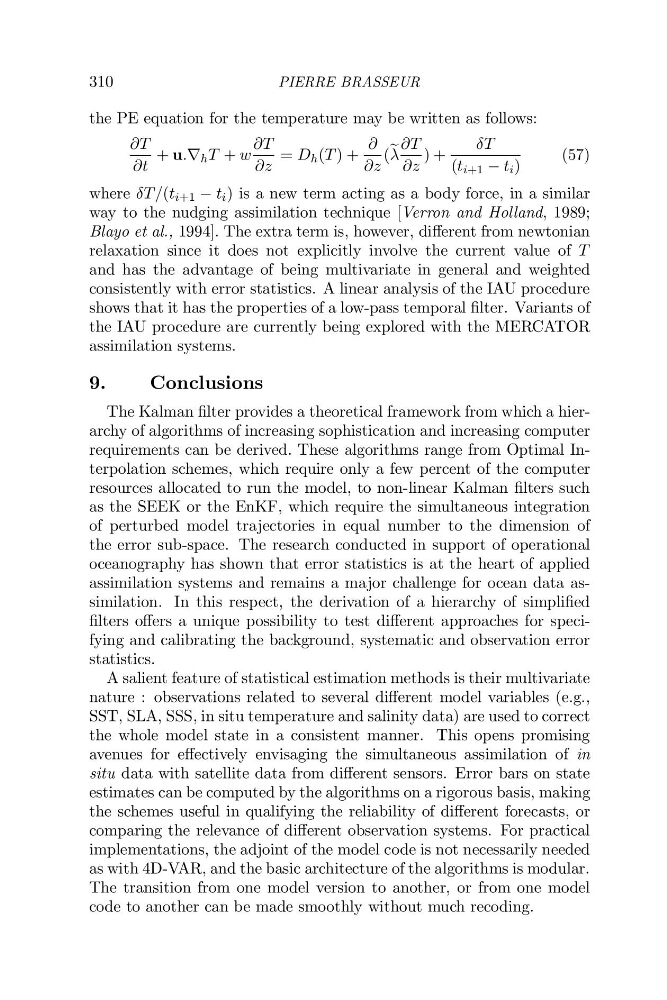
the PE equation for the temperature may be written as follows:
CT
Ct
+ u.u h T + w
CT
Cz
= D h (T ) +
C
Cz
( h
CT
Cz
) +
T
(t i+1 t i )
(57)
where T/(t i+1 t i ) is a new term acting as a body force, in a similar
way to the nudging assimilation technique [Verron and Holland, 1989;
Blayo et al., 1994]. The extra term is, however, dierent from newtonian
relaxation since it does not explicitly involve the current value of T
and has the advantage of being multivariate in general and weighted
consistently with error statistics. A linear analysis of the IAU procedure
shows that it has the properties of a low-pass temporal filter. Variants of
the IAU procedure are currently being explored with the MERCATOR
assimilation systems.
9.
Conclusions
The Kalman filter provides a theoretical framework from which a hierarchy of algorithms of increasing sophistication and increasing computer
requirements can be derived. These algorithms range from Optimal Interpolation schemes, which require only a few percent of the computer
resources allocated to run the model, to non-linear Kalman filters such
as the SEEK or the EnKF, which require the simultaneous integration
of perturbed model trajectories in equal number to the dimension of
the error sub-space. The research conducted in support of operational
oceanography has shown that error statistics is at the heart of applied
assimilation systems and remains a major challenge for ocean data assimilation. In this respect, the derivation of a hierarchy of simplified
filters oers a unique possibility to test dierent approaches for specifying and calibrating the background, systematic and observation error
statistics.
A salient feature of statistical estimation methods is their multivariate
nature : observations related to several dierent model variables (e.g.,
SST, SLA, SSS, in situ temperature and salinity data) are used to correct
the whole model state in a consistent manner. This opens promising
avenues for eectively envisaging the simultaneous assimilation of in
situ data with satellite data from dierent sensors. Error bars on state
estimates can be computed by the algorithms on a rigorous basis, making
the schemes useful in qualifying the reliability of dierent forecasts, or
comparing the relevance of dierent observation systems. For practical
implementations, the adjoint of the model code is not necessarily needed
as with 4D-VAR, and the basic architecture of the algorithms is modular.
The transition from one model version to another, or from one model
code to another can be made smoothly without much recoding.
PIERRE BRASSEUR
the PE equation for the temperature may be written as follows:
CT
Ct
+ u.u h T + w
CT
Cz
= D h (T ) +
C
Cz
( h
CT
Cz
) +
T
(t i+1 t i )
(57)
where T/(t i+1 t i ) is a new term acting as a body force, in a similar
way to the nudging assimilation technique [Verron and Holland, 1989;
Blayo et al., 1994]. The extra term is, however, dierent from newtonian
relaxation since it does not explicitly involve the current value of T
and has the advantage of being multivariate in general and weighted
consistently with error statistics. A linear analysis of the IAU procedure
shows that it has the properties of a low-pass temporal filter. Variants of
the IAU procedure are currently being explored with the MERCATOR
assimilation systems.
9.
Conclusions
The Kalman filter provides a theoretical framework from which a hierarchy of algorithms of increasing sophistication and increasing computer
requirements can be derived. These algorithms range from Optimal Interpolation schemes, which require only a few percent of the computer
resources allocated to run the model, to non-linear Kalman filters such
as the SEEK or the EnKF, which require the simultaneous integration
of perturbed model trajectories in equal number to the dimension of
the error sub-space. The research conducted in support of operational
oceanography has shown that error statistics is at the heart of applied
assimilation systems and remains a major challenge for ocean data assimilation. In this respect, the derivation of a hierarchy of simplified
filters oers a unique possibility to test dierent approaches for specifying and calibrating the background, systematic and observation error
statistics.
A salient feature of statistical estimation methods is their multivariate
nature : observations related to several dierent model variables (e.g.,
SST, SLA, SSS, in situ temperature and salinity data) are used to correct
the whole model state in a consistent manner. This opens promising
avenues for eectively envisaging the simultaneous assimilation of in
situ data with satellite data from dierent sensors. Error bars on state
estimates can be computed by the algorithms on a rigorous basis, making
the schemes useful in qualifying the reliability of dierent forecasts, or
comparing the relevance of dierent observation systems. For practical
implementations, the adjoint of the model code is not necessarily needed
as with 4D-VAR, and the basic architecture of the algorithms is modular.
The transition from one model version to another, or from one model
code to another can be made smoothly without much recoding.