

281
the model M(t i , t j ) will never be available as an explicit operator (even
for linear dynamics) but the numerical code of the ocean model will be
used as a routine to compute the time evolution of the model state and
forecast error components, as required by (17) and (18).
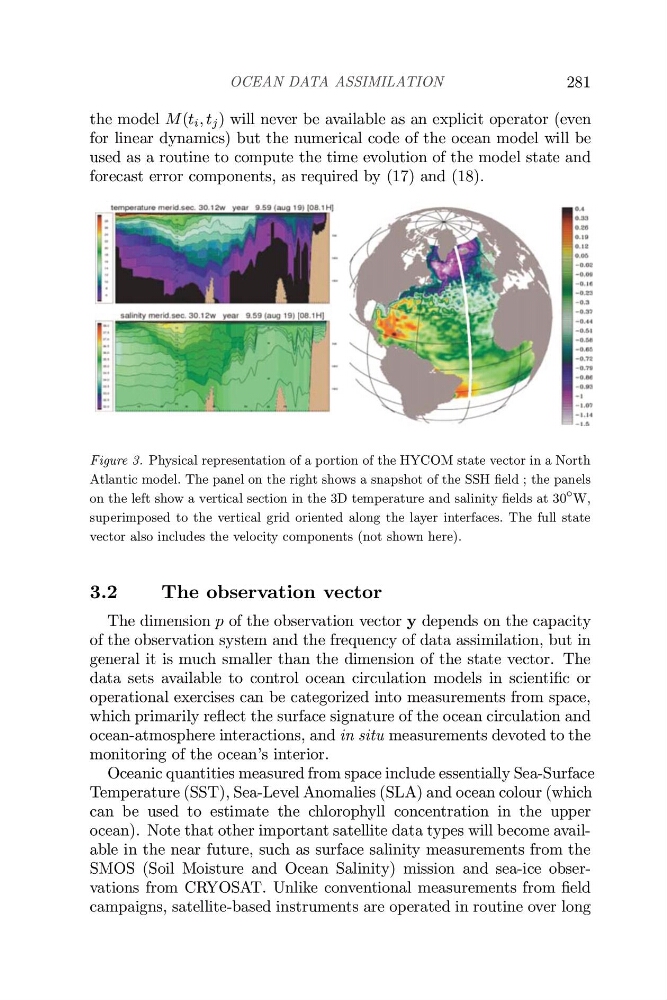
Figure 3. Physical representation of a portion of the HYCOM state vector in a North
Atlantic model. The panel on the right shows a snapshot of the SSH field ; the panels
on the left show a vertical section in the 3D temperature and salinity fields at 30 W,
superimposed to the vertical grid oriented along the layer interfaces. The full state
vector also includes the velocity components (not shown here).
3.2
The observation vector
The dimension p of the observation vector y depends on the capacity
of the observation system and the frequency of data assimilation, but in
general it is much smaller than the dimension of the state vector. The
data sets available to control ocean circulation models in scientific or
operational exercises can be categorized into measurements from space,
which primarily reflect the surface signature of the ocean circulation and
ocean-atmosphere interactions, and in situ measurements devoted to the
monitoring of the ocean’s interior.
Oceanic quantities measured from space include essentially Sea-Surface
Temperature (SST), Sea-Level Anomalies (SLA) and ocean colour (which
can be used to estimate the chlorophyll concentration in the upper
ocean). Note that other important satellite data types will become available in the near future, such as surface salinity measurements from the
SMOS (Soil Moisture and Ocean Salinity) mission and sea-ice observations from CRYOSAT. Unlike conventional measurements from field
campaigns, satellite-based instruments are operated in routine over long
OCEAN DATA ASSIMILATION
the model M(t i , t j ) will never be available as an explicit operator (even
for linear dynamics) but the numerical code of the ocean model will be
used as a routine to compute the time evolution of the model state and
forecast error components, as required by (17) and (18).
Figure 3. Physical representation of a portion of the HYCOM state vector in a North
Atlantic model. The panel on the right shows a snapshot of the SSH field ; the panels
on the left show a vertical section in the 3D temperature and salinity fields at 30 W,
superimposed to the vertical grid oriented along the layer interfaces. The full state
vector also includes the velocity components (not shown here).
3.2
The observation vector
The dimension p of the observation vector y depends on the capacity
of the observation system and the frequency of data assimilation, but in
general it is much smaller than the dimension of the state vector. The
data sets available to control ocean circulation models in scientific or
operational exercises can be categorized into measurements from space,
which primarily reflect the surface signature of the ocean circulation and
ocean-atmosphere interactions, and in situ measurements devoted to the
monitoring of the ocean’s interior.
Oceanic quantities measured from space include essentially Sea-Surface
Temperature (SST), Sea-Level Anomalies (SLA) and ocean colour (which
can be used to estimate the chlorophyll concentration in the upper
ocean). Note that other important satellite data types will become available in the near future, such as surface salinity measurements from the
SMOS (Soil Moisture and Ocean Salinity) mission and sea-ice observations from CRYOSAT. Unlike conventional measurements from field
campaigns, satellite-based instruments are operated in routine over long
OCEAN DATA ASSIMILATION