

SURFACE FLUXES
253
Satellites derive surface radiation from measurements of incoming and
outgoing radiation at the top of the atmosphere. These are generally
combined with information on the atmospheric column in a radiative
transfer model (RTM), with the treatment of clouds of critical importance. For example, the recent ISCCP-FD dataset (Zhang et al., 2004)
contains flux profiles, every 3 hours for 18 years at 280 km spatial resolution. By improving the treatment of cloud vertical structure, revising
the aerosol chemistry and water vapor profiles, and accounting for diurnal skin and air temperatures, the overall uncertainty in surface fluxes is
claimed to be reduced to 10 − 15W/m 2 . The standard of comparison is
the Baseline Surface Radiation Network over land (Gilgen et al., 1995),
and ship radiometers as part of the SEAFLUX project (Curry et al.,
2004).
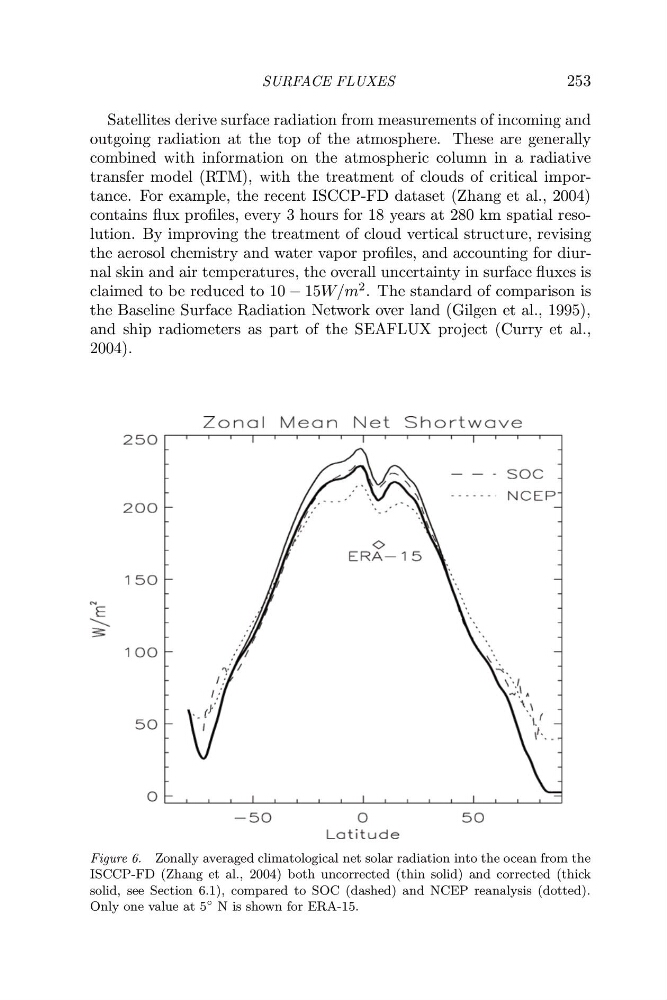
Figure 6. Zonally averaged climatological net solar radiation into the ocean from the
ISCCP-FD (Zhang et al., 2004) both uncorrected (thin solid) and corrected (thick
solid, see Section 6.1), compared to SOC (dashed) and NCEP reanalysis (dotted).
Only one value at 5
◦ N is shown for ERA-15.
253
Satellites derive surface radiation from measurements of incoming and
outgoing radiation at the top of the atmosphere. These are generally
combined with information on the atmospheric column in a radiative
transfer model (RTM), with the treatment of clouds of critical importance. For example, the recent ISCCP-FD dataset (Zhang et al., 2004)
contains flux profiles, every 3 hours for 18 years at 280 km spatial resolution. By improving the treatment of cloud vertical structure, revising
the aerosol chemistry and water vapor profiles, and accounting for diurnal skin and air temperatures, the overall uncertainty in surface fluxes is
claimed to be reduced to 10 − 15W/m 2 . The standard of comparison is
the Baseline Surface Radiation Network over land (Gilgen et al., 1995),
and ship radiometers as part of the SEAFLUX project (Curry et al.,
2004).
Figure 6. Zonally averaged climatological net solar radiation into the ocean from the
ISCCP-FD (Zhang et al., 2004) both uncorrected (thin solid) and corrected (thick
solid, see Section 6.1), compared to SOC (dashed) and NCEP reanalysis (dotted).
Only one value at 5
◦ N is shown for ERA-15.