

236
WILLIAM B. LARGE
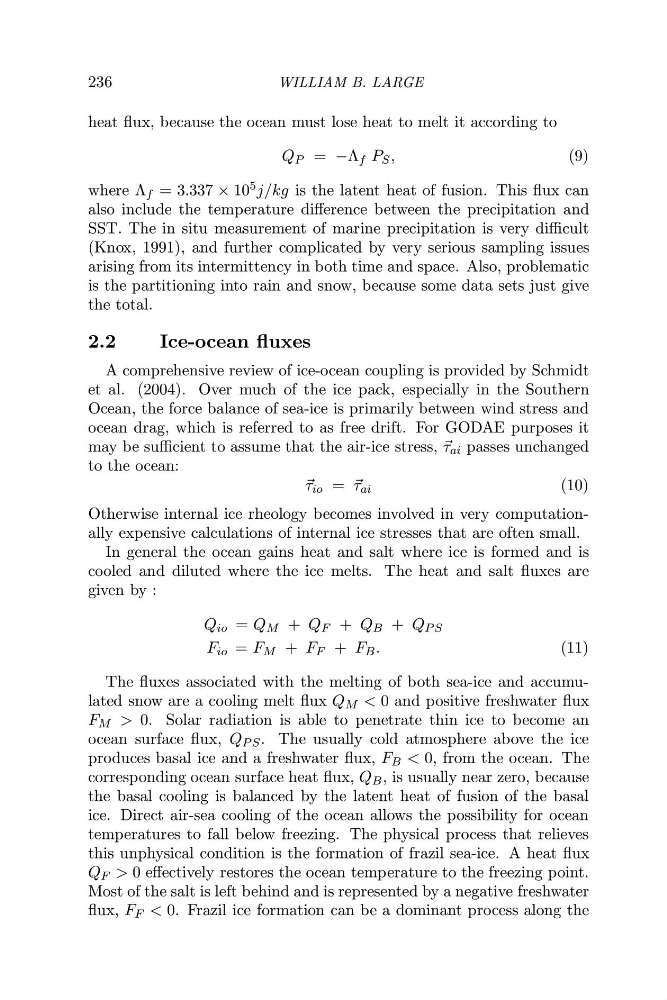
heat flux, because the ocean must lose heat to melt it according to
Q P = −Λ f P S ,
(9)
where Λ f = 3.337 × 10 5 j/kg is the latent heat of fusion. This flux can
also include the temperature difference between the precipitation and
SST. The in situ measurement of marine precipitation is very difficult
(Knox, 1991), and further complicated by very serious sampling issues
arising from its intermittency in both time and space. Also, problematic
is the partitioning into rain and snow, because some data sets just give
the total.
2.2
Ice-ocean fluxes
A comprehensive review of ice-ocean coupling is provided by Schmidt
et al. (2004). Over much of the ice pack, especially in the Southern
Ocean, the force balance of sea-ice is primarily between wind stress and
ocean drag, which is referred to as free drift. For GODAE purposes it
may be sufficient to assume that the air-ice stress, τ ai passes unchanged
to the ocean:
τ io = τ ai
(10)
Otherwise internal ice rheology becomes involved in very computationally expensive calculations of internal ice stresses that are often small.
In general the ocean gains heat and salt where ice is formed and is
cooled and diluted where the ice melts. The heat and salt fluxes are
given by :
Q io = Q M + Q F + Q B + Q P S
F io = F M + F F + F B .
(11)
The fluxes associated with the melting of both sea-ice and accumulated snow are a cooling melt flux Q M < 0 and positive freshwater flux
F M > 0. Solar radiation is able to penetrate thin ice to become an
ocean surface flux, Q P S . The usually cold atmosphere above the ice
produces basal ice and a freshwater flux, F B < 0, from the ocean. The
corresponding ocean surface heat flux, Q B , is usually near zero, because
the basal cooling is balanced by the latent heat of fusion of the basal
ice. Direct air-sea cooling of the ocean allows the possibility for ocean
temperatures to fall below freezing. The physical process that relieves
this unphysical condition is the formation of frazil sea-ice. A heat flux
Q F > 0 effectively restores the ocean temperature to the freezing point.
Most of the salt is left behind and is represented by a negative freshwater
flux, F F < 0. Frazil ice formation can be a dominant process along the
WILLIAM B. LARGE
heat flux, because the ocean must lose heat to melt it according to
Q P = −Λ f P S ,
(9)
where Λ f = 3.337 × 10 5 j/kg is the latent heat of fusion. This flux can
also include the temperature difference between the precipitation and
SST. The in situ measurement of marine precipitation is very difficult
(Knox, 1991), and further complicated by very serious sampling issues
arising from its intermittency in both time and space. Also, problematic
is the partitioning into rain and snow, because some data sets just give
the total.
2.2
Ice-ocean fluxes
A comprehensive review of ice-ocean coupling is provided by Schmidt
et al. (2004). Over much of the ice pack, especially in the Southern
Ocean, the force balance of sea-ice is primarily between wind stress and
ocean drag, which is referred to as free drift. For GODAE purposes it
may be sufficient to assume that the air-ice stress, τ ai passes unchanged
to the ocean:
τ io = τ ai
(10)
Otherwise internal ice rheology becomes involved in very computationally expensive calculations of internal ice stresses that are often small.
In general the ocean gains heat and salt where ice is formed and is
cooled and diluted where the ice melts. The heat and salt fluxes are
given by :
Q io = Q M + Q F + Q B + Q P S
F io = F M + F F + F B .
(11)
The fluxes associated with the melting of both sea-ice and accumulated snow are a cooling melt flux Q M < 0 and positive freshwater flux
F M > 0. Solar radiation is able to penetrate thin ice to become an
ocean surface flux, Q P S . The usually cold atmosphere above the ice
produces basal ice and a freshwater flux, F B < 0, from the ocean. The
corresponding ocean surface heat flux, Q B , is usually near zero, because
the basal cooling is balanced by the latent heat of fusion of the basal
ice. Direct air-sea cooling of the ocean allows the possibility for ocean
temperatures to fall below freezing. The physical process that relieves
this unphysical condition is the formation of frazil sea-ice. A heat flux
Q F > 0 effectively restores the ocean temperature to the freezing point.
Most of the salt is left behind and is represented by a negative freshwater
flux, F F < 0. Frazil ice formation can be a dominant process along the