

IN-SITU OBSERVATIONS
205
Platform/cost
Strengths
Weaknesses
Research
vessels
($25,000/day)
- taking samples
- deployment of heavy
equipment
- reach remote areas (VOS-like)
- sparse sampling (operational)
- too expensive for operational
obs (but needed for servicing of
operational installations)
VOS
(free)
- high resolution along repeat
tracks
- many variables (for surface
measurements)
- not always where wanted
- tracks may change, they
don‘t stop
- subsurface only for T (800m)
Surface drifters
($3,000)
- global coverage
- rapid sampling in time
- low-cost, robust technology
- sparse spatial sampling
- only surface observations
- limited variables (T, air-p, S)
Floats
($15,000)
- global coverage
- vertical profiling to mid
depth
- large numbers since “cheap”
- coarse x,y,t resolution
- limited weight/power (sensors)
- avoid/quickly leave passages,
divergences, places of interest
Moorings
($250,000)
- high time resolution,
surface to bottom
- many variables possible
- difficult locations possible
- re-calibrations, referencing
- no x,y resolution
- expensive, including the need
for ships
- large technical effort
Gliders
($70,000)
- good sampling along tracks
- free choice of track, can be
steered/controlled
- small sensor suite feasible
- very slow (20-25cm/s)
- limited depth range and
variables
Integrals
- integrate over long
distances
- good time resolution
- expensive
- limited variables and places
possible
Coastal radars
- good x,y,t resolution
- land based
- limited coverage
- only currents, waves (surface)
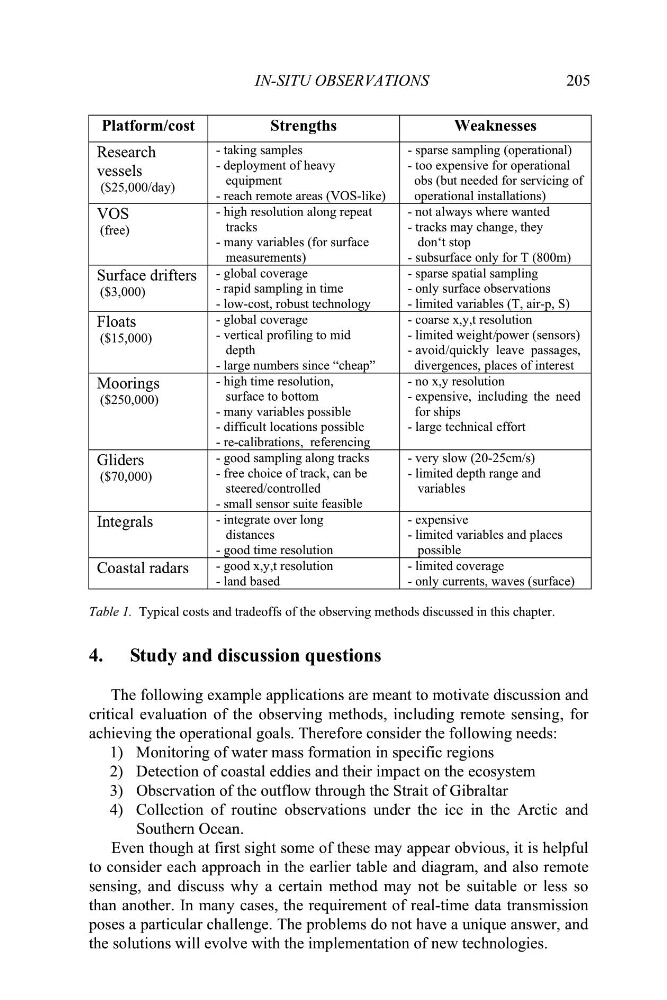
Table 1. Typical costs and tradeoffs of the observing methods discussed in this chapter.
4. Study and discussion questions
The following example applications are meant to motivate discussion and
critical evaluation of the observing methods, including remote sensing, for
achieving the operational goals. Therefore consider the following needs:
1) Monitoring of water mass formation in specific regions
2) Detection of coastal eddies and their impact on the ecosystem
3) Observation of the outflow through the Strait of Gibraltar
4) Collection of routine observations under the ice in the Arctic and
Southern Ocean.
Even though at first sight some of these may appear obvious, it is helpful
to consider each approach in the earlier table and diagram, and also remote
sensing, and discuss why a certain method may not be suitable or less so
than another. In many cases, the requirement of real-time data transmission
poses a particular challenge. The problems do not have a unique answer, and
the solutions will evolve with the implementation of new technologies.
205
Platform/cost
Strengths
Weaknesses
Research
vessels
($25,000/day)
- taking samples
- deployment of heavy
equipment
- reach remote areas (VOS-like)
- sparse sampling (operational)
- too expensive for operational
obs (but needed for servicing of
operational installations)
VOS
(free)
- high resolution along repeat
tracks
- many variables (for surface
measurements)
- not always where wanted
- tracks may change, they
don‘t stop
- subsurface only for T (800m)
Surface drifters
($3,000)
- global coverage
- rapid sampling in time
- low-cost, robust technology
- sparse spatial sampling
- only surface observations
- limited variables (T, air-p, S)
Floats
($15,000)
- global coverage
- vertical profiling to mid
depth
- large numbers since “cheap”
- coarse x,y,t resolution
- limited weight/power (sensors)
- avoid/quickly leave passages,
divergences, places of interest
Moorings
($250,000)
- high time resolution,
surface to bottom
- many variables possible
- difficult locations possible
- re-calibrations, referencing
- no x,y resolution
- expensive, including the need
for ships
- large technical effort
Gliders
($70,000)
- good sampling along tracks
- free choice of track, can be
steered/controlled
- small sensor suite feasible
- very slow (20-25cm/s)
- limited depth range and
variables
Integrals
- integrate over long
distances
- good time resolution
- expensive
- limited variables and places
possible
Coastal radars
- good x,y,t resolution
- land based
- limited coverage
- only currents, waves (surface)
Table 1. Typical costs and tradeoffs of the observing methods discussed in this chapter.
4. Study and discussion questions
The following example applications are meant to motivate discussion and
critical evaluation of the observing methods, including remote sensing, for
achieving the operational goals. Therefore consider the following needs:
1) Monitoring of water mass formation in specific regions
2) Detection of coastal eddies and their impact on the ecosystem
3) Observation of the outflow through the Strait of Gibraltar
4) Collection of routine observations under the ice in the Arctic and
Southern Ocean.
Even though at first sight some of these may appear obvious, it is helpful
to consider each approach in the earlier table and diagram, and also remote
sensing, and discuss why a certain method may not be suitable or less so
than another. In many cases, the requirement of real-time data transmission
poses a particular challenge. The problems do not have a unique answer, and
the solutions will evolve with the implementation of new technologies.