

196
UWE SEND
SSH = P ref + H dyn = SSH’ +
(1)
where <…> is the mean and SSH’ are the fluctuations observed by altimetry.
Altimetry has good spatial and temporal coverage but cannot determine/
differentiate the
- steric and non-steric components
- mean SSH field (relative to the geoid)
- T and S contributions (spiciness)
- interior structure (vertical distribution) of H dyn
The float profiles of T and S provide the H dyn component globally (i.e. the
steric component), as well as the spiciness and the interior structure. The
trajectory data provide the absolute flow at a reference level and thus an
estimate of the mean P ref field. As a residual in (1) then the mean SSH field
can be determined and thus the geoid.
Strengths and weaknesses:
The strength of these platforms is the broad (basin-scale or global) spatial
coverage achievable, as in the ARGO program, and the vertical information
provided. While at first sight they tend to spread randomly with time, there
are regions (divergences, passages) that are impossible to sample. Some
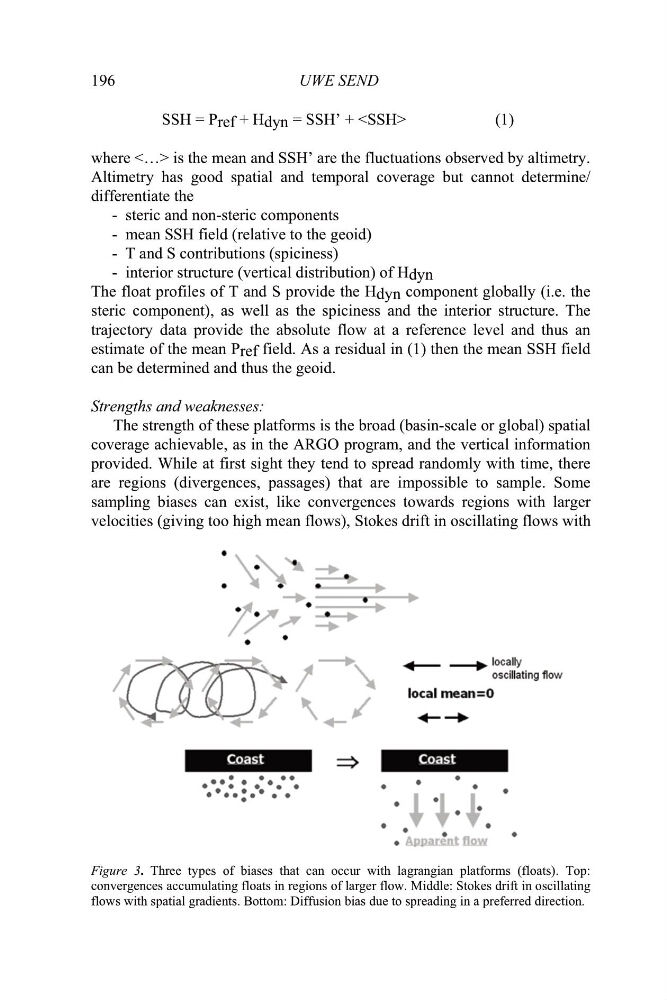
sampling biases can exist, like convergences towards regions with larger
velocities (giving too high mean flows), Stokes drift in oscillating flows with
Figure 3. Three types of biases that can occur with lagrangian platforms (floats). Top:
convergences accumulating floats in regions of larger flow. Middle: Stokes drift in oscillating
flows with spatial gradients. Bottom: Diffusion bias due to spreading in a preferred direction.
UWE SEND
SSH = P ref + H dyn = SSH’ +
(1)
where <…> is the mean and SSH’ are the fluctuations observed by altimetry.
Altimetry has good spatial and temporal coverage but cannot determine/
differentiate the
- steric and non-steric components
- mean SSH field (relative to the geoid)
- T and S contributions (spiciness)
- interior structure (vertical distribution) of H dyn
The float profiles of T and S provide the H dyn component globally (i.e. the
steric component), as well as the spiciness and the interior structure. The
trajectory data provide the absolute flow at a reference level and thus an
estimate of the mean P ref field. As a residual in (1) then the mean SSH field
can be determined and thus the geoid.
Strengths and weaknesses:
The strength of these platforms is the broad (basin-scale or global) spatial
coverage achievable, as in the ARGO program, and the vertical information
provided. While at first sight they tend to spread randomly with time, there
are regions (divergences, passages) that are impossible to sample. Some
sampling biases can exist, like convergences towards regions with larger
velocities (giving too high mean flows), Stokes drift in oscillating flows with
Figure 3. Three types of biases that can occur with lagrangian platforms (floats). Top:
convergences accumulating floats in regions of larger flow. Middle: Stokes drift in oscillating
flows with spatial gradients. Bottom: Diffusion bias due to spreading in a preferred direction.