

180
IAN ROBINSON
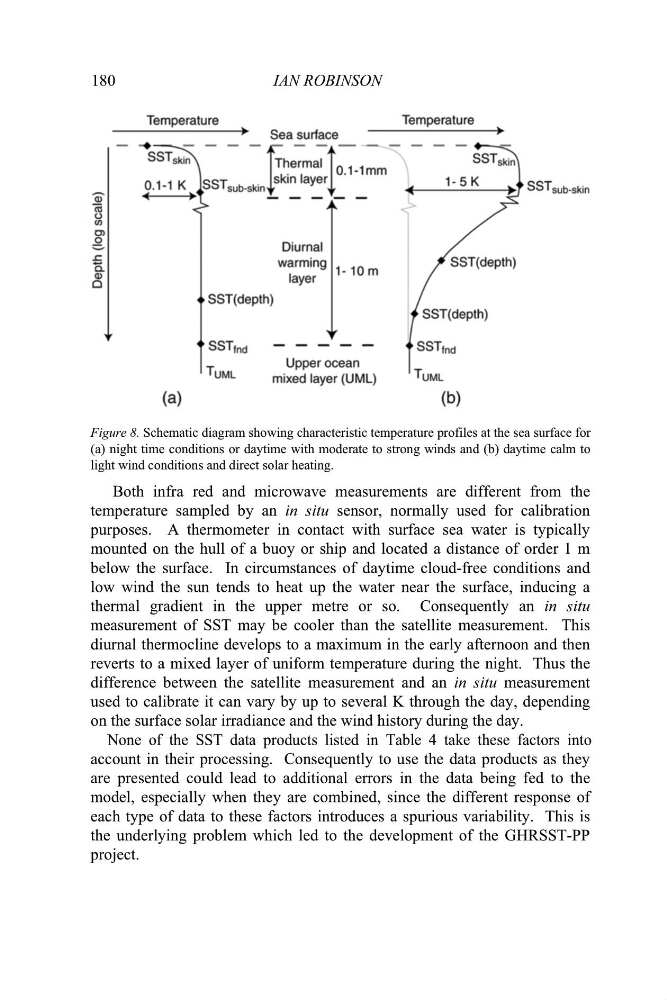
Figure 8. Schematic diagram showing characteristic temperature profiles at the sea surface for
(a) night time conditions or daytime with moderate to strong winds and (b) daytime calm to
light wind conditions and direct solar heating.
Both infra red and microwave measurements are different from the
temperature sampled by an in situ sensor, normally used for calibration
purposes. A thermometer in contact with surface sea water is typically
mounted on the hull of a buoy or ship and located a distance of order 1 m
below the surface. In circumstances of daytime cloud-free conditions and
low wind the sun tends to heat up the water near the surface, inducing a
thermal gradient in the upper metre or so. Consequently an in situ
measurement of SST may be cooler than the satellite measurement. This
diurnal thermocline develops to a maximum in the early afternoon and then
reverts to a mixed layer of uniform temperature during the night. Thus the
difference between the satellite measurement and an in situ measurement
used to calibrate it can vary by up to several K through the day, depending
on the surface solar irradiance and the wind history during the day.
None of the SST data products listed in Table 4 take these factors into
account in their processing. Consequently to use the data products as they
are presented could lead to additional errors in the data being fed to the
model, especially when they are combined, since the different response of
each type of data to these factors introduces a spurious variability. This is
the underlying problem which led to the development of the GHRSST-PP
project.
IAN ROBINSON
Figure 8. Schematic diagram showing characteristic temperature profiles at the sea surface for
(a) night time conditions or daytime with moderate to strong winds and (b) daytime calm to
light wind conditions and direct solar heating.
Both infra red and microwave measurements are different from the
temperature sampled by an in situ sensor, normally used for calibration
purposes. A thermometer in contact with surface sea water is typically
mounted on the hull of a buoy or ship and located a distance of order 1 m
below the surface. In circumstances of daytime cloud-free conditions and
low wind the sun tends to heat up the water near the surface, inducing a
thermal gradient in the upper metre or so. Consequently an in situ
measurement of SST may be cooler than the satellite measurement. This
diurnal thermocline develops to a maximum in the early afternoon and then
reverts to a mixed layer of uniform temperature during the night. Thus the
difference between the satellite measurement and an in situ measurement
used to calibrate it can vary by up to several K through the day, depending
on the surface solar irradiance and the wind history during the day.
None of the SST data products listed in Table 4 take these factors into
account in their processing. Consequently to use the data products as they
are presented could lead to additional errors in the data being fed to the
model, especially when they are combined, since the different response of
each type of data to these factors introduces a spurious variability. This is
the underlying problem which led to the development of the GHRSST-PP
project.