

162
IAN ROBINSON
3.2
Ocean colour
The light measured by an ocean colour sensor pointing towards the sea
comes originally from the sun. Photons of light on their path from the sun to
the sensor have encounters with the medium, such as reflection at the sea
surface and scattering in the atmosphere or ocean, while some photons are
absorbed and never reach the sensor. To the extent that the outcome of these
encounters are spectrally sensitive, the resulting colour (spectral distribution)
of the light reaching the sensor contains information about some aspects of
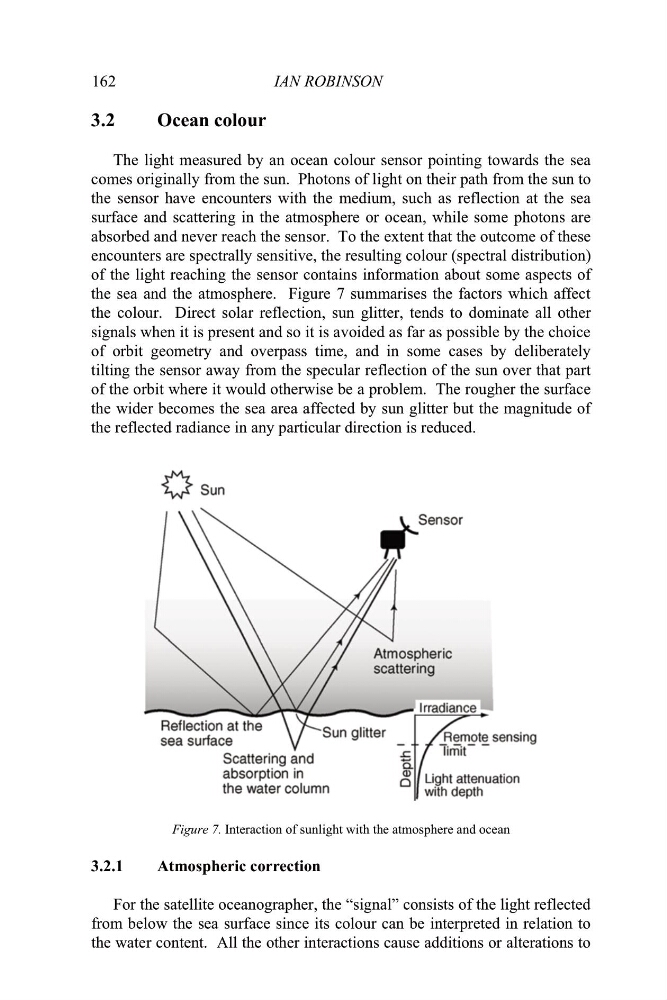
the sea and the atmosphere. Figure 7 summarises the factors which affect
the colour. Direct solar reflection, sun glitter, tends to dominate all other
signals when it is present and so it is avoided as far as possible by the choice
of orbit geometry and overpass time, and in some cases by deliberately
tilting the sensor away from the specular reflection of the sun over that part
of the orbit where it would otherwise be a problem. The rougher the surface
the wider becomes the sea area affected by sun glitter but the magnitude of
the reflected radiance in any particular direction is reduced.
Figure 7. Interaction of sunlight with the atmosphere and ocean
3.2.1
Atmospheric correction
For the satellite oceanographer, the “signal” consists of the light reflected
from below the sea surface since its colour can be interpreted in relation to
the water content. All the other interactions cause additions or alterations to
IAN ROBINSON
3.2
Ocean colour
The light measured by an ocean colour sensor pointing towards the sea
comes originally from the sun. Photons of light on their path from the sun to
the sensor have encounters with the medium, such as reflection at the sea
surface and scattering in the atmosphere or ocean, while some photons are
absorbed and never reach the sensor. To the extent that the outcome of these
encounters are spectrally sensitive, the resulting colour (spectral distribution)
of the light reaching the sensor contains information about some aspects of
the sea and the atmosphere. Figure 7 summarises the factors which affect
the colour. Direct solar reflection, sun glitter, tends to dominate all other
signals when it is present and so it is avoided as far as possible by the choice
of orbit geometry and overpass time, and in some cases by deliberately
tilting the sensor away from the specular reflection of the sun over that part
of the orbit where it would otherwise be a problem. The rougher the surface
the wider becomes the sea area affected by sun glitter but the magnitude of
the reflected radiance in any particular direction is reduced.
Figure 7. Interaction of sunlight with the atmosphere and ocean
3.2.1
Atmospheric correction
For the satellite oceanographer, the “signal” consists of the light reflected
from below the sea surface since its colour can be interpreted in relation to
the water content. All the other interactions cause additions or alterations to