

HYBRID VERTICAL COORDINATES
123
0
50
100
150
200
250
300
20
40
60
80
100
120
140
Year
10
12
m
3
Annual Mean Ice Volume in the Northern Hemisphere
ρ + saln
ρ + spice
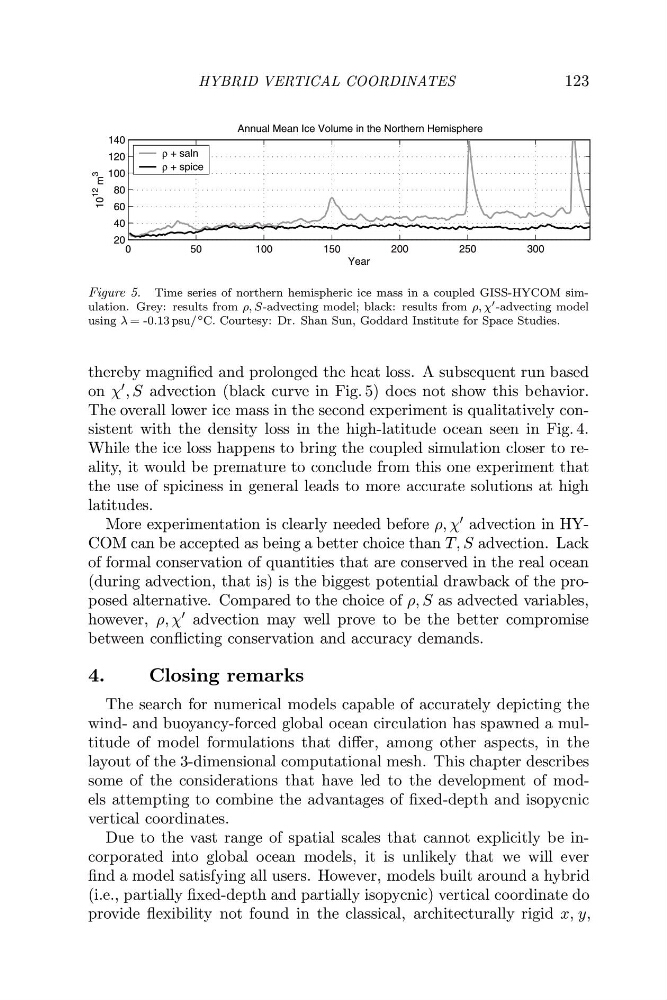
Figure 5. Time series of northern hemispheric ice mass in a coupled GISS-HYCOM simulation. Grey: results from ρ, S-advecting model; black: results from ρ, χ -advecting model
using λ = -0.13 psu/ ◦ C. Courtesy: Dr. Shan Sun, Goddard Institute for Space Studies.
thereby magnified and prolonged the heat loss. A subsequent run based
on χ , S advection (black curve in Fig. 5) does not show this behavior.
The overall lower ice mass in the second experiment is qualitatively consistent with the density loss in the high-latitude ocean seen in Fig. 4.
While the ice loss happens to bring the coupled simulation closer to reality, it would be premature to conclude from this one experiment that
the use of spiciness in general leads to more accurate solutions at high
latitudes.
More experimentation is clearly needed before ρ, χ advection in HYCOM can be accepted as being a better choice than T, S advection. Lack
of formal conservation of quantities that are conserved in the real ocean
(during advection, that is) is the biggest potential drawback of the proposed alternative. Compared to the choice of ρ, S as advected variables,
however, ρ, χ advection may well prove to be the better compromise
between conflicting conservation and accuracy demands.
4.
Closing remarks
The search for numerical models capable of accurately depicting the
wind- and buoyancy-forced global ocean circulation has spawned a multitude of model formulations that differ, among other aspects, in the
layout of the 3-dimensional computational mesh. This chapter describes
some of the considerations that have led to the development of models attempting to combine the advantages of fixed-depth and isopycnic
vertical coordinates.
Due to the vast range of spatial scales that cannot explicitly be incorporated into global ocean models, it is unlikely that we will ever
find a model satisfying all users. However, models built around a hybrid
(i.e., partially fixed-depth and partially isopycnic) vertical coordinate do
provide flexibility not found in the classical, architecturally rigid x, y,
123
0
50
100
150
200
250
300
20
40
60
80
100
120
140
Year
10
12
m
3
Annual Mean Ice Volume in the Northern Hemisphere
ρ + saln
ρ + spice
Figure 5. Time series of northern hemispheric ice mass in a coupled GISS-HYCOM simulation. Grey: results from ρ, S-advecting model; black: results from ρ, χ -advecting model
using λ = -0.13 psu/ ◦ C. Courtesy: Dr. Shan Sun, Goddard Institute for Space Studies.
thereby magnified and prolonged the heat loss. A subsequent run based
on χ , S advection (black curve in Fig. 5) does not show this behavior.
The overall lower ice mass in the second experiment is qualitatively consistent with the density loss in the high-latitude ocean seen in Fig. 4.
While the ice loss happens to bring the coupled simulation closer to reality, it would be premature to conclude from this one experiment that
the use of spiciness in general leads to more accurate solutions at high
latitudes.
More experimentation is clearly needed before ρ, χ advection in HYCOM can be accepted as being a better choice than T, S advection. Lack
of formal conservation of quantities that are conserved in the real ocean
(during advection, that is) is the biggest potential drawback of the proposed alternative. Compared to the choice of ρ, S as advected variables,
however, ρ, χ advection may well prove to be the better compromise
between conflicting conservation and accuracy demands.
4.
Closing remarks
The search for numerical models capable of accurately depicting the
wind- and buoyancy-forced global ocean circulation has spawned a multitude of model formulations that differ, among other aspects, in the
layout of the 3-dimensional computational mesh. This chapter describes
some of the considerations that have led to the development of models attempting to combine the advantages of fixed-depth and isopycnic
vertical coordinates.
Due to the vast range of spatial scales that cannot explicitly be incorporated into global ocean models, it is unlikely that we will ever
find a model satisfying all users. However, models built around a hybrid
(i.e., partially fixed-depth and partially isopycnic) vertical coordinate do
provide flexibility not found in the classical, architecturally rigid x, y,