

HYBRID VERTICAL COORDINATES
merid.sec. 5 4 . 9 0 ~ year
2.50 (ju1.15) HYC.225
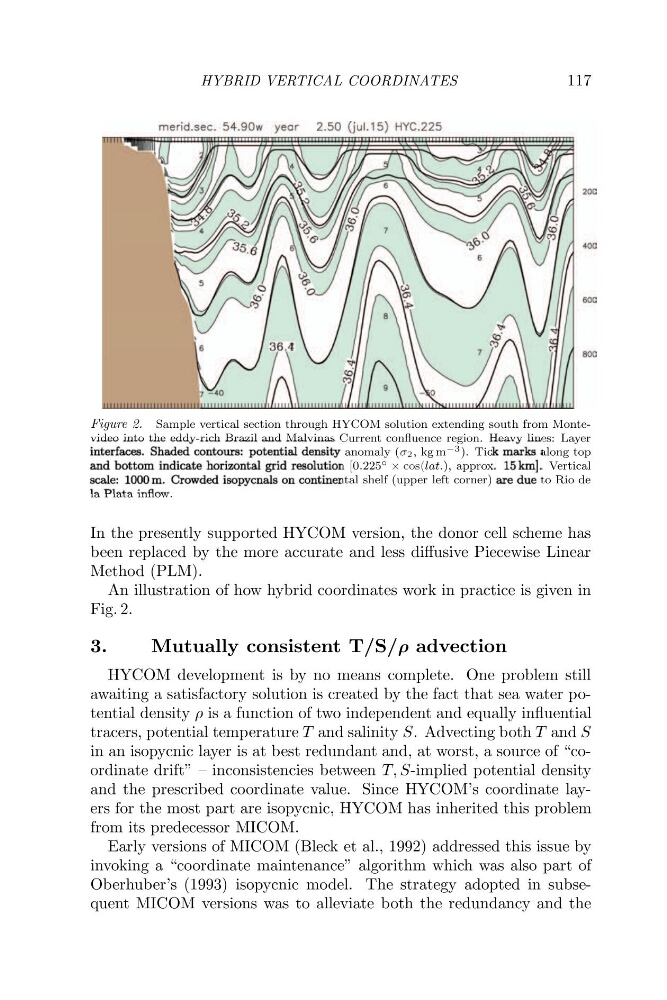
Figure 2. Sample vertical section through HYCOM solution extending south from Monte
video into the eddy-rich Brazil and Malvinas Current confluence region. Heavy lines: Layer
interfaces. Shaded contours: potential density anomaly (uz, kgmP3). Tick marks along top
and bottom indicate horizontal grid resolution [0.225O x cos(lat.), approx. 15 km]. Vertical
scale: 1000 m. Crowded isopycnals on continental shelf (upper left corner) are due to Rio de
la Plata inflow.
In the presently supported HYCOM version, the donor cell scheme has
been replaced by the more accurate and less diffusive Piecewise Linear
Method (PLM) .
An illustration of how hybrid coordinates work in practice is given in
Fig. 2.
3.
Mutually consistent T/S/p advection
HYCOM development is by no means complete. One problem still
awaiting a satisfactory solution is created by the fact that sea water potential density p is a function of two independent and equally influential
tracers, potential temperature T and salinity S. Advecting both T and S
in an isopycnic layer is at best redundant and, at worst, a source of "coordinate drift" - inconsistencies between T, S-implied potential density
and the prescribed coordinate value. Since HYCOM's coordinate layers for the most part are isopycnic, HYCOM has inherited this problem
from its predecessor MICOM.
Early versions of MICOM (Bleck et al., 1992) addressed this issue by
invoking a "coordinate maintenance" algorithm which was also part of
Oberhuber's (1993) isopycnic model. The strategy adopted in subsequent MICOM versions was to alleviate both the redundancy and the
merid.sec. 5 4 . 9 0 ~ year
2.50 (ju1.15) HYC.225
Figure 2. Sample vertical section through HYCOM solution extending south from Monte
video into the eddy-rich Brazil and Malvinas Current confluence region. Heavy lines: Layer
interfaces. Shaded contours: potential density anomaly (uz, kgmP3). Tick marks along top
and bottom indicate horizontal grid resolution [0.225O x cos(lat.), approx. 15 km]. Vertical
scale: 1000 m. Crowded isopycnals on continental shelf (upper left corner) are due to Rio de
la Plata inflow.
In the presently supported HYCOM version, the donor cell scheme has
been replaced by the more accurate and less diffusive Piecewise Linear
Method (PLM) .
An illustration of how hybrid coordinates work in practice is given in
Fig. 2.
3.
Mutually consistent T/S/p advection
HYCOM development is by no means complete. One problem still
awaiting a satisfactory solution is created by the fact that sea water potential density p is a function of two independent and equally influential
tracers, potential temperature T and salinity S. Advecting both T and S
in an isopycnic layer is at best redundant and, at worst, a source of "coordinate drift" - inconsistencies between T, S-implied potential density
and the prescribed coordinate value. Since HYCOM's coordinate layers for the most part are isopycnic, HYCOM has inherited this problem
from its predecessor MICOM.
Early versions of MICOM (Bleck et al., 1992) addressed this issue by
invoking a "coordinate maintenance" algorithm which was also part of
Oberhuber's (1993) isopycnic model. The strategy adopted in subsequent MICOM versions was to alleviate both the redundancy and the