

ANNE-MARIE TREGUIER
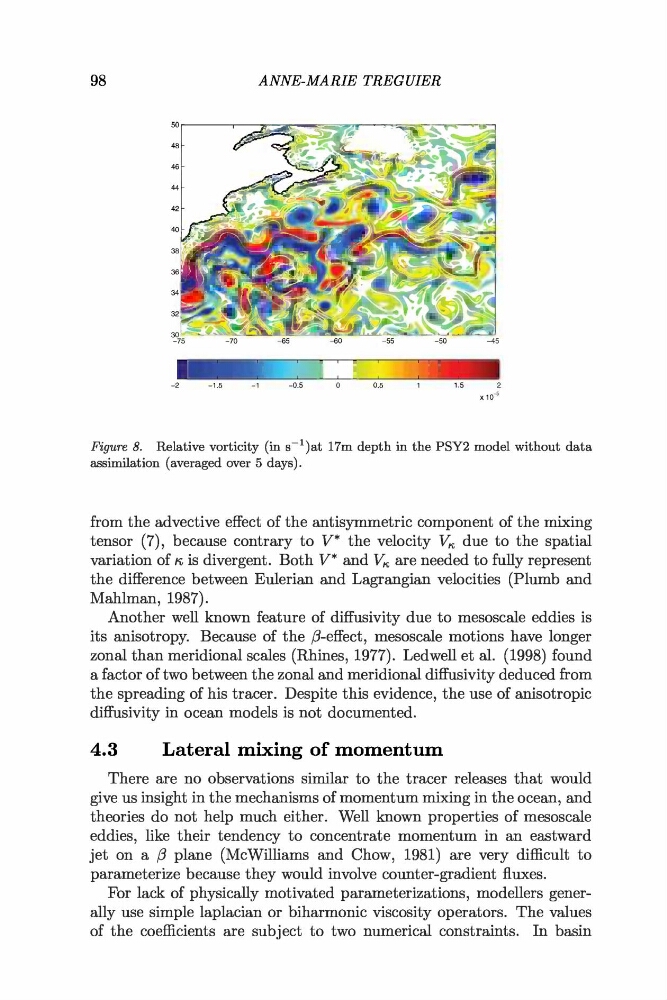
Figure 8. Relative vorticity (in sP1)at 17m depth in the PSY2 model without data
assimilation (averaged over 5 days).
from the advective effect of the antisymmetric component of the mixing
tensor (7), because contrary to V* the velocity V , due to the spatial
variation of 6 is divergent. Both V* and V , are needed to fully represent
the difference between Eulerian and Lagrangian velocities (Plumb and
Mahlman, 1987).
Another well known feature of diffusivity due to mesoscale eddies is
its anisotropy. Because of the P-effect, mesoscale motions have longer
zonal than meridional scales (Rhines, 1977). Ledwell et al. (1998) found
a factor of two between the zonal and meridional diffusivity deduced from
the spreading of his tracer. Despite this evidence, the use of anisotropic
diffusivity in ocean models is not documented.
Lateral mixing of momentum
There are no observations similar to the tracer releases that would
give us insight in the mechanisms of momentum mixing in the ocean, and
theories do not help much either. Well known properties of mesoscale
eddies, like their tendency to concentrate momentum in an eastward
jet on a ,B plane (McWilliams and Chow, 1981) are very difficult to
parameterize because they would involve counter-gradient fluxes.
For lack of physically motivated parameterizations, modellers generally use simple laplacian or biharmonic viscosity operators. The values
of the coefficients are subject to two numerical constraints. In basin
Figure 8. Relative vorticity (in sP1)at 17m depth in the PSY2 model without data
assimilation (averaged over 5 days).
from the advective effect of the antisymmetric component of the mixing
tensor (7), because contrary to V* the velocity V , due to the spatial
variation of 6 is divergent. Both V* and V , are needed to fully represent
the difference between Eulerian and Lagrangian velocities (Plumb and
Mahlman, 1987).
Another well known feature of diffusivity due to mesoscale eddies is
its anisotropy. Because of the P-effect, mesoscale motions have longer
zonal than meridional scales (Rhines, 1977). Ledwell et al. (1998) found
a factor of two between the zonal and meridional diffusivity deduced from
the spreading of his tracer. Despite this evidence, the use of anisotropic
diffusivity in ocean models is not documented.
Lateral mixing of momentum
There are no observations similar to the tracer releases that would
give us insight in the mechanisms of momentum mixing in the ocean, and
theories do not help much either. Well known properties of mesoscale
eddies, like their tendency to concentrate momentum in an eastward
jet on a ,B plane (McWilliams and Chow, 1981) are very difficult to
parameterize because they would involve counter-gradient fluxes.
For lack of physically motivated parameterizations, modellers generally use simple laplacian or biharmonic viscosity operators. The values
of the coefficients are subject to two numerical constraints. In basin