

3.23 Estuaries
83
The dynamic instability produces vigorous vertical mixing via the breaking of
internal waves. Interestingly, at later times of the simulation, velocity shear owing to
bottom friction creates a series of clockwise-rotating vortices that “roll” downward
on the slope and interact with previously created vortices that have detached from
the sea floor.
3.22.4 Additional Exercise for the Reader
Conduct a reference experiment with a small bottom inclination of, say, 1 degree.
Explore whether this slope is sufficient to create dynamical instabilities. If not,
increase the bottom inclination in additional experiments until the vertical shear
of the near-bottom flow is at a level to produce dynamical instabilities.
3.23 Estuaries
3.23.1 Definition
Estuaries are semi-enclosed and narrow bodies of water that are connected to the
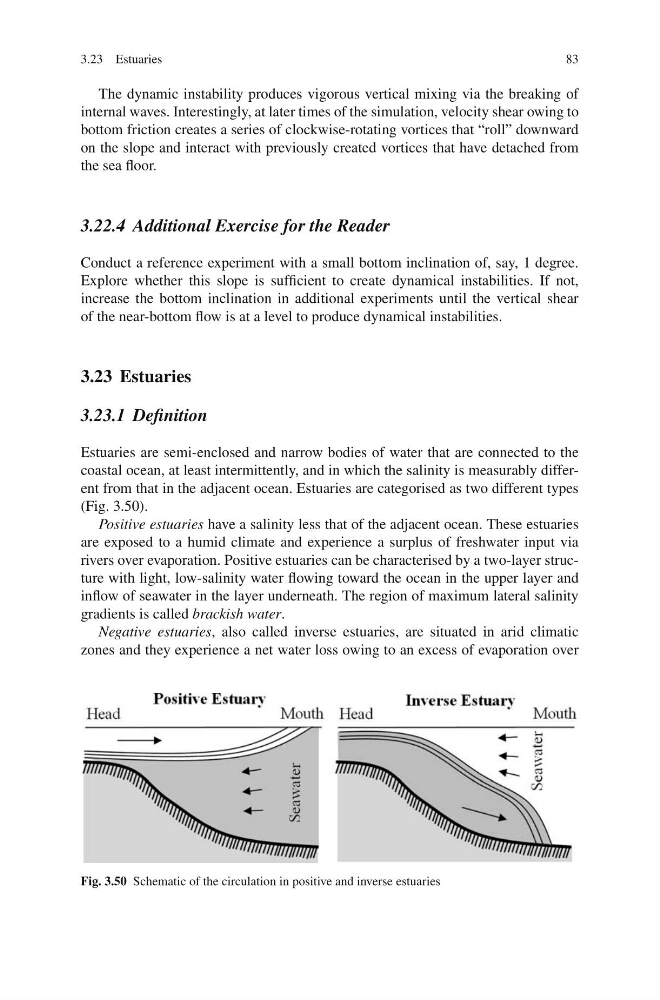
coastal ocean, at least intermittently, and in which the salinity is measurably different from that in the adjacent ocean. Estuaries are categorised as two different types
(Fig. 3.50).
Positive estuaries have a salinity less that of the adjacent ocean. These estuaries
are exposed to a humid climate and experience a surplus of freshwater input via
rivers over evaporation. Positive estuaries can be characterised by a two-layer structure with light, low-salinity water flowing toward the ocean in the upper layer and
inflow of seawater in the layer underneath. The region of maximum lateral salinity
gradients is called brackish water.
Negative estuaries, also called inverse estuaries, are situated in arid climatic
zones and they experience a net water loss owing to an excess of evaporation over
Fig. 3.50 Schematic of the circulation in positive and inverse estuaries
83
The dynamic instability produces vigorous vertical mixing via the breaking of
internal waves. Interestingly, at later times of the simulation, velocity shear owing to
bottom friction creates a series of clockwise-rotating vortices that “roll” downward
on the slope and interact with previously created vortices that have detached from
the sea floor.
3.22.4 Additional Exercise for the Reader
Conduct a reference experiment with a small bottom inclination of, say, 1 degree.
Explore whether this slope is sufficient to create dynamical instabilities. If not,
increase the bottom inclination in additional experiments until the vertical shear
of the near-bottom flow is at a level to produce dynamical instabilities.
3.23 Estuaries
3.23.1 Definition
Estuaries are semi-enclosed and narrow bodies of water that are connected to the
coastal ocean, at least intermittently, and in which the salinity is measurably different from that in the adjacent ocean. Estuaries are categorised as two different types
(Fig. 3.50).
Positive estuaries have a salinity less that of the adjacent ocean. These estuaries
are exposed to a humid climate and experience a surplus of freshwater input via
rivers over evaporation. Positive estuaries can be characterised by a two-layer structure with light, low-salinity water flowing toward the ocean in the upper layer and
inflow of seawater in the layer underneath. The region of maximum lateral salinity
gradients is called brackish water.
Negative estuaries, also called inverse estuaries, are situated in arid climatic
zones and they experience a net water loss owing to an excess of evaporation over
Fig. 3.50 Schematic of the circulation in positive and inverse estuaries