

3.15 Exercise 8: Free Convection
63
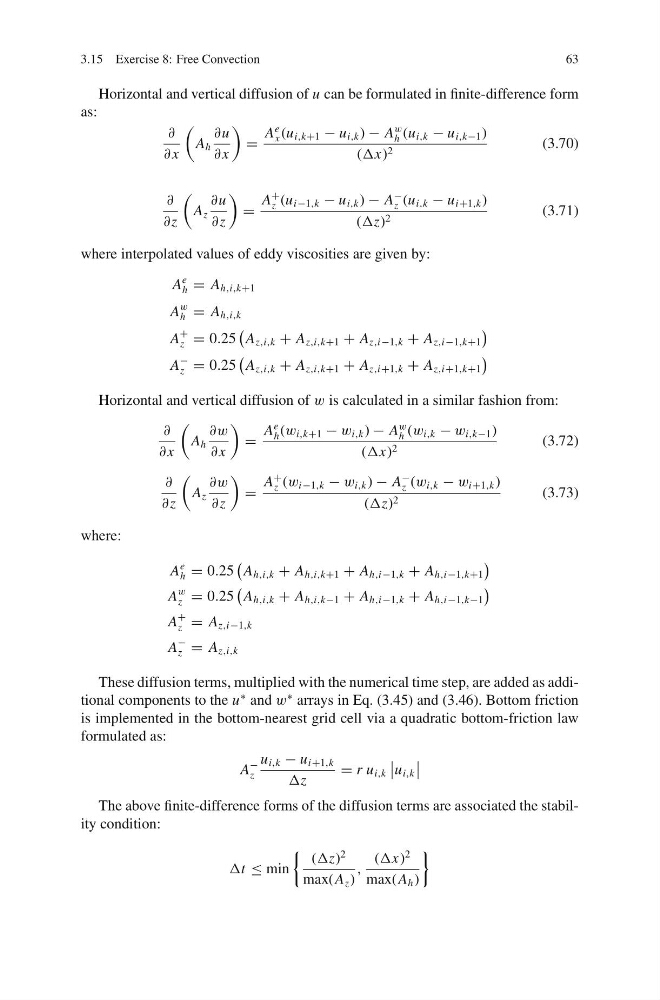
Horizontal and vertical diffusion of u can be formulated in finite-difference form
as:
∂
∂ x
A h
∂u
∂ x
=
A
e
x (u i,k+1 − u i,k ) − A
w
h (u i,k − u i,k−1 )
(Δx) 2
(3.70)
∂
∂z
A z
∂u
∂z
=
A
+
z (u i−1,k − u i,k ) − A
−
z (u i,k − u i+1,k )
(Δz) 2
(3.71)
where interpolated values of eddy viscosities are given by:
A
e
h = A h,i,k+1
A
w
h = A h,i,k
A
+
z = 0.25
A z,i,k + A z,i,k+1 + A z,i−1,k + A z,i−1,k+1
A
−
z = 0.25
A z,i,k + A z,i,k+1 + A z,i+1,k + A z,i+1,k+1
Horizontal and vertical diffusion of w is calculated in a similar fashion from:
∂
∂ x
A h
∂w
∂ x
=
A
e
h (w i,k+1 − w i,k ) − A
w
h (w i,k − w i,k−1 )
(Δx) 2
(3.72)
∂
∂z
A z
∂w
∂z
=
A
+
z (w i−1,k − w i,k ) − A
−
z (w i,k − w i+1,k )
(Δz) 2
(3.73)
where:
A
e
h = 0.25
A h,i,k + A h,i,k+1 + A h,i−1,k + A h,i−1,k+1
A
w
z = 0.25
A h,i,k + A h,i,k−1 + A h,i−1,k + A h,i−1,k−1
A
+
z = A z,i−1,k
A
−
z = A z,i,k
These diffusion terms, multiplied with the numerical time step, are added as additional components to the u
∗ and w
∗ arrays in Eq. (3.45) and (3.46). Bottom friction
is implemented in the bottom-nearest grid cell via a quadratic bottom-friction law
formulated as:
A
−
z
u i,k − u i+1,k
Δz
= r u i,k
u i,k
The above finite-difference forms of the diffusion terms are associated the stability condition:
Δt ≤ min
(Δz)
2
max(A z )
,
(Δx)
2
max(A h )
63
Horizontal and vertical diffusion of u can be formulated in finite-difference form
as:
∂
∂ x
A h
∂u
∂ x
=
A
e
x (u i,k+1 − u i,k ) − A
w
h (u i,k − u i,k−1 )
(Δx) 2
(3.70)
∂
∂z
A z
∂u
∂z
=
A
+
z (u i−1,k − u i,k ) − A
−
z (u i,k − u i+1,k )
(Δz) 2
(3.71)
where interpolated values of eddy viscosities are given by:
A
e
h = A h,i,k+1
A
w
h = A h,i,k
A
+
z = 0.25
A z,i,k + A z,i,k+1 + A z,i−1,k + A z,i−1,k+1
A
−
z = 0.25
A z,i,k + A z,i,k+1 + A z,i+1,k + A z,i+1,k+1
Horizontal and vertical diffusion of w is calculated in a similar fashion from:
∂
∂ x
A h
∂w
∂ x
=
A
e
h (w i,k+1 − w i,k ) − A
w
h (w i,k − w i,k−1 )
(Δx) 2
(3.72)
∂
∂z
A z
∂w
∂z
=
A
+
z (w i−1,k − w i,k ) − A
−
z (w i,k − w i+1,k )
(Δz) 2
(3.73)
where:
A
e
h = 0.25
A h,i,k + A h,i,k+1 + A h,i−1,k + A h,i−1,k+1
A
w
z = 0.25
A h,i,k + A h,i,k−1 + A h,i−1,k + A h,i−1,k−1
A
+
z = A z,i−1,k
A
−
z = A z,i,k
These diffusion terms, multiplied with the numerical time step, are added as additional components to the u
∗ and w
∗ arrays in Eq. (3.45) and (3.46). Bottom friction
is implemented in the bottom-nearest grid cell via a quadratic bottom-friction law
formulated as:
A
−
z
u i,k − u i+1,k
Δz
= r u i,k
u i,k
The above finite-difference forms of the diffusion terms are associated the stability condition:
Δt ≤ min
(Δz)
2
max(A z )
,
(Δx)
2
max(A h )