

56
3 Basics of Nonhydrostatic Modelling
to a Froude number of unity. We anticipate that stronger density stratification leads
to smaller amplitudes of lee waves.
3.13.3 Results: Two-Layer Stratification
Existence of a pycnocline supports the creation of long interfacial waves of a phase
speed of (e.g. Pond and Pickard, 1983):
c =
g h ∗
(3.63)
where reduced gravity is g
= Δρ/ρ o g with Δρ being the difference in layer
densities, and the reduced depth scale is given by: h
∗ = H 1 H 2 /(H 1 + H 2 ), where
H 1 and H 2 , are the initial thicknesses of the upper and lower layers.
In contrast to long internal waves in a fluid of continuous density stratification,
the phase speed of such waves is independent of wavelength. In this situation, the
creation of a hydraulic jump exclusively depends on whether the incident flow is
swift enough to become supercritical over the sill. For the density configuration
of Scenario 2, the phase speed of interfacial waves is about 50 cm/s upstream the
topographic obstacle, but decreases to 28 cm/s over the hill. The occurrence of a
hydraulic jump and lee wave formation requires an ambient flow of speed exceeding
30 cm/s.
The choice of a sea-level gradient of 0.1 cm over the length of the model domain
creates an ambient flow of maximum speed of 16 cm/s over the sill, which is not
sufficient to create a hydraulic jump (not shown). The reader can easily verify
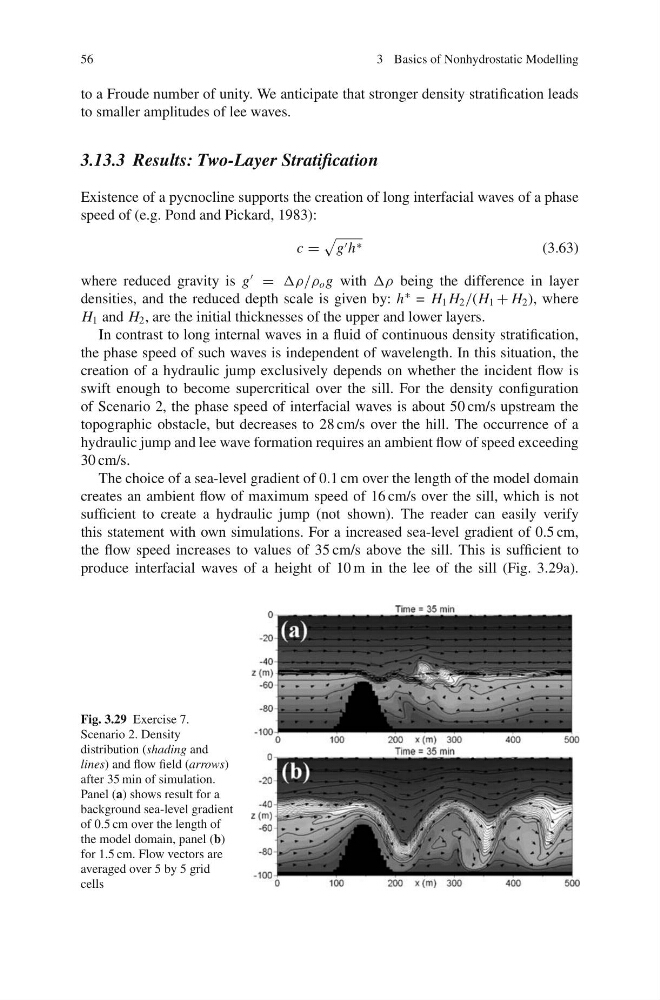
this statement with own simulations. For a increased sea-level gradient of 0.5 cm,
the flow speed increases to values of 35 cm/s above the sill. This is sufficient to
produce interfacial waves of a height of 10 m in the lee of the sill (Fig. 3.29a).
Fig. 3.29 Exercise 7.
Scenario 2. Density
distribution (shading and
lines) and flow field (arrows)
after 35 min of simulation.
Panel (a) shows result for a
background sea-level gradient
of 0.5 cm over the length of
the model domain, panel (b)
for 1.5 cm. Flow vectors are
averaged over 5 by 5 grid
cells
3 Basics of Nonhydrostatic Modelling
to a Froude number of unity. We anticipate that stronger density stratification leads
to smaller amplitudes of lee waves.
3.13.3 Results: Two-Layer Stratification
Existence of a pycnocline supports the creation of long interfacial waves of a phase
speed of (e.g. Pond and Pickard, 1983):
c =
g h ∗
(3.63)
where reduced gravity is g
= Δρ/ρ o g with Δρ being the difference in layer
densities, and the reduced depth scale is given by: h
∗ = H 1 H 2 /(H 1 + H 2 ), where
H 1 and H 2 , are the initial thicknesses of the upper and lower layers.
In contrast to long internal waves in a fluid of continuous density stratification,
the phase speed of such waves is independent of wavelength. In this situation, the
creation of a hydraulic jump exclusively depends on whether the incident flow is
swift enough to become supercritical over the sill. For the density configuration
of Scenario 2, the phase speed of interfacial waves is about 50 cm/s upstream the
topographic obstacle, but decreases to 28 cm/s over the hill. The occurrence of a
hydraulic jump and lee wave formation requires an ambient flow of speed exceeding
30 cm/s.
The choice of a sea-level gradient of 0.1 cm over the length of the model domain
creates an ambient flow of maximum speed of 16 cm/s over the sill, which is not
sufficient to create a hydraulic jump (not shown). The reader can easily verify
this statement with own simulations. For a increased sea-level gradient of 0.5 cm,
the flow speed increases to values of 35 cm/s above the sill. This is sufficient to
produce interfacial waves of a height of 10 m in the lee of the sill (Fig. 3.29a).
Fig. 3.29 Exercise 7.
Scenario 2. Density
distribution (shading and
lines) and flow field (arrows)
after 35 min of simulation.
Panel (a) shows result for a
background sea-level gradient
of 0.5 cm over the length of
the model domain, panel (b)
for 1.5 cm. Flow vectors are
averaged over 5 by 5 grid
cells