

3.10 Mechanical Turbulence
49
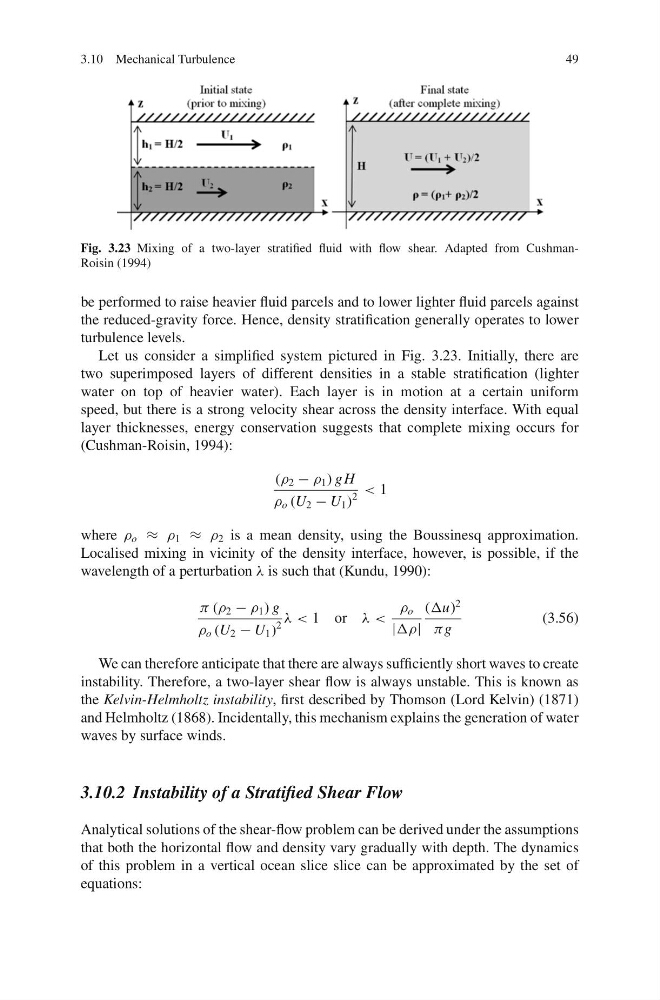
Fig. 3.23 Mixing of a two-layer stratified fluid with flow shear. Adapted from CushmanRoisin (1994)
be performed to raise heavier fluid parcels and to lower lighter fluid parcels against
the reduced-gravity force. Hence, density stratification generally operates to lower
turbulence levels.
Let us consider a simplified system pictured in Fig. 3.23. Initially, there are
two superimposed layers of different densities in a stable stratification (lighter
water on top of heavier water). Each layer is in motion at a certain uniform
speed, but there is a strong velocity shear across the density interface. With equal
layer thicknesses, energy conservation suggests that complete mixing occurs for
(Cushman-Roisin, 1994):
(ρ 2 − ρ 1 ) g H
ρ o (U 2 − U 1 )
2
< 1
where ρ o ≈ ρ 1 ≈ ρ 2 is a mean density, using the Boussinesq approximation.
Localised mixing in vicinity of the density interface, however, is possible, if the
wavelength of a perturbation λ is such that (Kundu, 1990):
π (ρ 2 − ρ 1 ) g
ρ o (U 2 − U 1 )
2
λ < 1 or λ <
ρ o
|Δρ|
(Δu)
2
πg
(3.56)
We can therefore anticipate that there are always sufficiently short waves to create
instability. Therefore, a two-layer shear flow is always unstable. This is known as
the Kelvin-Helmholtz instability, first described by Thomson (Lord Kelvin) (1871)
and Helmholtz (1868). Incidentally, this mechanism explains the generation of water
waves by surface winds.
3.10.2 Instability of a Stratified Shear Flow
Analytical solutions of the shear-flow problem can be derived under the assumptions
that both the horizontal flow and density vary gradually with depth. The dynamics
of this problem in a vertical ocean slice slice can be approximated by the set of
equations:
49
Fig. 3.23 Mixing of a two-layer stratified fluid with flow shear. Adapted from CushmanRoisin (1994)
be performed to raise heavier fluid parcels and to lower lighter fluid parcels against
the reduced-gravity force. Hence, density stratification generally operates to lower
turbulence levels.
Let us consider a simplified system pictured in Fig. 3.23. Initially, there are
two superimposed layers of different densities in a stable stratification (lighter
water on top of heavier water). Each layer is in motion at a certain uniform
speed, but there is a strong velocity shear across the density interface. With equal
layer thicknesses, energy conservation suggests that complete mixing occurs for
(Cushman-Roisin, 1994):
(ρ 2 − ρ 1 ) g H
ρ o (U 2 − U 1 )
2
< 1
where ρ o ≈ ρ 1 ≈ ρ 2 is a mean density, using the Boussinesq approximation.
Localised mixing in vicinity of the density interface, however, is possible, if the
wavelength of a perturbation λ is such that (Kundu, 1990):
π (ρ 2 − ρ 1 ) g
ρ o (U 2 − U 1 )
2
λ < 1 or λ <
ρ o
|Δρ|
(Δu)
2
πg
(3.56)
We can therefore anticipate that there are always sufficiently short waves to create
instability. Therefore, a two-layer shear flow is always unstable. This is known as
the Kelvin-Helmholtz instability, first described by Thomson (Lord Kelvin) (1871)
and Helmholtz (1868). Incidentally, this mechanism explains the generation of water
waves by surface winds.
3.10.2 Instability of a Stratified Shear Flow
Analytical solutions of the shear-flow problem can be derived under the assumptions
that both the horizontal flow and density vary gradually with depth. The dynamics
of this problem in a vertical ocean slice slice can be approximated by the set of
equations: