

126
5 3D Level Modelling
where z is the vertical coordinate, ρ is true density, ρ o is surface density, g is acceleration due to gravity. The second pressure contribution q appears implicitly in the
momentum equations and cannot be derived in an explicit manner. The momentum
equations can be written as:
∂u
∂t
+ Adv(u) − f v = −
1
ρ o
∂( p + q)
∂ x
+ Diff(u)
∂v
∂t
+ Adv(v) + f u = −
1
ρ o
∂( p + q)
∂ y
+ Diff(v)
(5.3)
∂w
∂t
+ Adv(w) = −
1
ρ o
∂q
∂z
+ Diff(w)
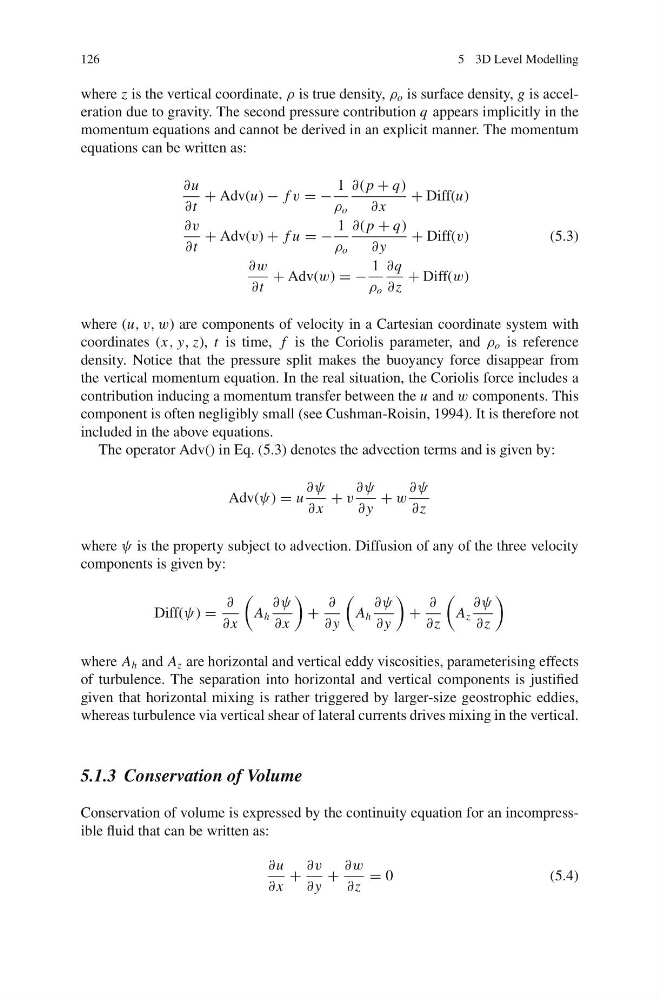
where (u, v, w) are components of velocity in a Cartesian coordinate system with
coordinates (x, y, z), t is time, f is the Coriolis parameter, and ρ o is reference
density. Notice that the pressure split makes the buoyancy force disappear from
the vertical momentum equation. In the real situation, the Coriolis force includes a
contribution inducing a momentum transfer between the u and w components. This
component is often negligibly small (see Cushman-Roisin, 1994). It is therefore not
included in the above equations.
The operator Adv() in Eq. (5.3) denotes the advection terms and is given by:
Adv(ψ) = u
∂ψ
∂ x
+ v
∂ψ
∂ y
+ w
∂ψ
∂z
where ψ is the property subject to advection. Diffusion of any of the three velocity
components is given by:
Diff(ψ) =
∂
∂ x
A h
∂ψ
∂ x
+
∂
∂ y
A h
∂ψ
∂ y
+
∂
∂z
A z
∂ψ
∂z
where A h and A z are horizontal and vertical eddy viscosities, parameterising effects
of turbulence. The separation into horizontal and vertical components is justified
given that horizontal mixing is rather triggered by larger-size geostrophic eddies,
whereas turbulence via vertical shear of lateral currents drives mixing in the vertical.
5.1.3 Conservation of Volume
Conservation of volume is expressed by the continuity equation for an incompressible fluid that can be written as:
∂u
∂ x
+
∂v
∂ y
+
∂w
∂z
= 0
(5.4)
5 3D Level Modelling
where z is the vertical coordinate, ρ is true density, ρ o is surface density, g is acceleration due to gravity. The second pressure contribution q appears implicitly in the
momentum equations and cannot be derived in an explicit manner. The momentum
equations can be written as:
∂u
∂t
+ Adv(u) − f v = −
1
ρ o
∂( p + q)
∂ x
+ Diff(u)
∂v
∂t
+ Adv(v) + f u = −
1
ρ o
∂( p + q)
∂ y
+ Diff(v)
(5.3)
∂w
∂t
+ Adv(w) = −
1
ρ o
∂q
∂z
+ Diff(w)
where (u, v, w) are components of velocity in a Cartesian coordinate system with
coordinates (x, y, z), t is time, f is the Coriolis parameter, and ρ o is reference
density. Notice that the pressure split makes the buoyancy force disappear from
the vertical momentum equation. In the real situation, the Coriolis force includes a
contribution inducing a momentum transfer between the u and w components. This
component is often negligibly small (see Cushman-Roisin, 1994). It is therefore not
included in the above equations.
The operator Adv() in Eq. (5.3) denotes the advection terms and is given by:
Adv(ψ) = u
∂ψ
∂ x
+ v
∂ψ
∂ y
+ w
∂ψ
∂z
where ψ is the property subject to advection. Diffusion of any of the three velocity
components is given by:
Diff(ψ) =
∂
∂ x
A h
∂ψ
∂ x
+
∂
∂ y
A h
∂ψ
∂ y
+
∂
∂z
A z
∂ψ
∂z
where A h and A z are horizontal and vertical eddy viscosities, parameterising effects
of turbulence. The separation into horizontal and vertical components is justified
given that horizontal mixing is rather triggered by larger-size geostrophic eddies,
whereas turbulence via vertical shear of lateral currents drives mixing in the vertical.
5.1.3 Conservation of Volume
Conservation of volume is expressed by the continuity equation for an incompressible fluid that can be written as:
∂u
∂ x
+
∂v
∂ y
+
∂w
∂z
= 0
(5.4)