

Chapter 4
Long Waves in a Channel
Abstract This chapter introduces the reader to the modelling of layered fl ws in
one-dimensional channel applications including a simple floodin algorithm. Practical exercises address a variety of processes including shallow-water surface waves,
tsunamis and interfacial waves in a multi-layer fluid
4.1 More on Finite Differences
4.1.1 Taylor Series
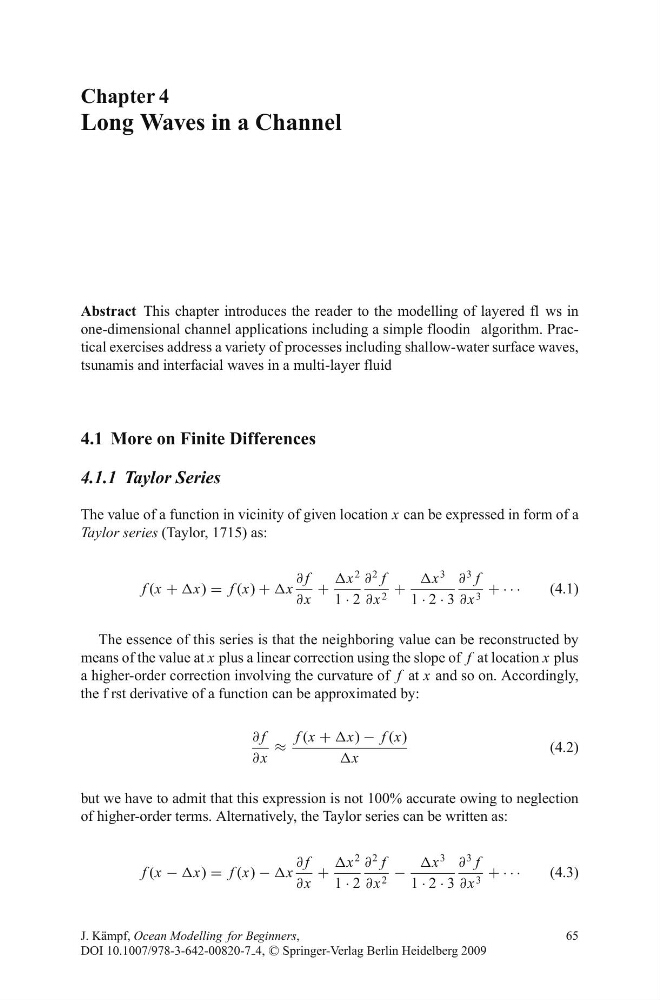
The value of a function in vicinity of given location x can be expressed in form of a
Taylor series (Taylor, 1715) as:
f (x + Δx) = f (x) + Δx
∂ f
∂ x
+
Δx
2
1 · 2
∂
2
f
∂ x 2 +
Δx
3
1 · 2 · 3
∂
3
f
∂ x 3 + · · ·
(4.1)
The essence of this series is that the neighboring value can be reconstructed by
means of the value at x plus a linear correction using the slope of f at location x plus
a higher-order correction involving the curvature of f at x and so on. Accordingly,
the f rst derivative of a function can be approximated by:
∂ f
∂ x
≈
f (x + Δx) − f (x)
Δx
(4.2)
but we have to admit that this expression is not 100% accurate owing to neglection
of higher-order terms. Alternatively, the Taylor series can be written as:
f (x − Δx) = f (x) − Δx
∂ f
∂ x
+
Δx
2
1 · 2
∂
2
f
∂ x 2 −
Δx
3
1 · 2 · 3
∂
3
f
∂ x 3 + · · ·
(4.3)
J. K¨ ampf, Ocean Modelling for Beginners,
DOI 10.1007/978-3-642-00820-7 4, C
Springer-Verlag Berlin Heidelberg 2009
65
Long Waves in a Channel
Abstract This chapter introduces the reader to the modelling of layered fl ws in
one-dimensional channel applications including a simple floodin algorithm. Practical exercises address a variety of processes including shallow-water surface waves,
tsunamis and interfacial waves in a multi-layer fluid
4.1 More on Finite Differences
4.1.1 Taylor Series
The value of a function in vicinity of given location x can be expressed in form of a
Taylor series (Taylor, 1715) as:
f (x + Δx) = f (x) + Δx
∂ f
∂ x
+
Δx
2
1 · 2
∂
2
f
∂ x 2 +
Δx
3
1 · 2 · 3
∂
3
f
∂ x 3 + · · ·
(4.1)
The essence of this series is that the neighboring value can be reconstructed by
means of the value at x plus a linear correction using the slope of f at location x plus
a higher-order correction involving the curvature of f at x and so on. Accordingly,
the f rst derivative of a function can be approximated by:
∂ f
∂ x
≈
f (x + Δx) − f (x)
Δx
(4.2)
but we have to admit that this expression is not 100% accurate owing to neglection
of higher-order terms. Alternatively, the Taylor series can be written as:
f (x − Δx) = f (x) − Δx
∂ f
∂ x
+
Δx
2
1 · 2
∂
2
f
∂ x 2 −
Δx
3
1 · 2 · 3
∂
3
f
∂ x 3 + · · ·
(4.3)
J. K¨ ampf, Ocean Modelling for Beginners,
DOI 10.1007/978-3-642-00820-7 4, C
Springer-Verlag Berlin Heidelberg 2009
65