

62
3 Basics of Geophysical Fluid Dynamics
to ask is whether we need to include the nonlinear terms and the Coriolis force in
the momentum equations, or can either or both of these terms be neglected under
certain circumstances?
3.17.2 Example of Scaling
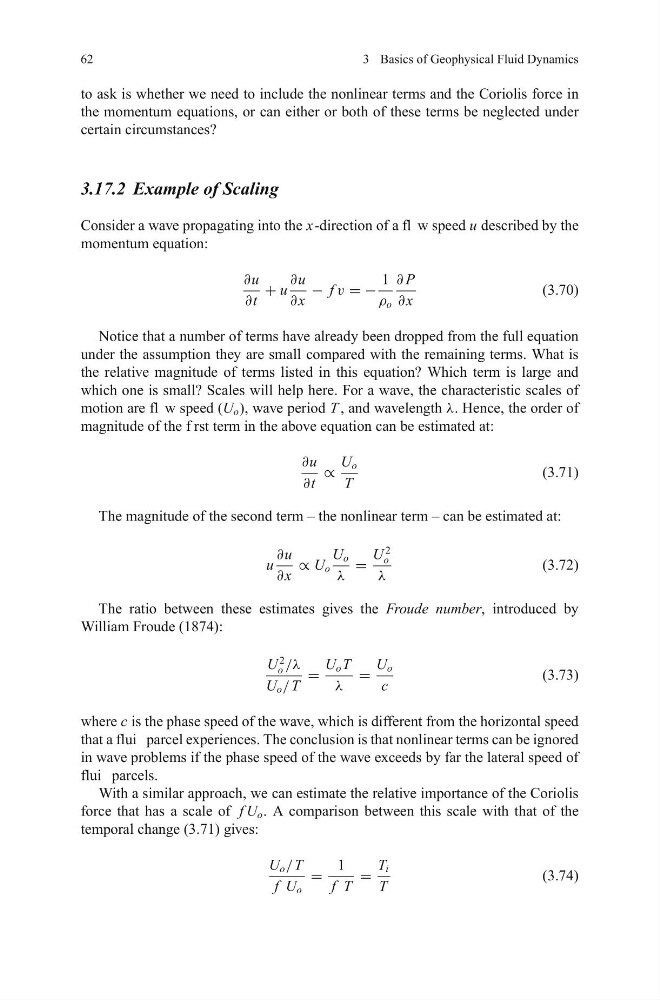
Consider a wave propagating into the x-direction of a fl w speed u described by the
momentum equation:
∂u
∂t
+ u
∂u
∂ x
− f v = −
1
ρ o
∂ P
∂ x
(3.70)
Notice that a number of terms have already been dropped from the full equation
under the assumption they are small compared with the remaining terms. What is
the relative magnitude of terms listed in this equation? Which term is large and
which one is small? Scales will help here. For a wave, the characteristic scales of
motion are fl w speed (U o ), wave period T , and wavelength λ. Hence, the order of
magnitude of the f rst term in the above equation can be estimated at:
∂u
∂t
∝
U o
T
(3.71)
The magnitude of the second term – the nonlinear term – can be estimated at:
u
∂u
∂ x
∝ U o
U o
λ
=
U
2
o
λ
(3.72)
The ratio between these estimates gives the Froude number, introduced by
William Froude (1874):
U
2
o /λ
U o /T
=
U o T
λ
=
U o
c
(3.73)
where c is the phase speed of the wave, which is different from the horizontal speed
that a flui parcel experiences. The conclusion is that nonlinear terms can be ignored
in wave problems if the phase speed of the wave exceeds by far the lateral speed of
flui parcels.
With a similar approach, we can estimate the relative importance of the Coriolis
force that has a scale of f U o . A comparison between this scale with that of the
temporal change (3.71) gives:
U o /T
f U o
=
1
f T
=
T i
T
(3.74)
3 Basics of Geophysical Fluid Dynamics
to ask is whether we need to include the nonlinear terms and the Coriolis force in
the momentum equations, or can either or both of these terms be neglected under
certain circumstances?
3.17.2 Example of Scaling
Consider a wave propagating into the x-direction of a fl w speed u described by the
momentum equation:
∂u
∂t
+ u
∂u
∂ x
− f v = −
1
ρ o
∂ P
∂ x
(3.70)
Notice that a number of terms have already been dropped from the full equation
under the assumption they are small compared with the remaining terms. What is
the relative magnitude of terms listed in this equation? Which term is large and
which one is small? Scales will help here. For a wave, the characteristic scales of
motion are fl w speed (U o ), wave period T , and wavelength λ. Hence, the order of
magnitude of the f rst term in the above equation can be estimated at:
∂u
∂t
∝
U o
T
(3.71)
The magnitude of the second term – the nonlinear term – can be estimated at:
u
∂u
∂ x
∝ U o
U o
λ
=
U
2
o
λ
(3.72)
The ratio between these estimates gives the Froude number, introduced by
William Froude (1874):
U
2
o /λ
U o /T
=
U o T
λ
=
U o
c
(3.73)
where c is the phase speed of the wave, which is different from the horizontal speed
that a flui parcel experiences. The conclusion is that nonlinear terms can be ignored
in wave problems if the phase speed of the wave exceeds by far the lateral speed of
flui parcels.
With a similar approach, we can estimate the relative importance of the Coriolis
force that has a scale of f U o . A comparison between this scale with that of the
temporal change (3.71) gives:
U o /T
f U o
=
1
f T
=
T i
T
(3.74)