

3.13 The Coriolis Force on Earth
51
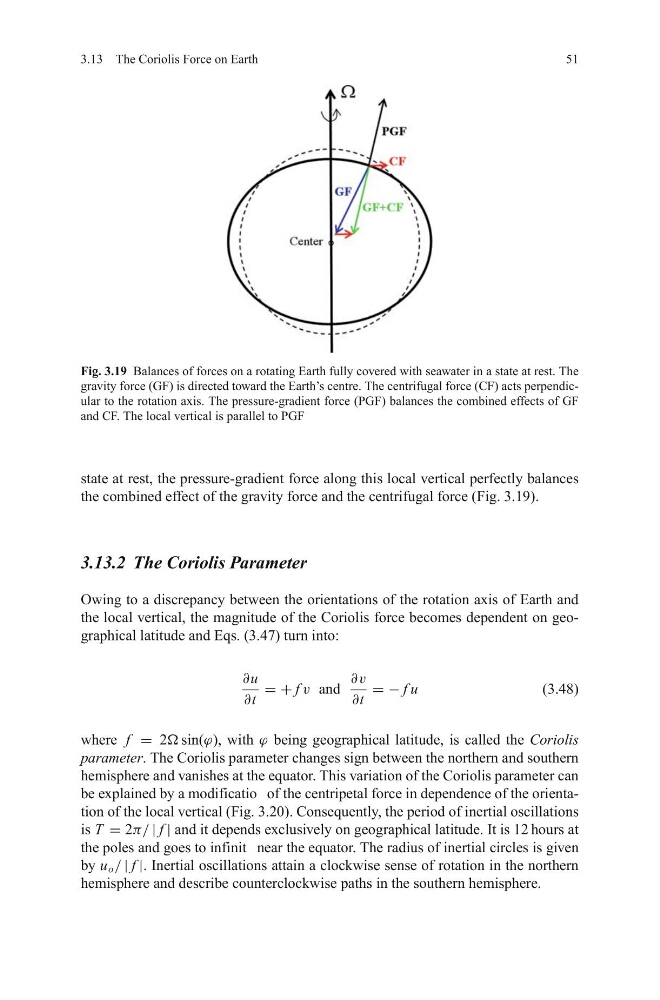
Fig. 3.19 Balances of forces on a rotating Earth fully covered with seawater in a state at rest. The
gravity force (GF) is directed toward the Earth’s centre. The centrifugal force (CF) acts perpendicular to the rotation axis. The pressure-gradient force (PGF) balances the combined effects of GF
and CF. The local vertical is parallel to PGF
state at rest, the pressure-gradient force along this local vertical perfectly balances
the combined effect of the gravity force and the centrifugal force (Fig. 3.19).
3.13.2 The Coriolis Parameter
Owing to a discrepancy between the orientations of the rotation axis of Earth and
the local vertical, the magnitude of the Coriolis force becomes dependent on geographical latitude and Eqs. (3.47) turn into:
∂u
∂t
= + f v and
∂v
∂t
= − f u
(3.48)
where f = 2Ω sin(ϕ), with ϕ being geographical latitude, is called the Coriolis
parameter. The Coriolis parameter changes sign between the northern and southern
hemisphere and vanishes at the equator. This variation of the Coriolis parameter can
be explained by a modificatio of the centripetal force in dependence of the orientation of the local vertical (Fig. 3.20). Consequently, the period of inertial oscillations
is T = 2π/ | f | and it depends exclusively on geographical latitude. It is 12 hours at
the poles and goes to infinit near the equator. The radius of inertial circles is given
by u o / | f |. Inertial oscillations attain a clockwise sense of rotation in the northern
hemisphere and describe counterclockwise paths in the southern hemisphere.
51
Fig. 3.19 Balances of forces on a rotating Earth fully covered with seawater in a state at rest. The
gravity force (GF) is directed toward the Earth’s centre. The centrifugal force (CF) acts perpendicular to the rotation axis. The pressure-gradient force (PGF) balances the combined effects of GF
and CF. The local vertical is parallel to PGF
state at rest, the pressure-gradient force along this local vertical perfectly balances
the combined effect of the gravity force and the centrifugal force (Fig. 3.19).
3.13.2 The Coriolis Parameter
Owing to a discrepancy between the orientations of the rotation axis of Earth and
the local vertical, the magnitude of the Coriolis force becomes dependent on geographical latitude and Eqs. (3.47) turn into:
∂u
∂t
= + f v and
∂v
∂t
= − f u
(3.48)
where f = 2Ω sin(ϕ), with ϕ being geographical latitude, is called the Coriolis
parameter. The Coriolis parameter changes sign between the northern and southern
hemisphere and vanishes at the equator. This variation of the Coriolis parameter can
be explained by a modificatio of the centripetal force in dependence of the orientation of the local vertical (Fig. 3.20). Consequently, the period of inertial oscillations
is T = 2π/ | f | and it depends exclusively on geographical latitude. It is 12 hours at
the poles and goes to infinit near the equator. The radius of inertial circles is given
by u o / | f |. Inertial oscillations attain a clockwise sense of rotation in the northern
hemisphere and describe counterclockwise paths in the southern hemisphere.