

42
3 Basics of Geophysical Fluid Dynamics
3.11.4 Dynamic Pressure in the Ocean
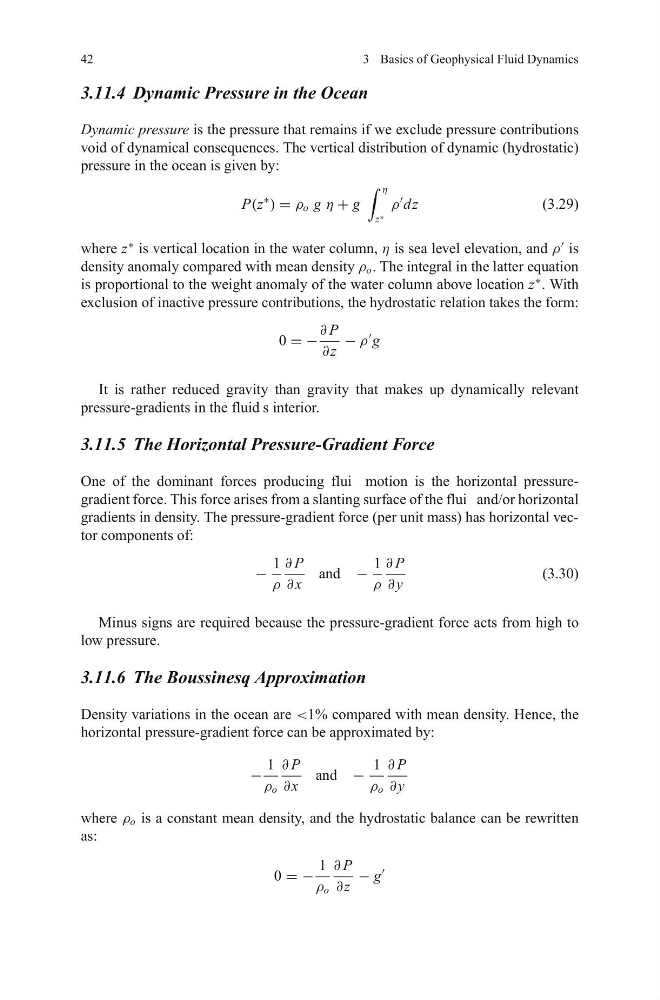
Dynamic pressure is the pressure that remains if we exclude pressure contributions
void of dynamical consequences. The vertical distribution of dynamic (hydrostatic)
pressure in the ocean is given by:
P(z
∗
) = ρ o g η + g
η
z ∗
ρ
dz
(3.29)
where z
∗
is vertical location in the water column, η is sea level elevation, and ρ
is
density anomaly compared with mean density ρ o . The integral in the latter equation
is proportional to the weight anomaly of the water column above location z
∗
. With
exclusion of inactive pressure contributions, the hydrostatic relation takes the form:
0 = −
∂ P
∂z
− ρ
g
It is rather reduced gravity than gravity that makes up dynamically relevant
pressure-gradients in the fluid s interior.
3.11.5 The Horizontal Pressure-Gradient Force
One of the dominant forces producing flui motion is the horizontal pressuregradient force. This force arises from a slanting surface of the flui and/or horizontal
gradients in density. The pressure-gradient force (per unit mass) has horizontal vector components of:
−
1
ρ
∂ P
∂ x
and −
1
ρ
∂ P
∂ y
(3.30)
Minus signs are required because the pressure-gradient force acts from high to
low pressure.
3.11.6 The Boussinesq Approximation
Density variations in the ocean are <1% compared with mean density. Hence, the
horizontal pressure-gradient force can be approximated by:
−
1
ρ o
∂ P
∂ x
and −
1
ρ o
∂ P
∂ y
where ρ o is a constant mean density, and the hydrostatic balance can be rewritten
as:
0 = −
1
ρ o
∂ P
∂z
− g
3 Basics of Geophysical Fluid Dynamics
3.11.4 Dynamic Pressure in the Ocean
Dynamic pressure is the pressure that remains if we exclude pressure contributions
void of dynamical consequences. The vertical distribution of dynamic (hydrostatic)
pressure in the ocean is given by:
P(z
∗
) = ρ o g η + g
η
z ∗
ρ
dz
(3.29)
where z
∗
is vertical location in the water column, η is sea level elevation, and ρ
is
density anomaly compared with mean density ρ o . The integral in the latter equation
is proportional to the weight anomaly of the water column above location z
∗
. With
exclusion of inactive pressure contributions, the hydrostatic relation takes the form:
0 = −
∂ P
∂z
− ρ
g
It is rather reduced gravity than gravity that makes up dynamically relevant
pressure-gradients in the fluid s interior.
3.11.5 The Horizontal Pressure-Gradient Force
One of the dominant forces producing flui motion is the horizontal pressuregradient force. This force arises from a slanting surface of the flui and/or horizontal
gradients in density. The pressure-gradient force (per unit mass) has horizontal vector components of:
−
1
ρ
∂ P
∂ x
and −
1
ρ
∂ P
∂ y
(3.30)
Minus signs are required because the pressure-gradient force acts from high to
low pressure.
3.11.6 The Boussinesq Approximation
Density variations in the ocean are <1% compared with mean density. Hence, the
horizontal pressure-gradient force can be approximated by:
−
1
ρ o
∂ P
∂ x
and −
1
ρ o
∂ P
∂ y
where ρ o is a constant mean density, and the hydrostatic balance can be rewritten
as:
0 = −
1
ρ o
∂ P
∂z
− g