

36
3 Basics of Geophysical Fluid Dynamics
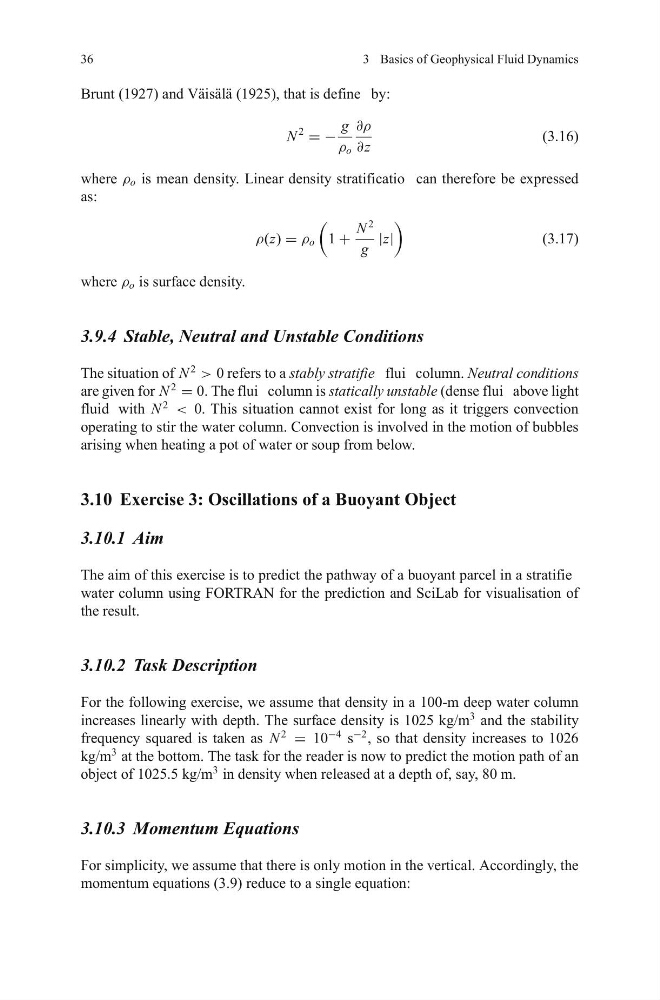
Brunt (1927) and V¨ ais¨ al¨ a (1925), that is define by:
N
2
= −
g
ρ o
∂ρ
∂z
(3.16)
where ρ o is mean density. Linear density stratificatio can therefore be expressed
as:
ρ(z) = ρ o
1 +
N
2
g
|z|
(3.17)
where ρ o is surface density.
3.9.4 Stable, Neutral and Unstable Conditions
The situation of N
2
> 0 refers to a stably stratifie flui column. Neutral conditions
are given for N
2
= 0. The flui column is statically unstable (dense flui above light
fluid with N
2
< 0. This situation cannot exist for long as it triggers convection
operating to stir the water column. Convection is involved in the motion of bubbles
arising when heating a pot of water or soup from below.
3.10 Exercise 3: Oscillations of a Buoyant Object
3.10.1 Aim
The aim of this exercise is to predict the pathway of a buoyant parcel in a stratifie
water column using FORTRAN for the prediction and SciLab for visualisation of
the result.
3.10.2 Task Description
For the following exercise, we assume that density in a 100-m deep water column
increases linearly with depth. The surface density is 1025 kg/m
3
and the stability
frequency squared is taken as N
2
= 10
−4
s
−2
, so that density increases to 1026
kg/m
3
at the bottom. The task for the reader is now to predict the motion path of an
object of 1025.5 kg/m
3
in density when released at a depth of, say, 80 m.
3.10.3 Momentum Equations
For simplicity, we assume that there is only motion in the vertical. Accordingly, the
momentum equations (3.9) reduce to a single equation:
3 Basics of Geophysical Fluid Dynamics
Brunt (1927) and V¨ ais¨ al¨ a (1925), that is define by:
N
2
= −
g
ρ o
∂ρ
∂z
(3.16)
where ρ o is mean density. Linear density stratificatio can therefore be expressed
as:
ρ(z) = ρ o
1 +
N
2
g
|z|
(3.17)
where ρ o is surface density.
3.9.4 Stable, Neutral and Unstable Conditions
The situation of N
2
> 0 refers to a stably stratifie flui column. Neutral conditions
are given for N
2
= 0. The flui column is statically unstable (dense flui above light
fluid with N
2
< 0. This situation cannot exist for long as it triggers convection
operating to stir the water column. Convection is involved in the motion of bubbles
arising when heating a pot of water or soup from below.
3.10 Exercise 3: Oscillations of a Buoyant Object
3.10.1 Aim
The aim of this exercise is to predict the pathway of a buoyant parcel in a stratifie
water column using FORTRAN for the prediction and SciLab for visualisation of
the result.
3.10.2 Task Description
For the following exercise, we assume that density in a 100-m deep water column
increases linearly with depth. The surface density is 1025 kg/m
3
and the stability
frequency squared is taken as N
2
= 10
−4
s
−2
, so that density increases to 1026
kg/m
3
at the bottom. The task for the reader is now to predict the motion path of an
object of 1025.5 kg/m
3
in density when released at a depth of, say, 80 m.
3.10.3 Momentum Equations
For simplicity, we assume that there is only motion in the vertical. Accordingly, the
momentum equations (3.9) reduce to a single equation: