

132
6 Rotational Effects
appearance of these waves, the fl w still tends to follow bathymetric contours, at
least, on average.
6.5.7 Additional Exercise for the Reader
Repeat this exercise with a reduced speed of the ambient geostrophic f ow of
U geo = 0.05 m/s. This setting corresponds to a pseudo Rossby number, based on
the width of the bottom-escarpment zone, of Ro = 0.05, which is half that used
before. Explore the topographic steering mechanism for this modifie situation and
verify whether the wavelength of standing topographic Rossby waves increases or
decreases. Because of weaker ambient fl w, the reader should double the total simulation time.
6.6 Instability of Lateral Shear Flows
6.6.1 Theory
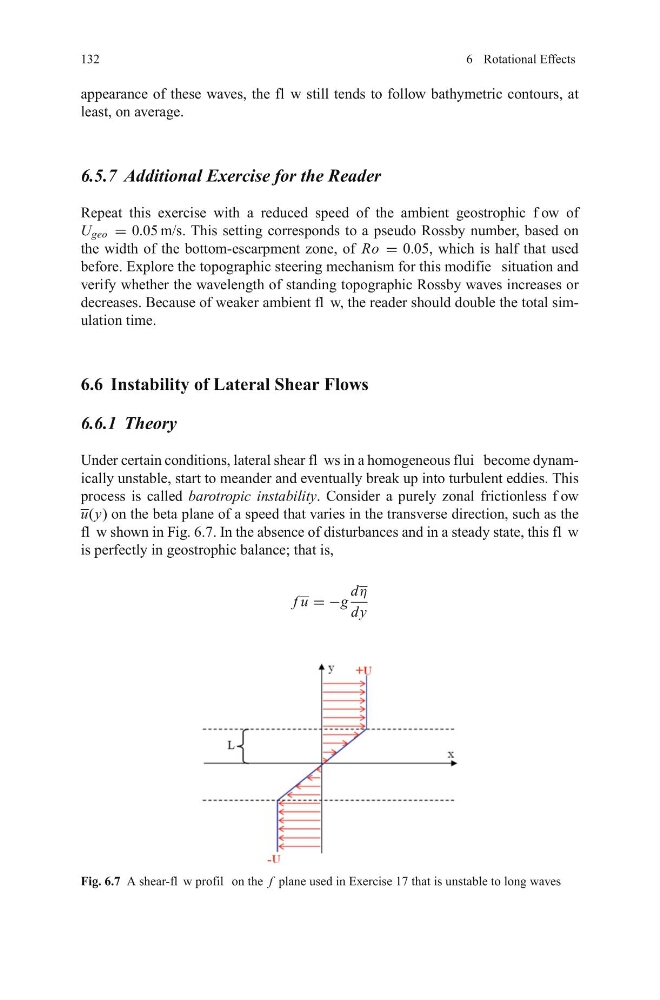
Under certain conditions, lateral shear fl ws in a homogeneous flui become dynamically unstable, start to meander and eventually break up into turbulent eddies. This
process is called barotropic instability. Consider a purely zonal frictionless f ow
u(y) on the beta plane of a speed that varies in the transverse direction, such as the
fl w shown in Fig. 6.7. In the absence of disturbances and in a steady state, this fl w
is perfectly in geostrophic balance; that is,
f u = −g
dη
dy
Fig. 6.7 A shear-fl w profil on the f plane used in Exercise 17 that is unstable to long waves
6 Rotational Effects
appearance of these waves, the fl w still tends to follow bathymetric contours, at
least, on average.
6.5.7 Additional Exercise for the Reader
Repeat this exercise with a reduced speed of the ambient geostrophic f ow of
U geo = 0.05 m/s. This setting corresponds to a pseudo Rossby number, based on
the width of the bottom-escarpment zone, of Ro = 0.05, which is half that used
before. Explore the topographic steering mechanism for this modifie situation and
verify whether the wavelength of standing topographic Rossby waves increases or
decreases. Because of weaker ambient fl w, the reader should double the total simulation time.
6.6 Instability of Lateral Shear Flows
6.6.1 Theory
Under certain conditions, lateral shear fl ws in a homogeneous flui become dynamically unstable, start to meander and eventually break up into turbulent eddies. This
process is called barotropic instability. Consider a purely zonal frictionless f ow
u(y) on the beta plane of a speed that varies in the transverse direction, such as the
fl w shown in Fig. 6.7. In the absence of disturbances and in a steady state, this fl w
is perfectly in geostrophic balance; that is,
f u = −g
dη
dy
Fig. 6.7 A shear-fl w profil on the f plane used in Exercise 17 that is unstable to long waves