

6.4 Geostrophic Flow
123
Sect. 3.17) compares the inertial period with the time scale of a process. The Coriolis
force influence or even controls processes that have time scales of or exceeding the
inertial period. On the other hand, the ratio between the nonlinear terms and the
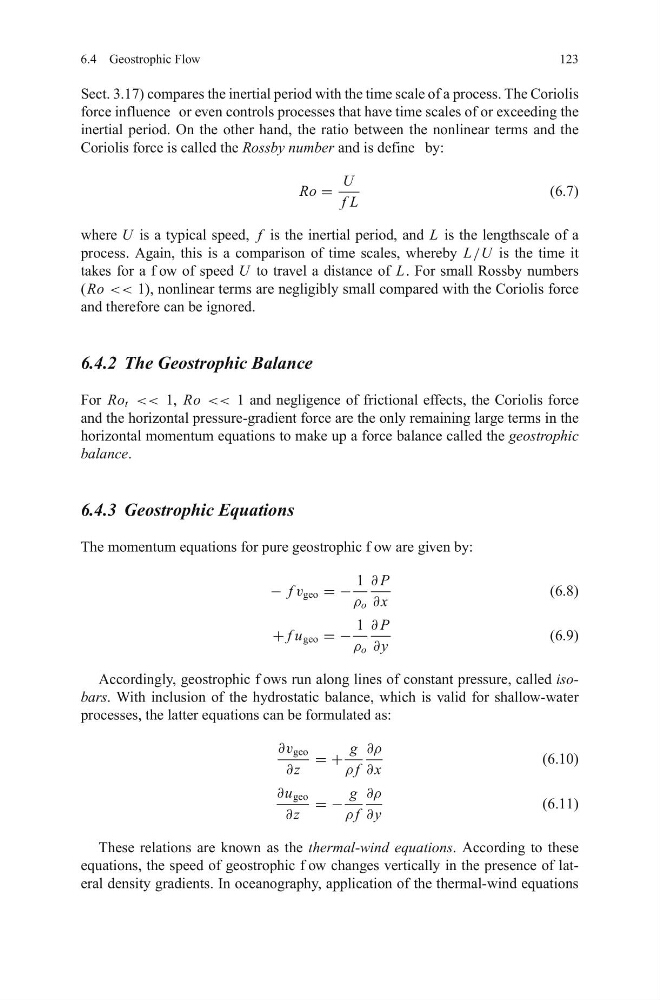
Coriolis force is called the Rossby number and is define by:
Ro =
U
f L
(6.7)
where U is a typical speed, f is the inertial period, and L is the lengthscale of a
process. Again, this is a comparison of time scales, whereby L/U is the time it
takes for a f ow of speed U to travel a distance of L. For small Rossby numbers
(Ro << 1), nonlinear terms are negligibly small compared with the Coriolis force
and therefore can be ignored.
6.4.2 The Geostrophic Balance
For Ro t << 1, Ro << 1 and negligence of frictional effects, the Coriolis force
and the horizontal pressure-gradient force are the only remaining large terms in the
horizontal momentum equations to make up a force balance called the geostrophic
balance.
6.4.3 Geostrophic Equations
The momentum equations for pure geostrophic f ow are given by:
− f v geo = −
1
ρ o
∂ P
∂ x
(6.8)
+ f u geo = −
1
ρ o
∂ P
∂ y
(6.9)
Accordingly, geostrophic f ows run along lines of constant pressure, called isobars. With inclusion of the hydrostatic balance, which is valid for shallow-water
processes, the latter equations can be formulated as:
∂v geo
∂z
= +
g
ρ f
∂ρ
∂ x
(6.10)
∂u geo
∂z
= −
g
ρ f
∂ρ
∂ y
(6.11)
These relations are known as the thermal-wind equations. According to these
equations, the speed of geostrophic f ow changes vertically in the presence of lateral density gradients. In oceanography, application of the thermal-wind equations
123
Sect. 3.17) compares the inertial period with the time scale of a process. The Coriolis
force influence or even controls processes that have time scales of or exceeding the
inertial period. On the other hand, the ratio between the nonlinear terms and the
Coriolis force is called the Rossby number and is define by:
Ro =
U
f L
(6.7)
where U is a typical speed, f is the inertial period, and L is the lengthscale of a
process. Again, this is a comparison of time scales, whereby L/U is the time it
takes for a f ow of speed U to travel a distance of L. For small Rossby numbers
(Ro << 1), nonlinear terms are negligibly small compared with the Coriolis force
and therefore can be ignored.
6.4.2 The Geostrophic Balance
For Ro t << 1, Ro << 1 and negligence of frictional effects, the Coriolis force
and the horizontal pressure-gradient force are the only remaining large terms in the
horizontal momentum equations to make up a force balance called the geostrophic
balance.
6.4.3 Geostrophic Equations
The momentum equations for pure geostrophic f ow are given by:
− f v geo = −
1
ρ o
∂ P
∂ x
(6.8)
+ f u geo = −
1
ρ o
∂ P
∂ y
(6.9)
Accordingly, geostrophic f ows run along lines of constant pressure, called isobars. With inclusion of the hydrostatic balance, which is valid for shallow-water
processes, the latter equations can be formulated as:
∂v geo
∂z
= +
g
ρ f
∂ρ
∂ x
(6.10)
∂u geo
∂z
= −
g
ρ f
∂ρ
∂ y
(6.11)
These relations are known as the thermal-wind equations. According to these
equations, the speed of geostrophic f ow changes vertically in the presence of lateral density gradients. In oceanography, application of the thermal-wind equations