

While alkali-enriched volcanics having a hotspot origin and back-arc volcanics
are both well documented in their silica-enriched rocks, very little is known about
similar lava erupted along the spreading ridge systems of the World. In the East
Pacific, only a few cases have been documented, such as on the flank of the North
East Pacific Rise (NEPR) at 9°30
0 N and 10°30
0 N (Thompson et al. 1989; Batiza et al.
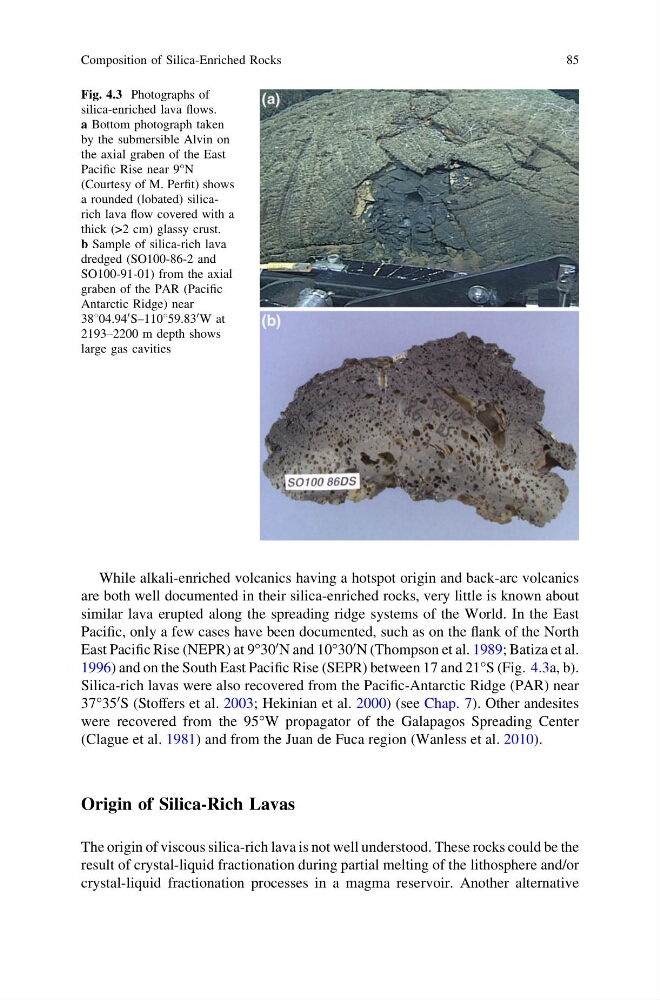
1996) and on the South East Pacific Rise (SEPR) between 17 and 21°S (Fig. 4.3a, b).
Silica-rich lavas were also recovered from the Pacific-Antarctic Ridge (PAR) near
37°35
0 S (Stoffers et al. 2003; Hekinian et al. 2000) (see Chap. 7). Other andesites
were recovered from the 95°W propagator of the Galapagos Spreading Center
(Clague et al. 1981) and from the Juan de Fuca region (Wanless et al. 2010).
Origin of Silica-Rich Lavas
The origin of viscous silica-rich lava is not well understood. These rocks could be the
result of crystal-liquid fractionation during partial melting of the lithosphere and/or
crystal-liquid fractionation processes in a magma reservoir. Another alternative
Fig. 4.3 Photographs of
silica-enriched lava flows.
a Bottom photograph taken
by the submersible Alvin on
the axial graben of the East
Pacific Rise near 9°N
(Courtesy of M. Perfit) shows
a rounded (lobated) silicarich lava flow covered with a
thick (>2 cm) glassy crust.
b Sample of silica-rich lava
dredged (SO100-86-2 and
SO100-91-01) from the axial
graben of the PAR (Pacific
Antarctic Ridge) near
38804.94
0 S–110859.83
0 W at
2193–2200 m depth shows
large gas cavities
Composition of Silica-Enriched Rocks
85
are both well documented in their silica-enriched rocks, very little is known about
similar lava erupted along the spreading ridge systems of the World. In the East
Pacific, only a few cases have been documented, such as on the flank of the North
East Pacific Rise (NEPR) at 9°30
0 N and 10°30
0 N (Thompson et al. 1989; Batiza et al.
1996) and on the South East Pacific Rise (SEPR) between 17 and 21°S (Fig. 4.3a, b).
Silica-rich lavas were also recovered from the Pacific-Antarctic Ridge (PAR) near
37°35
0 S (Stoffers et al. 2003; Hekinian et al. 2000) (see Chap. 7). Other andesites
were recovered from the 95°W propagator of the Galapagos Spreading Center
(Clague et al. 1981) and from the Juan de Fuca region (Wanless et al. 2010).
Origin of Silica-Rich Lavas
The origin of viscous silica-rich lava is not well understood. These rocks could be the
result of crystal-liquid fractionation during partial melting of the lithosphere and/or
crystal-liquid fractionation processes in a magma reservoir. Another alternative
Fig. 4.3 Photographs of
silica-enriched lava flows.
a Bottom photograph taken
by the submersible Alvin on
the axial graben of the East
Pacific Rise near 9°N
(Courtesy of M. Perfit) shows
a rounded (lobated) silicarich lava flow covered with a
thick (>2 cm) glassy crust.
b Sample of silica-rich lava
dredged (SO100-86-2 and
SO100-91-01) from the axial
graben of the PAR (Pacific
Antarctic Ridge) near
38804.94
0 S–110859.83
0 W at
2193–2200 m depth shows
large gas cavities
Composition of Silica-Enriched Rocks
85