

Silica-rich flows are less abundant than basaltic lavas, but it is often difficult to
distinguish them from other flows on the ocean floor because silica-enriched lava
forms a relatively small fraction of any volcanic structure (only a few tens of cubic
meters up to 1 km
3
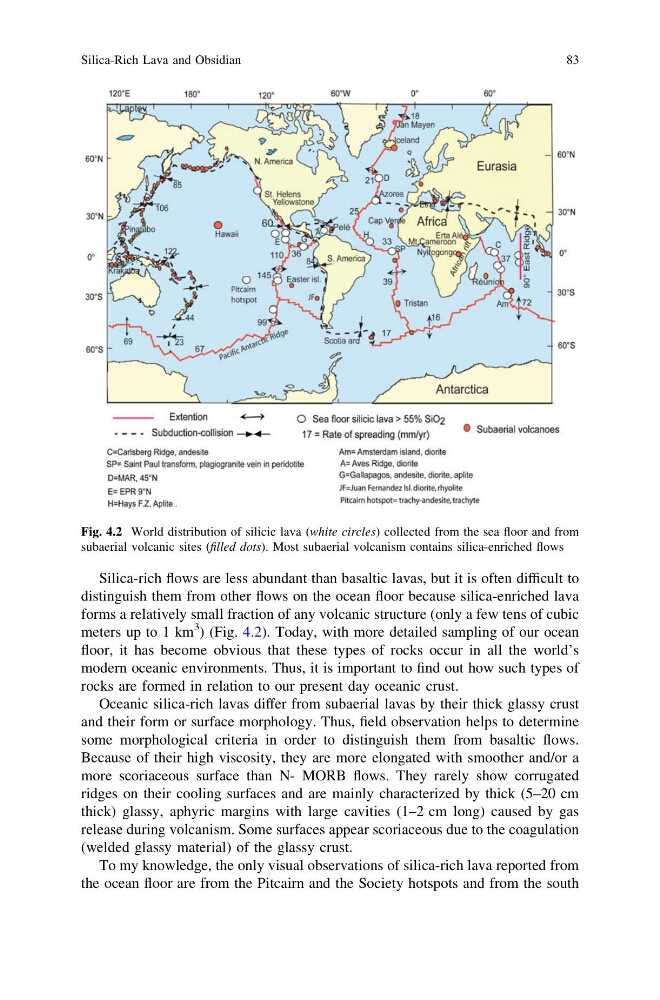
) (Fig. 4.2). Today, with more detailed sampling of our ocean
floor, it has become obvious that these types of rocks occur in all the world’s
modern oceanic environments. Thus, it is important to find out how such types of
rocks are formed in relation to our present day oceanic crust.
Oceanic silica-rich lavas differ from subaerial lavas by their thick glassy crust
and their form or surface morphology. Thus, field observation helps to determine
some morphological criteria in order to distinguish them from basaltic flows.
Because of their high viscosity, they are more elongated with smoother and/or a
more scoriaceous surface than N- MORB flows. They rarely show corrugated
ridges on their cooling surfaces and are mainly characterized by thick (5–20 cm
thick) glassy, aphyric margins with large cavities (1–2 cm long) caused by gas
release during volcanism. Some surfaces appear scoriaceous due to the coagulation
(welded glassy material) of the glassy crust.
To my knowledge, the only visual observations of silica-rich lava reported from
the ocean floor are from the Pitcairn and the Society hotspots and from the south
Fig. 4.2 World distribution of silicic lava (white circles) collected from the sea floor and from
subaerial volcanic sites (filled dots). Most subaerial volcanism contains silica-enriched flows
Silica-Rich Lava and Obsidian
83
distinguish them from other flows on the ocean floor because silica-enriched lava
forms a relatively small fraction of any volcanic structure (only a few tens of cubic
meters up to 1 km
3
) (Fig. 4.2). Today, with more detailed sampling of our ocean
floor, it has become obvious that these types of rocks occur in all the world’s
modern oceanic environments. Thus, it is important to find out how such types of
rocks are formed in relation to our present day oceanic crust.
Oceanic silica-rich lavas differ from subaerial lavas by their thick glassy crust
and their form or surface morphology. Thus, field observation helps to determine
some morphological criteria in order to distinguish them from basaltic flows.
Because of their high viscosity, they are more elongated with smoother and/or a
more scoriaceous surface than N- MORB flows. They rarely show corrugated
ridges on their cooling surfaces and are mainly characterized by thick (5–20 cm
thick) glassy, aphyric margins with large cavities (1–2 cm long) caused by gas
release during volcanism. Some surfaces appear scoriaceous due to the coagulation
(welded glassy material) of the glassy crust.
To my knowledge, the only visual observations of silica-rich lava reported from
the ocean floor are from the Pitcairn and the Society hotspots and from the south
Fig. 4.2 World distribution of silicic lava (white circles) collected from the sea floor and from
subaerial volcanic sites (filled dots). Most subaerial volcanism contains silica-enriched flows
Silica-Rich Lava and Obsidian
83