

The atomic configuration of the elements provides a guide for understanding
the degree of compatibility between the various elements composing a mineral’s
crystalline lattice. The size of each atom’s radius and the electric bonding of each
element will govern the architecture of the oxides and silicate minerals, which
compose both crystalline and glassy (aphyric) rocks. A decrease in ionic size will
be proportional to the degree of element affinity forming the atomic configuration.
A list of the most commonly occurring elements based on the size of their ions
(from large ions to small) and related to an increase in the number of their electrons is as follows: K, Na, Ca, Mg, Fe, Al, Si.
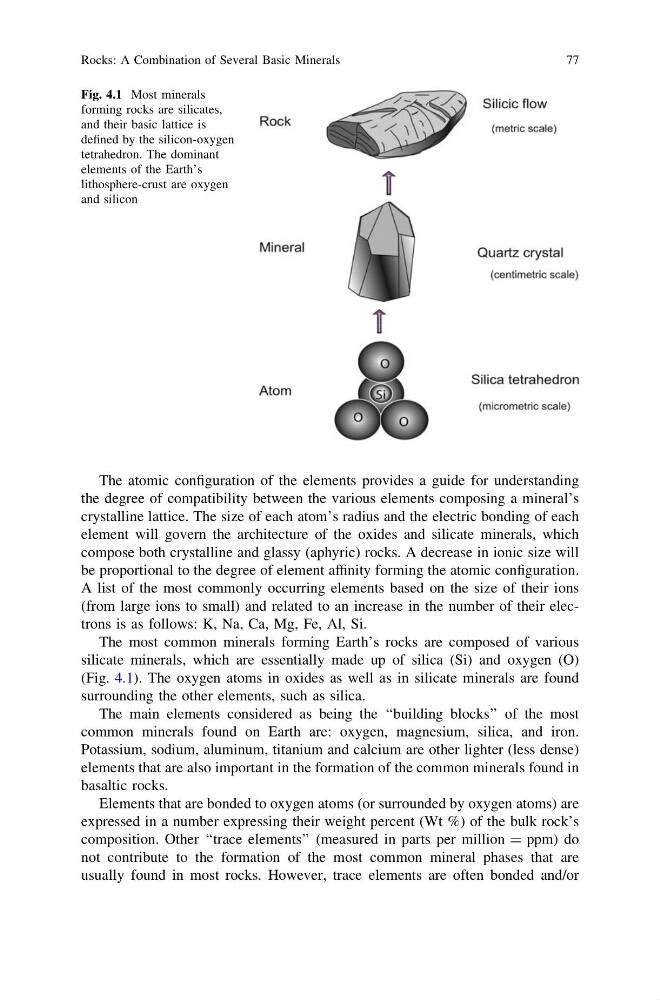
The most common minerals forming Earth’s rocks are composed of various
silicate minerals, which are essentially made up of silica (Si) and oxygen (O)
(Fig. 4.1). The oxygen atoms in oxides as well as in silicate minerals are found
surrounding the other elements, such as silica.
The main elements considered as being the ‘‘building blocks’’ of the most
common minerals found on Earth are: oxygen, magnesium, silica, and iron.
Potassium, sodium, aluminum, titanium and calcium are other lighter (less dense)
elements that are also important in the formation of the common minerals found in
basaltic rocks.
Elements that are bonded to oxygen atoms (or surrounded by oxygen atoms) are
expressed in a number expressing their weight percent (Wt %) of the bulk rock’s
composition. Other ‘‘trace elements’’ (measured in parts per million = ppm) do
not contribute to the formation of the most common mineral phases that are
usually found in most rocks. However, trace elements are often bonded and/or
Fig. 4.1 Most minerals
forming rocks are silicates,
and their basic lattice is
defined by the silicon-oxygen
tetrahedron. The dominant
elements of the Earth’s
lithosphere-crust are oxygen
and silicon
Rocks: A Combination of Several Basic Minerals
77
the degree of compatibility between the various elements composing a mineral’s
crystalline lattice. The size of each atom’s radius and the electric bonding of each
element will govern the architecture of the oxides and silicate minerals, which
compose both crystalline and glassy (aphyric) rocks. A decrease in ionic size will
be proportional to the degree of element affinity forming the atomic configuration.
A list of the most commonly occurring elements based on the size of their ions
(from large ions to small) and related to an increase in the number of their electrons is as follows: K, Na, Ca, Mg, Fe, Al, Si.
The most common minerals forming Earth’s rocks are composed of various
silicate minerals, which are essentially made up of silica (Si) and oxygen (O)
(Fig. 4.1). The oxygen atoms in oxides as well as in silicate minerals are found
surrounding the other elements, such as silica.
The main elements considered as being the ‘‘building blocks’’ of the most
common minerals found on Earth are: oxygen, magnesium, silica, and iron.
Potassium, sodium, aluminum, titanium and calcium are other lighter (less dense)
elements that are also important in the formation of the common minerals found in
basaltic rocks.
Elements that are bonded to oxygen atoms (or surrounded by oxygen atoms) are
expressed in a number expressing their weight percent (Wt %) of the bulk rock’s
composition. Other ‘‘trace elements’’ (measured in parts per million = ppm) do
not contribute to the formation of the most common mineral phases that are
usually found in most rocks. However, trace elements are often bonded and/or
Fig. 4.1 Most minerals
forming rocks are silicates,
and their basic lattice is
defined by the silicon-oxygen
tetrahedron. The dominant
elements of the Earth’s
lithosphere-crust are oxygen
and silicon
Rocks: A Combination of Several Basic Minerals
77