

although the tether can also be easily tangled and this will limit the maneuverability of the vehicle. Such difficulties are related to the cable and to the positioning system of the ship that has to follow the movement of the vehicle moving
about at a few meters above the sea floor. Usually the ships using ROV have a
dynamic positioning system controlled by a computer that can correct any shifts in
position of the ship with respect to the ROV and its target. This helps the ship to
stay close to the right spot within the assigned field of exploration.
The US ROV most used at the present time is the Jason II-Medea system
managed by Woods Hole (WHOI, Woods Hole Oceanographic Institute in Massachusetts, USA). This ROV has high precision acoustic and imaging sensors, a
sampling platform for any recovered material, and has a maximum depth capability of 6,500 m. The French ROV Victor 6000 (Fig. 3.4) is a modular remote
controlled vehicle, which can descend up to 6,000 m depth. It was first used on a
scientific expedition in 1999 on board the RV. L’ATALANTE. The Victor 6000 is
composed of two systems: (1) The vehicle itself with its service equipment, propulsion, video survey equipment, lighting and navigation services, (2) The scientific module composed of sampling tools and scientific equipment which are
specific to a given mission. Victor 6000 is relatively heavy with respect to its being
handled and to the space requirements for its four 20 meter-long containers carrying all the material which could be required for operational purposes.
The Canadian ROV called Ropos has a 5,000 m depth capability and has been
successfully deployed from many oceanographic vessels. Ropos is connected to a
cage by a 300-meter long tether (Fig. 3.5). It has two manipulating arms, two main
video cameras and a payload for samples of about 36 kg. As opposed to the French
ROV Victor 6000 and because of its compact size and small amount of accompanying equipment, Ropos it is the most suitable choice of an ROV to be used on
normal-size ocean going vessels. The German ROV ‘‘Quest’’ acquired in 2004 and
with a diving capability of 4,000 m is also equipped for modern exploration. Both
Ropos and Quest are easy to transport and handle on board normal sized ocean
going vessels and their cost of handling is less expensive than that required for
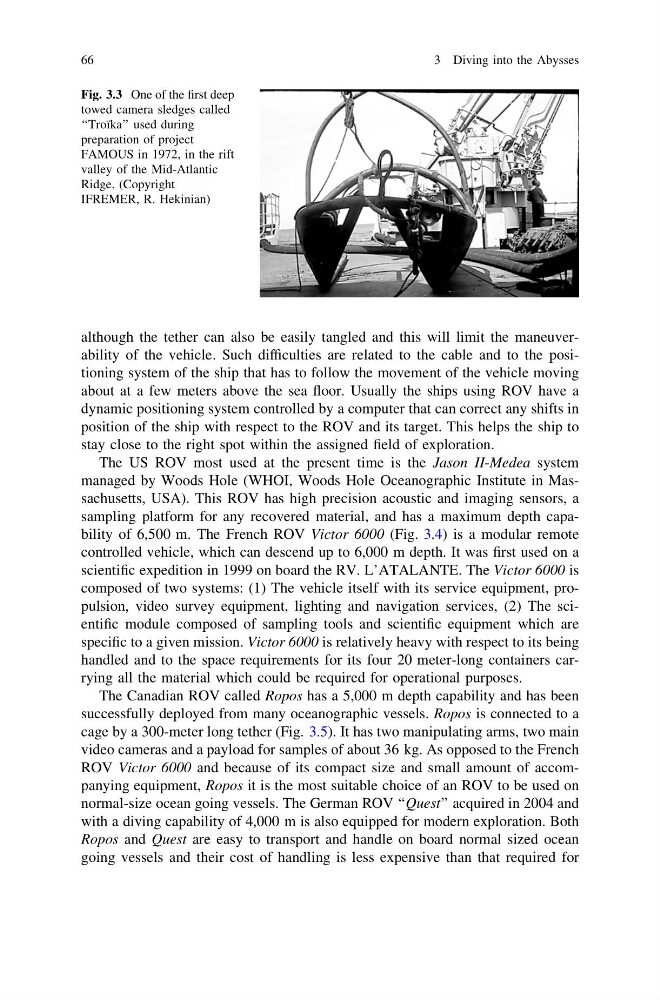
Fig. 3.3 One of the first deep
towed camera sledges called
‘‘Troïka’’ used during
preparation of project
FAMOUS in 1972, in the rift
valley of the Mid-Atlantic
Ridge. (Copyright
IFREMER, R. Hekinian)
66
3 Diving into the Abysses
about at a few meters above the sea floor. Usually the ships using ROV have a
dynamic positioning system controlled by a computer that can correct any shifts in
position of the ship with respect to the ROV and its target. This helps the ship to
stay close to the right spot within the assigned field of exploration.
The US ROV most used at the present time is the Jason II-Medea system
managed by Woods Hole (WHOI, Woods Hole Oceanographic Institute in Massachusetts, USA). This ROV has high precision acoustic and imaging sensors, a
sampling platform for any recovered material, and has a maximum depth capability of 6,500 m. The French ROV Victor 6000 (Fig. 3.4) is a modular remote
controlled vehicle, which can descend up to 6,000 m depth. It was first used on a
scientific expedition in 1999 on board the RV. L’ATALANTE. The Victor 6000 is
composed of two systems: (1) The vehicle itself with its service equipment, propulsion, video survey equipment, lighting and navigation services, (2) The scientific module composed of sampling tools and scientific equipment which are
specific to a given mission. Victor 6000 is relatively heavy with respect to its being
handled and to the space requirements for its four 20 meter-long containers carrying all the material which could be required for operational purposes.
The Canadian ROV called Ropos has a 5,000 m depth capability and has been
successfully deployed from many oceanographic vessels. Ropos is connected to a
cage by a 300-meter long tether (Fig. 3.5). It has two manipulating arms, two main
video cameras and a payload for samples of about 36 kg. As opposed to the French
ROV Victor 6000 and because of its compact size and small amount of accompanying equipment, Ropos it is the most suitable choice of an ROV to be used on
normal-size ocean going vessels. The German ROV ‘‘Quest’’ acquired in 2004 and
with a diving capability of 4,000 m is also equipped for modern exploration. Both
Ropos and Quest are easy to transport and handle on board normal sized ocean
going vessels and their cost of handling is less expensive than that required for
Fig. 3.3 One of the first deep
towed camera sledges called
‘‘Troïka’’ used during
preparation of project
FAMOUS in 1972, in the rift
valley of the Mid-Atlantic
Ridge. (Copyright
IFREMER, R. Hekinian)
66
3 Diving into the Abysses