

when the colonies of North America were fighting for their independence from the
British, the English had concentrated their fleet in a bay of the Hudson River in
New York. Among the vessels there was the admiral ship, Eagle, which was the
target that the Colonial General, George Washington, wanted to destroy. The
Turtle submersible, piloted by Sergeant Ezra Lee, dropped its charge of explosives
into the water before it could reach its target, however this made so much noise
that the British fleet hastily left the harbor (Jarry 2003).
In June 1930, the scientist Charles W. Beebe and an engineer, Otis Barton, both
from New York, dove in a bathysphere (a term coined from the Greek words
meaning ‘‘deep’’ and ‘‘ball’’) which descended to a depth of about 250 m near the
Bahama Islands. The bathysphere was made of cast iron and had two portholes.
The sphere hung on the end of a cable connected to a ship. More details on the
history of humankind’s penetration into the sea can be found in a book entitled
‘‘Les Grandes Aventures des Hommes sous la Mer’’ written in 1988 by Claude
Riffaud, one of the early directors of the CNEXO (now IFREMER) center in Brest.
Today, human penetration in the deep-sea environment has become a necessity.
To explore and understand the formation of our planet requires that scientists be
able to observe what is taking place on the sea floor. This involves the preparation
of an extensive diving program whose first task is to have detailed bathymetric
charts, which are like road maps for the journey. Another important requirement is
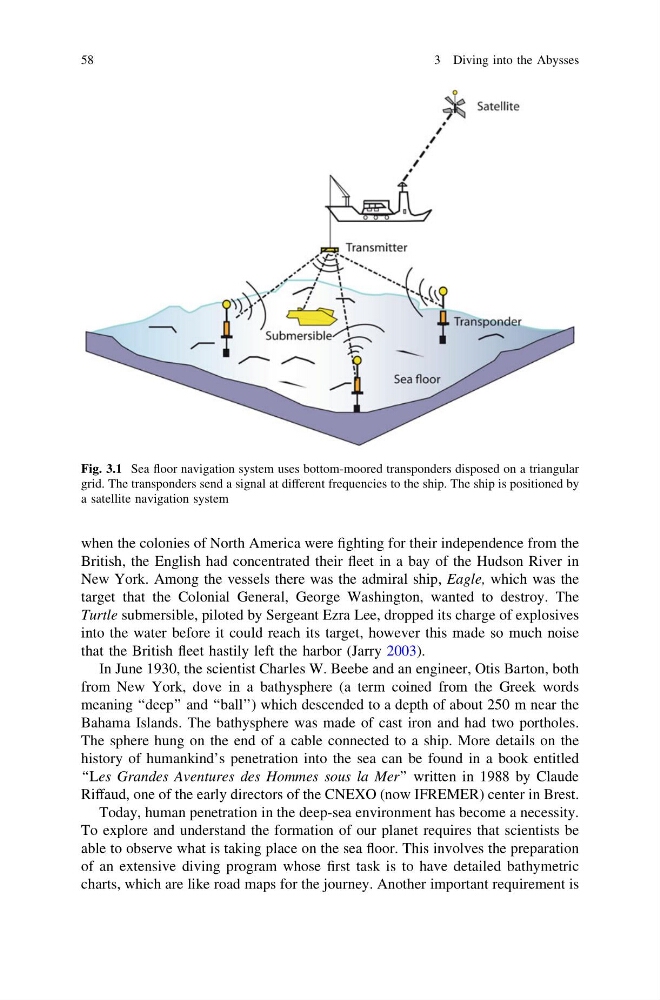
Fig. 3.1 Sea floor navigation system uses bottom-moored transponders disposed on a triangular
grid. The transponders send a signal at different frequencies to the ship. The ship is positioned by
a satellite navigation system
58
3 Diving into the Abysses
British, the English had concentrated their fleet in a bay of the Hudson River in
New York. Among the vessels there was the admiral ship, Eagle, which was the
target that the Colonial General, George Washington, wanted to destroy. The
Turtle submersible, piloted by Sergeant Ezra Lee, dropped its charge of explosives
into the water before it could reach its target, however this made so much noise
that the British fleet hastily left the harbor (Jarry 2003).
In June 1930, the scientist Charles W. Beebe and an engineer, Otis Barton, both
from New York, dove in a bathysphere (a term coined from the Greek words
meaning ‘‘deep’’ and ‘‘ball’’) which descended to a depth of about 250 m near the
Bahama Islands. The bathysphere was made of cast iron and had two portholes.
The sphere hung on the end of a cable connected to a ship. More details on the
history of humankind’s penetration into the sea can be found in a book entitled
‘‘Les Grandes Aventures des Hommes sous la Mer’’ written in 1988 by Claude
Riffaud, one of the early directors of the CNEXO (now IFREMER) center in Brest.
Today, human penetration in the deep-sea environment has become a necessity.
To explore and understand the formation of our planet requires that scientists be
able to observe what is taking place on the sea floor. This involves the preparation
of an extensive diving program whose first task is to have detailed bathymetric
charts, which are like road maps for the journey. Another important requirement is
Fig. 3.1 Sea floor navigation system uses bottom-moored transponders disposed on a triangular
grid. The transponders send a signal at different frequencies to the ship. The ship is positioned by
a satellite navigation system
58
3 Diving into the Abysses