

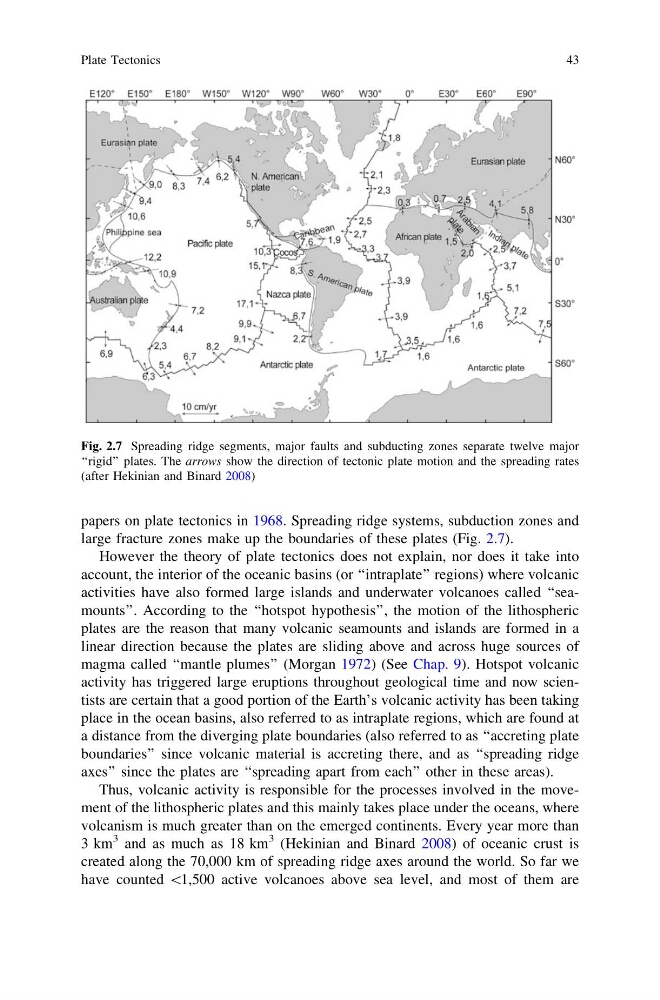
papers on plate tectonics in 1968. Spreading ridge systems, subduction zones and
large fracture zones make up the boundaries of these plates (Fig. 2.7).
However the theory of plate tectonics does not explain, nor does it take into
account, the interior of the oceanic basins (or ‘‘intraplate’’ regions) where volcanic
activities have also formed large islands and underwater volcanoes called ‘‘seamounts’’. According to the ‘‘hotspot hypothesis’’, the motion of the lithospheric
plates are the reason that many volcanic seamounts and islands are formed in a
linear direction because the plates are sliding above and across huge sources of
magma called ‘‘mantle plumes’’ (Morgan 1972) (See Chap. 9). Hotspot volcanic
activity has triggered large eruptions throughout geological time and now scientists are certain that a good portion of the Earth’s volcanic activity has been taking
place in the ocean basins, also referred to as intraplate regions, which are found at
a distance from the diverging plate boundaries (also referred to as ‘‘accreting plate
boundaries’’ since volcanic material is accreting there, and as ‘‘spreading ridge
axes’’ since the plates are ‘‘spreading apart from each’’ other in these areas).
Thus, volcanic activity is responsible for the processes involved in the movement of the lithospheric plates and this mainly takes place under the oceans, where
volcanism is much greater than on the emerged continents. Every year more than
3 km
3 and as much as 18 km
3 (Hekinian and Binard 2008) of oceanic crust is
created along the 70,000 km of spreading ridge axes around the world. So far we
have counted \1,500 active volcanoes above sea level, and most of them are
Fig. 2.7 Spreading ridge segments, major faults and subducting zones separate twelve major
‘‘rigid’’ plates. The arrows show the direction of tectonic plate motion and the spreading rates
(after Hekinian and Binard 2008)
Plate Tectonics
43
large fracture zones make up the boundaries of these plates (Fig. 2.7).
However the theory of plate tectonics does not explain, nor does it take into
account, the interior of the oceanic basins (or ‘‘intraplate’’ regions) where volcanic
activities have also formed large islands and underwater volcanoes called ‘‘seamounts’’. According to the ‘‘hotspot hypothesis’’, the motion of the lithospheric
plates are the reason that many volcanic seamounts and islands are formed in a
linear direction because the plates are sliding above and across huge sources of
magma called ‘‘mantle plumes’’ (Morgan 1972) (See Chap. 9). Hotspot volcanic
activity has triggered large eruptions throughout geological time and now scientists are certain that a good portion of the Earth’s volcanic activity has been taking
place in the ocean basins, also referred to as intraplate regions, which are found at
a distance from the diverging plate boundaries (also referred to as ‘‘accreting plate
boundaries’’ since volcanic material is accreting there, and as ‘‘spreading ridge
axes’’ since the plates are ‘‘spreading apart from each’’ other in these areas).
Thus, volcanic activity is responsible for the processes involved in the movement of the lithospheric plates and this mainly takes place under the oceans, where
volcanism is much greater than on the emerged continents. Every year more than
3 km
3 and as much as 18 km
3 (Hekinian and Binard 2008) of oceanic crust is
created along the 70,000 km of spreading ridge axes around the world. So far we
have counted \1,500 active volcanoes above sea level, and most of them are
Fig. 2.7 Spreading ridge segments, major faults and subducting zones separate twelve major
‘‘rigid’’ plates. The arrows show the direction of tectonic plate motion and the spreading rates
(after Hekinian and Binard 2008)
Plate Tectonics
43