

with the alkali components (i.e. K
- , Na
- , ammonia, Cl
- ) of the crust to form the
atmosphere.
Volcanic eruption is one way for the Earth to release volatiles (gases) and
various elements such as sulfur, methane, hydrogen, carbon dioxide, hydrogen
chloride, and hydrogen sulfide that are present in magma (See Chap. 5). Whether
volcanic activity has provided sufficient water to account for all the hydrosphere is
a matter of speculation.
For any planet to be able to sustain life in any form, liquid water must be
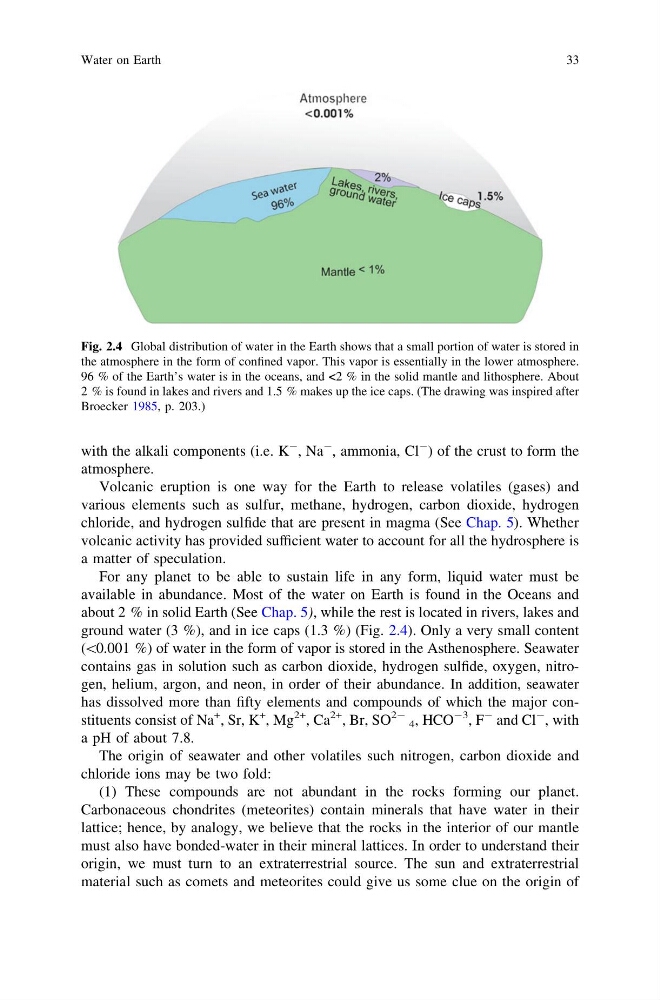
available in abundance. Most of the water on Earth is found in the Oceans and
about 2 % in solid Earth (See Chap. 5), while the rest is located in rivers, lakes and
ground water (3 %), and in ice caps (1.3 %) (Fig. 2.4). Only a very small content
(\0.001 %) of water in the form of vapor is stored in the Asthenosphere. Seawater
contains gas in solution such as carbon dioxide, hydrogen sulfide, oxygen, nitrogen, helium, argon, and neon, in order of their abundance. In addition, seawater
has dissolved more than fifty elements and compounds of which the major constituents consist of Na
+ , Sr, K
+
, Mg
2+ , Ca
2+ , Br, SO
24 , HCO
-3 , F
- and Cl
- , with
a pH of about 7.8.
The origin of seawater and other volatiles such nitrogen, carbon dioxide and
chloride ions may be two fold:
(1) These compounds are not abundant in the rocks forming our planet.
Carbonaceous chondrites (meteorites) contain minerals that have water in their
lattice; hence, by analogy, we believe that the rocks in the interior of our mantle
must also have bonded-water in their mineral lattices. In order to understand their
origin, we must turn to an extraterrestrial source. The sun and extraterrestrial
material such as comets and meteorites could give us some clue on the origin of
Fig. 2.4 Global distribution of water in the Earth shows that a small portion of water is stored in
the atmosphere in the form of confined vapor. This vapor is essentially in the lower atmosphere.
96 % of the Earth’s water is in the oceans, and <2 % in the solid mantle and lithosphere. About
2 % is found in lakes and rivers and 1.5 % makes up the ice caps. (The drawing was inspired after
Broecker 1985, p. 203.)
Water on Earth
33
- , Na
- , ammonia, Cl
- ) of the crust to form the
atmosphere.
Volcanic eruption is one way for the Earth to release volatiles (gases) and
various elements such as sulfur, methane, hydrogen, carbon dioxide, hydrogen
chloride, and hydrogen sulfide that are present in magma (See Chap. 5). Whether
volcanic activity has provided sufficient water to account for all the hydrosphere is
a matter of speculation.
For any planet to be able to sustain life in any form, liquid water must be
available in abundance. Most of the water on Earth is found in the Oceans and
about 2 % in solid Earth (See Chap. 5), while the rest is located in rivers, lakes and
ground water (3 %), and in ice caps (1.3 %) (Fig. 2.4). Only a very small content
(\0.001 %) of water in the form of vapor is stored in the Asthenosphere. Seawater
contains gas in solution such as carbon dioxide, hydrogen sulfide, oxygen, nitrogen, helium, argon, and neon, in order of their abundance. In addition, seawater
has dissolved more than fifty elements and compounds of which the major constituents consist of Na
+ , Sr, K
+
, Mg
2+ , Ca
2+ , Br, SO
24 , HCO
-3 , F
- and Cl
- , with
a pH of about 7.8.
The origin of seawater and other volatiles such nitrogen, carbon dioxide and
chloride ions may be two fold:
(1) These compounds are not abundant in the rocks forming our planet.
Carbonaceous chondrites (meteorites) contain minerals that have water in their
lattice; hence, by analogy, we believe that the rocks in the interior of our mantle
must also have bonded-water in their mineral lattices. In order to understand their
origin, we must turn to an extraterrestrial source. The sun and extraterrestrial
material such as comets and meteorites could give us some clue on the origin of
Fig. 2.4 Global distribution of water in the Earth shows that a small portion of water is stored in
the atmosphere in the form of confined vapor. This vapor is essentially in the lower atmosphere.
96 % of the Earth’s water is in the oceans, and <2 % in the solid mantle and lithosphere. About
2 % is found in lakes and rivers and 1.5 % makes up the ice caps. (The drawing was inspired after
Broecker 1985, p. 203.)
Water on Earth
33