

The intrusive and extrusive volcanic flows associated with the volcaniclastic
deposits show several types of morphology as indicated below.
(1) The flattened, lobated and vesicular flows. They often have a pancake-like
pitted surface and a semi-circular scoria-like appearance with chilled margins
and they contain large gas cavities, which are about 1 cm in length. These
flows are associated with the rusty-colored breccia cementing material (i.e.
R10, R14) at 324 m and 255 m depth respectively (Fig. 10.4a).
(2) Vertical dykes form separate units about 1 m thick that often terminate at the
base of the pillow lava and lobated flows (Fig. 10.4d).). They are holocrystalline (completely crystallized) and porphyritic plagioclase-rich felsic rocks.
They differ from other massive tabular flows (see below) by their shorter and
smaller (centimeter scale) parallel cooling joints characterizing each individual unit, as well as by their lack of large cavities and abundant vesicles, and
their more crystalline texture.
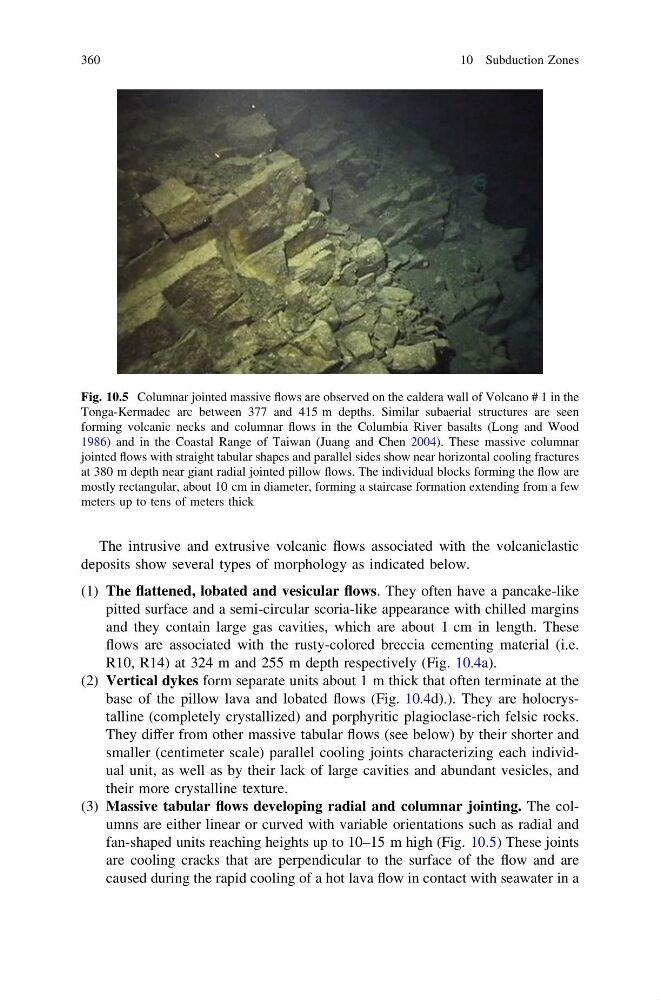
(3) Massive tabular flows developing radial and columnar jointing. The columns are either linear or curved with variable orientations such as radial and
fan-shaped units reaching heights up to 10–15 m high (Fig. 10.5) These joints
are cooling cracks that are perpendicular to the surface of the flow and are
caused during the rapid cooling of a hot lava flow in contact with seawater in a
Fig. 10.5 Columnar jointed massive flows are observed on the caldera wall of Volcano # 1 in the
Tonga-Kermadec arc between 377 and 415 m depths. Similar subaerial structures are seen
forming volcanic necks and columnar flows in the Columbia River basalts (Long and Wood
1986) and in the Coastal Range of Taiwan (Juang and Chen 2004). These massive columnar
jointed flows with straight tabular shapes and parallel sides show near horizontal cooling fractures
at 380 m depth near giant radial jointed pillow flows. The individual blocks forming the flow are
mostly rectangular, about 10 cm in diameter, forming a staircase formation extending from a few
meters up to tens of meters thick
360
10 Subduction Zones
deposits show several types of morphology as indicated below.
(1) The flattened, lobated and vesicular flows. They often have a pancake-like
pitted surface and a semi-circular scoria-like appearance with chilled margins
and they contain large gas cavities, which are about 1 cm in length. These
flows are associated with the rusty-colored breccia cementing material (i.e.
R10, R14) at 324 m and 255 m depth respectively (Fig. 10.4a).
(2) Vertical dykes form separate units about 1 m thick that often terminate at the
base of the pillow lava and lobated flows (Fig. 10.4d).). They are holocrystalline (completely crystallized) and porphyritic plagioclase-rich felsic rocks.
They differ from other massive tabular flows (see below) by their shorter and
smaller (centimeter scale) parallel cooling joints characterizing each individual unit, as well as by their lack of large cavities and abundant vesicles, and
their more crystalline texture.
(3) Massive tabular flows developing radial and columnar jointing. The columns are either linear or curved with variable orientations such as radial and
fan-shaped units reaching heights up to 10–15 m high (Fig. 10.5) These joints
are cooling cracks that are perpendicular to the surface of the flow and are
caused during the rapid cooling of a hot lava flow in contact with seawater in a
Fig. 10.5 Columnar jointed massive flows are observed on the caldera wall of Volcano # 1 in the
Tonga-Kermadec arc between 377 and 415 m depths. Similar subaerial structures are seen
forming volcanic necks and columnar flows in the Columbia River basalts (Long and Wood
1986) and in the Coastal Range of Taiwan (Juang and Chen 2004). These massive columnar
jointed flows with straight tabular shapes and parallel sides show near horizontal cooling fractures
at 380 m depth near giant radial jointed pillow flows. The individual blocks forming the flow are
mostly rectangular, about 10 cm in diameter, forming a staircase formation extending from a few
meters up to tens of meters thick
360
10 Subduction Zones