

Nomenclature of Subduction Zones
Convergent plate boundary regions are the place where the oceanic plates created
on spreading ridge axes have drifted away from their point of origin and are
subducted beneath intra-oceanic and/continental volcanic chains. The trenches,
and the volcanoes that are associated with subduction zones, are all part of what is
referred to as an ‘‘active margin’’. The geological setting of the convergent plate
boundary regions is comprised of several provinces. These provinces include the
‘‘fore-arc’’ area, separating the trench from the island arc, the ‘‘island arc’’ and/or
the ‘‘volcanic chain’’ and the ‘‘back-arc basin’’. Because basalt, which is the
prominent type of rock of the oceanic lithosphere and crust, is denser than the
continental and/or island arc rocks, basalt will sink underneath the lighter types of
rock formations and thereby generate volcanic activity and earthquakes.
During subduction, new crust can be created in the fore-arc, or within the arc or
in back-arc area. In the fore-arc, a ‘‘mixture’’ of lighter oceanic sediment plus the
debris of broken and altered silica-enriched rocks, which result from the degradation of older continental shore lines or island arcs, can be deformed, folded and
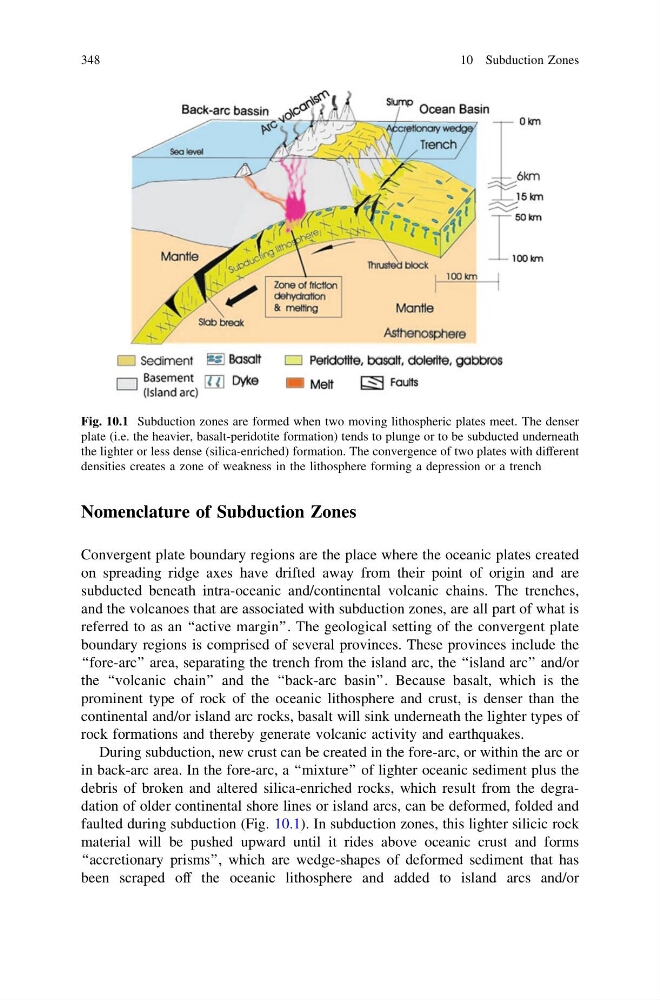
faulted during subduction (Fig. 10.1). In subduction zones, this lighter silicic rock
material will be pushed upward until it rides above oceanic crust and forms
‘‘accretionary prisms’’, which are wedge-shapes of deformed sediment that has
been scraped off the oceanic lithosphere and added to island arcs and/or
Fig. 10.1 Subduction zones are formed when two moving lithospheric plates meet. The denser
plate (i.e. the heavier, basalt-peridotite formation) tends to plunge or to be subducted underneath
the lighter or less dense (silica-enriched) formation. The convergence of two plates with different
densities creates a zone of weakness in the lithosphere forming a depression or a trench
348
10 Subduction Zones
Convergent plate boundary regions are the place where the oceanic plates created
on spreading ridge axes have drifted away from their point of origin and are
subducted beneath intra-oceanic and/continental volcanic chains. The trenches,
and the volcanoes that are associated with subduction zones, are all part of what is
referred to as an ‘‘active margin’’. The geological setting of the convergent plate
boundary regions is comprised of several provinces. These provinces include the
‘‘fore-arc’’ area, separating the trench from the island arc, the ‘‘island arc’’ and/or
the ‘‘volcanic chain’’ and the ‘‘back-arc basin’’. Because basalt, which is the
prominent type of rock of the oceanic lithosphere and crust, is denser than the
continental and/or island arc rocks, basalt will sink underneath the lighter types of
rock formations and thereby generate volcanic activity and earthquakes.
During subduction, new crust can be created in the fore-arc, or within the arc or
in back-arc area. In the fore-arc, a ‘‘mixture’’ of lighter oceanic sediment plus the
debris of broken and altered silica-enriched rocks, which result from the degradation of older continental shore lines or island arcs, can be deformed, folded and
faulted during subduction (Fig. 10.1). In subduction zones, this lighter silicic rock
material will be pushed upward until it rides above oceanic crust and forms
‘‘accretionary prisms’’, which are wedge-shapes of deformed sediment that has
been scraped off the oceanic lithosphere and added to island arcs and/or
Fig. 10.1 Subduction zones are formed when two moving lithospheric plates meet. The denser
plate (i.e. the heavier, basalt-peridotite formation) tends to plunge or to be subducted underneath
the lighter or less dense (silica-enriched) formation. The convergence of two plates with different
densities creates a zone of weakness in the lithosphere forming a depression or a trench
348
10 Subduction Zones