

Formation and Evolution of a Volcanic Island
The creation of an oceanic island takes place within a relatively short time when
compared to its evolution once it has been formed. The activity of a hotspot
volcano is related to its position with respect to the mantle plume supplying the
magma. By knowing the rate of spreading, we could estimate the speed of
the movement of a plate over a hotspot. In the central Pacific, by calculating the
average speed of a plate’s motion, it is estimated that the time for creating a
volcanic island is about 1 million years.
As soon as an island is formed, it will begin to be eroded by the waves and the
alteration of its rocks. If the magma supply is sustained and continues to provide
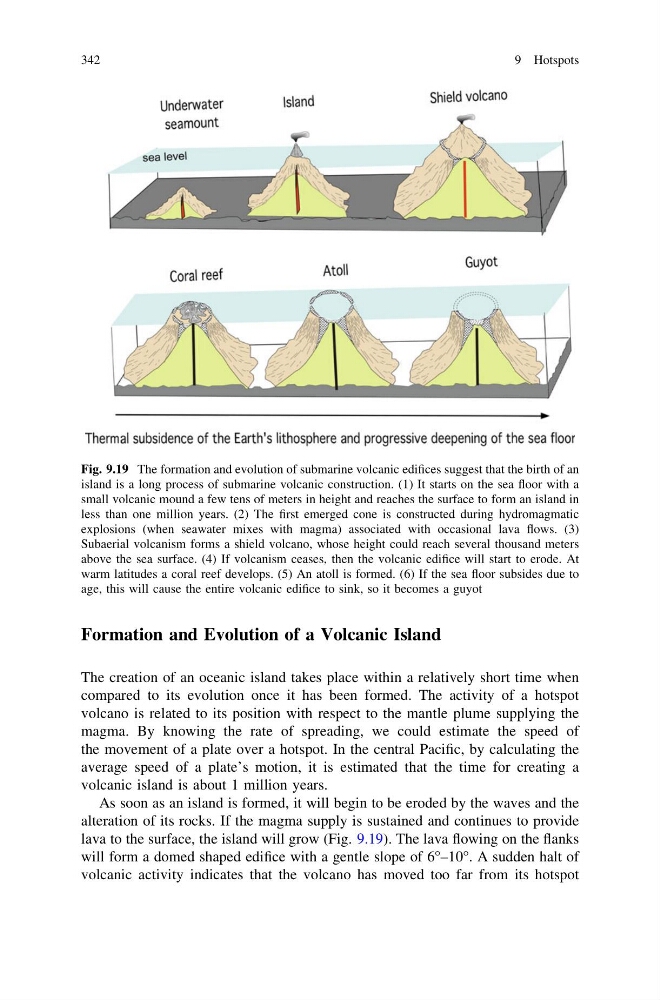
lava to the surface, the island will grow (Fig. 9.19). The lava flowing on the flanks
will form a domed shaped edifice with a gentle slope of 6°–10°. A sudden halt of
volcanic activity indicates that the volcano has moved too far from its hotspot
Fig. 9.19 The formation and evolution of submarine volcanic edifices suggest that the birth of an
island is a long process of submarine volcanic construction. (1) It starts on the sea floor with a
small volcanic mound a few tens of meters in height and reaches the surface to form an island in
less than one million years. (2) The first emerged cone is constructed during hydromagmatic
explosions (when seawater mixes with magma) associated with occasional lava flows. (3)
Subaerial volcanism forms a shield volcano, whose height could reach several thousand meters
above the sea surface. (4) If volcanism ceases, then the volcanic edifice will start to erode. At
warm latitudes a coral reef develops. (5) An atoll is formed. (6) If the sea floor subsides due to
age, this will cause the entire volcanic edifice to sink, so it becomes a guyot
342
9 Hotspots
The creation of an oceanic island takes place within a relatively short time when
compared to its evolution once it has been formed. The activity of a hotspot
volcano is related to its position with respect to the mantle plume supplying the
magma. By knowing the rate of spreading, we could estimate the speed of
the movement of a plate over a hotspot. In the central Pacific, by calculating the
average speed of a plate’s motion, it is estimated that the time for creating a
volcanic island is about 1 million years.
As soon as an island is formed, it will begin to be eroded by the waves and the
alteration of its rocks. If the magma supply is sustained and continues to provide
lava to the surface, the island will grow (Fig. 9.19). The lava flowing on the flanks
will form a domed shaped edifice with a gentle slope of 6°–10°. A sudden halt of
volcanic activity indicates that the volcano has moved too far from its hotspot
Fig. 9.19 The formation and evolution of submarine volcanic edifices suggest that the birth of an
island is a long process of submarine volcanic construction. (1) It starts on the sea floor with a
small volcanic mound a few tens of meters in height and reaches the surface to form an island in
less than one million years. (2) The first emerged cone is constructed during hydromagmatic
explosions (when seawater mixes with magma) associated with occasional lava flows. (3)
Subaerial volcanism forms a shield volcano, whose height could reach several thousand meters
above the sea surface. (4) If volcanism ceases, then the volcanic edifice will start to erode. At
warm latitudes a coral reef develops. (5) An atoll is formed. (6) If the sea floor subsides due to
age, this will cause the entire volcanic edifice to sink, so it becomes a guyot
342
9 Hotspots