

flows’’ to distinguish them from those found on spreading ridges. They abound on
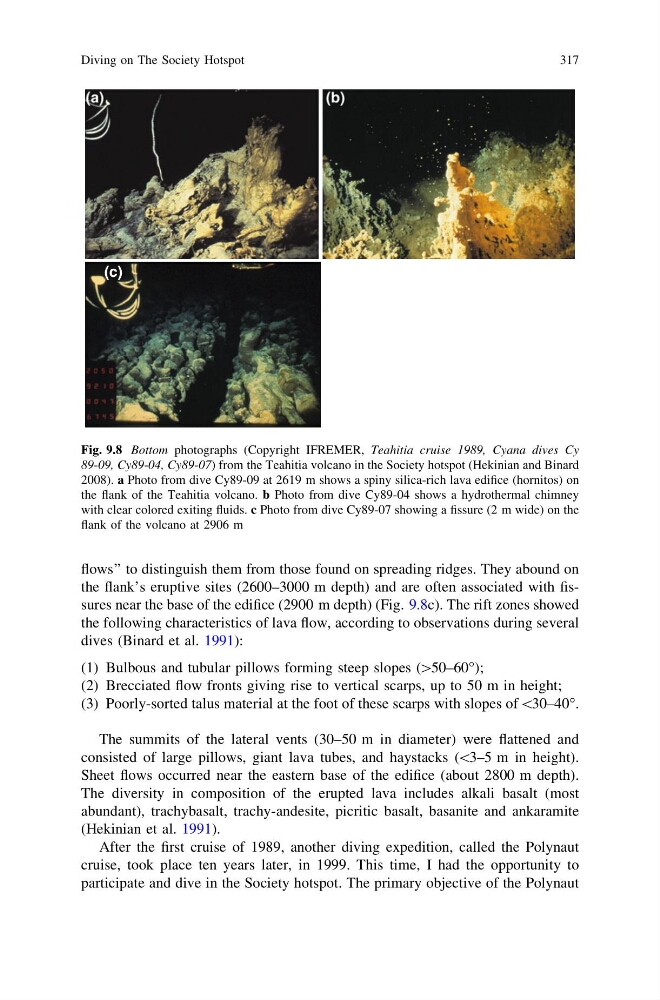
the flank’s eruptive sites (2600–3000 m depth) and are often associated with fissures near the base of the edifice (2900 m depth) (Fig. 9.8c). The rift zones showed
the following characteristics of lava flow, according to observations during several
dives (Binard et al. 1991):
(1) Bulbous and tubular pillows forming steep slopes ([50–60°);
(2) Brecciated flow fronts giving rise to vertical scarps, up to 50 m in height;
(3) Poorly-sorted talus material at the foot of these scarps with slopes of\30–40°.
The summits of the lateral vents (30–50 m in diameter) were flattened and
consisted of large pillows, giant lava tubes, and haystacks (\3–5 m in height).
Sheet flows occurred near the eastern base of the edifice (about 2800 m depth).
The diversity in composition of the erupted lava includes alkali basalt (most
abundant), trachybasalt, trachy-andesite, picritic basalt, basanite and ankaramite
(Hekinian et al. 1991).
After the first cruise of 1989, another diving expedition, called the Polynaut
cruise, took place ten years later, in 1999. This time, I had the opportunity to
participate and dive in the Society hotspot. The primary objective of the Polynaut
(c)
Fig. 9.8 Bottom photographs (Copyright IFREMER, Teahitia cruise 1989, Cyana dives Cy
89-09, Cy89-04, Cy89-07) from the Teahitia volcano in the Society hotspot (Hekinian and Binard
2008). a Photo from dive Cy89-09 at 2619 m shows a spiny silica-rich lava edifice (hornitos) on
the flank of the Teahitia volcano. b Photo from dive Cy89-04 shows a hydrothermal chimney
with clear colored exiting fluids. c Photo from dive Cy89-07 showing a fissure (2 m wide) on the
flank of the volcano at 2906 m
Diving on The Society Hotspot
317
the flank’s eruptive sites (2600–3000 m depth) and are often associated with fissures near the base of the edifice (2900 m depth) (Fig. 9.8c). The rift zones showed
the following characteristics of lava flow, according to observations during several
dives (Binard et al. 1991):
(1) Bulbous and tubular pillows forming steep slopes ([50–60°);
(2) Brecciated flow fronts giving rise to vertical scarps, up to 50 m in height;
(3) Poorly-sorted talus material at the foot of these scarps with slopes of\30–40°.
The summits of the lateral vents (30–50 m in diameter) were flattened and
consisted of large pillows, giant lava tubes, and haystacks (\3–5 m in height).
Sheet flows occurred near the eastern base of the edifice (about 2800 m depth).
The diversity in composition of the erupted lava includes alkali basalt (most
abundant), trachybasalt, trachy-andesite, picritic basalt, basanite and ankaramite
(Hekinian et al. 1991).
After the first cruise of 1989, another diving expedition, called the Polynaut
cruise, took place ten years later, in 1999. This time, I had the opportunity to
participate and dive in the Society hotspot. The primary objective of the Polynaut
(c)
Fig. 9.8 Bottom photographs (Copyright IFREMER, Teahitia cruise 1989, Cyana dives Cy
89-09, Cy89-04, Cy89-07) from the Teahitia volcano in the Society hotspot (Hekinian and Binard
2008). a Photo from dive Cy89-09 at 2619 m shows a spiny silica-rich lava edifice (hornitos) on
the flank of the Teahitia volcano. b Photo from dive Cy89-04 shows a hydrothermal chimney
with clear colored exiting fluids. c Photo from dive Cy89-07 showing a fissure (2 m wide) on the
flank of the volcano at 2906 m
Diving on The Society Hotspot
317